
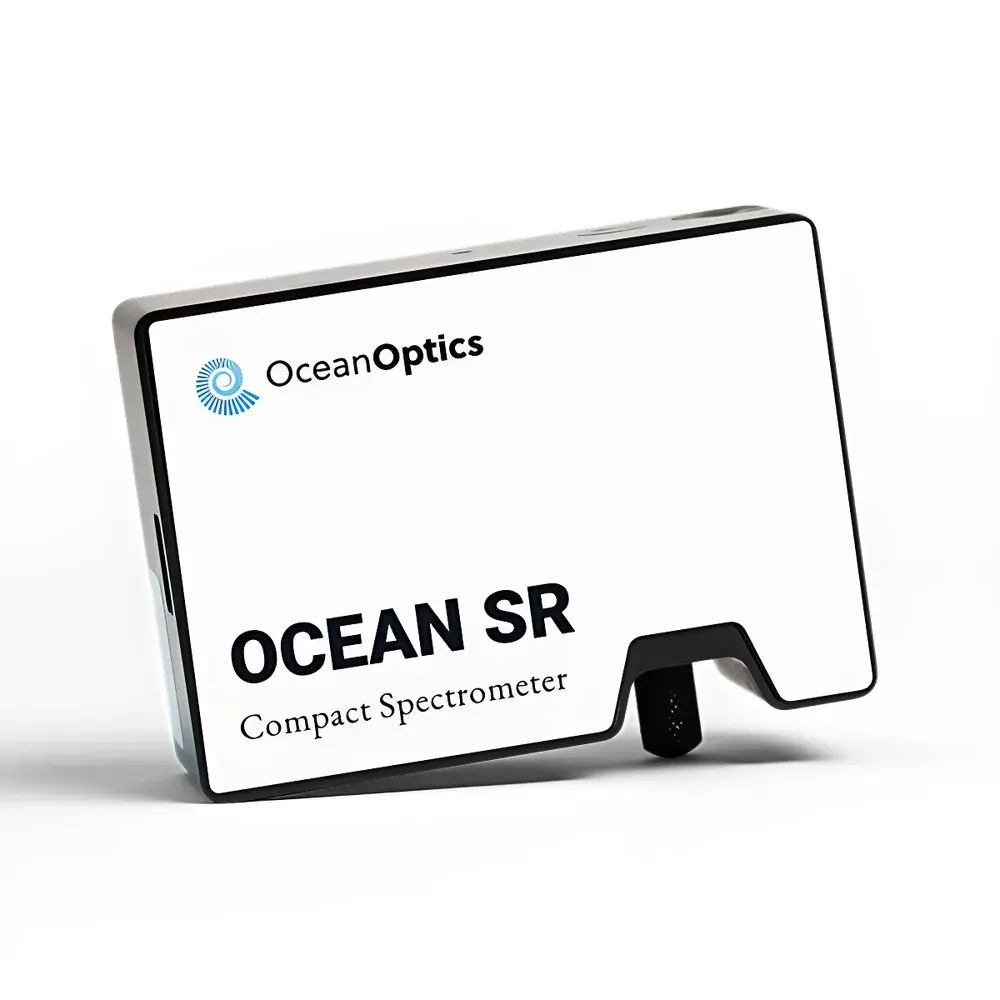
Ocean Optics Ocean SR6 Fiber Optic Spectrometer
| Brand | Ocean Optics |
|---|---|
| Origin | USA |
| Manufacturer Type | Original Equipment Manufacturer (OEM) |
| Product Category | Imported Instrument |
| Model | Ocean SR6 |
| Detector Type | CCD |
| Spectral Range | ~185–1100 nm (configuration-dependent) |
| Optical Resolution (25 µm slit) | 0.50–2.0 nm FWHM (configuration-dependent) |
| Signal-to-Noise Ratio | 3500:1 (on-board averaging mode) |
| Dynamic Range | 12,000:1 (single-scan) |
Overview
The Ocean Optics Ocean SR6 Fiber Optic Spectrometer is a compact, high-performance UV-VIS-NIR spectrometer engineered for precision spectral measurement across demanding laboratory and industrial environments. Based on a robust back-thinned CCD linear array detector and optimized optical bench architecture, the SR6 delivers exceptional thermal stability (0.02 nm/°C), high quantum efficiency in the deep-UV down to 185 nm, and consistent radiometric response from 185 nm to 1100 nm. Its modular design enables seamless integration with Ocean Optics’ ecosystem of broadband and monochromatic light sources, SMA-905-coupled sampling optics (e.g., reflection probes, cuvette holders, integrating spheres), and fiber-optic delivery systems. Unlike legacy benchtop spectrometers, the SR6 leverages real-time hardware-based signal processing—including on-chip averaging and programmable trigger synchronization—to maintain measurement fidelity under variable ambient temperatures (0–55 °C operating range) and dynamic acquisition conditions. It is not a general-purpose optical sensor but a calibrated, traceable spectroscopic measurement system designed for quantitative intensity analysis, spectral shape characterization, and time-resolved spectral monitoring.
Key Features
- Back-thinned CCD detector with 2048 pixels for enhanced UV sensitivity and low-noise performance
- Configurable spectral resolution: 0.50–2.0 nm FWHM (with slit options from 5–200 µm)
- Thermal drift compensation architecture yielding 0.02 nm/°C wavelength stability
- High dynamic range of 12,000:1 (single-scan) and SNR up to 3500:1 (on-board averaged)
- USB-C interface with full-speed data streaming and RS-232 serial control for embedded OEM deployment
- Hardware-accelerated averaging mode enabling rapid SNR improvement without host CPU overhead
- Programmable external triggering via 16-pin Samtec TM connector for synchronization with pulsed lasers, shutters, or process signals
- Compact form factor (89.0 × 63.5 × 31.3 mm) and lightweight construction (275 g) for portable and space-constrained installations
Sample Compatibility & Compliance
The Ocean SR6 supports diverse sample interaction modalities through standardized fiber-optic coupling (SMA 905). It is routinely deployed in reflectance, transmittance, fluorescence, absorbance, and emission measurements across liquid, solid, and gaseous phases. When paired with NIST-traceable calibration standards (e.g., HG/Ne lamp, WS-1 diffuse reflectance standard), the system supports compliance with ISO/IEC 17025 requirements for testing laboratories. Its firmware and data output protocols are compatible with FDA 21 CFR Part 11-compliant software environments when used with validated OceanView configurations and audit-trail-enabled OceanDirect implementations. The instrument’s operating temperature range (0–55 °C) and storage specification (−30–70 °C) meet IEC 61000-4 electromagnetic compatibility guidelines for industrial instrumentation.
Software & Data Management
The SR6 is fully supported by OceanView—Ocean Optics’ flagship spectral acquisition and analysis platform—providing real-time visualization, peak identification, spectral math operations, and export to CSV, HDF5, and JCAMP-DX formats. For custom integration, OceanDirect SDK offers native C/C++, Python, MATLAB, LabVIEW, and .NET APIs with thread-safe function calls and low-latency command-response cycles. OceanDirect enables deterministic timing control, hardware-triggered acquisition sequencing, and direct access to raw pixel data, dark reference, and nonlinearity correction coefficients. All spectral metadata—including integration time, slit width, calibration file ID, and temperature sensor readings—are embedded in exported spectra per ASTM E131-22 conventions. Audit trails, user authentication, and electronic signature support can be implemented at the application layer using OceanDirect’s event logging and configuration persistence interfaces.
Applications
- UV-Vis quantification of pharmaceutical actives and excipients in dissolution testing (aligned with USP & EP monographs)
- In-line monitoring of chemical reaction kinetics in flow reactors and microfluidic platforms
- Plasma emission analysis for semiconductor process endpoint detection
- Colorimetric validation of LED and OLED spectral power distribution (SPD) in display manufacturing
- Environmental water quality assessment via nitrate/nitrite absorption bands (200–220 nm) and organic matter fluorescence (Ex/Em mapping)
- OEM integration into handheld Raman spectrometers, portable gas analyzers, and agricultural nutrient sensors
FAQ
What spectral calibration options are available for the Ocean SR6?
Factory-installed wavelength and intensity calibrations are provided with each unit, traceable to NIST standards. Users may perform recalibration using optional HG/Ne, tungsten-halogen, or deuterium lamps via OceanView’s Calibration Wizard.
Can the SR6 operate in continuous scanning mode for real-time process monitoring?
Yes—the USB-C interface supports sustained spectral acquisition at rates up to 100 Hz (dependent on integration time and ROI settings), with hardware buffering to prevent frame loss during high-throughput streaming.
Is the Ocean SR6 suitable for GLP/GMP-regulated environments?
When deployed with validated OceanView configurations, electronic signatures, and change-controlled firmware versions, the SR6 meets foundational requirements for analytical instrument qualification (AIQ) per ICH Q2(R2) and Annex 11.
How does thermal drift affect long-duration measurements?
The SR6’s thermally compensated optical path and onboard temperature sensor enable real-time wavelength correction algorithms; residual drift remains ≤ ±0.05 nm over 8-hour operation at ±5 °C ambient fluctuation.
What is the minimum integration time and how is dark current managed?
Minimum integration time is 7.2 ms. Dark current is suppressed via on-chip correlated double sampling (CDS), and user-definable dark scans are supported for advanced background subtraction workflows.
Related Products





