
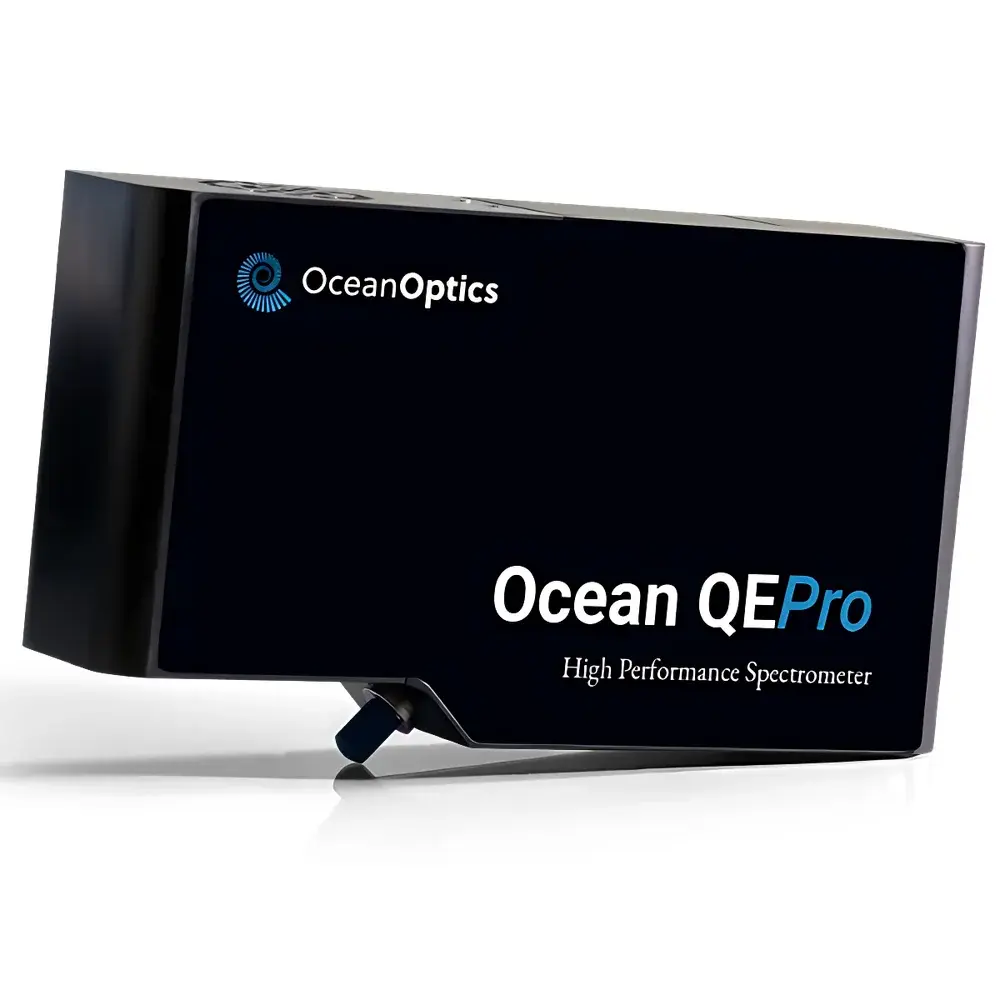
Ocean Optics QE Pro Raman+ Portable Raman Spectrometer
| Brand | Ocean Optics |
|---|---|
| Origin | Shanghai, China |
| Manufacturer Type | Authorized Distributor |
| Product Category | Domestic (China-made) |
| Model | QE Pro Raman+ |
| Instrument Type | Portable / Handheld Raman Spectrometer |
| Spectral Range | 150 cm⁻¹ – 4000 cm⁻¹ |
| Spectral Resolution | 0.42 nm (FWHM, typical) |
| Detector | TE-cooled 1044 × 64-pixel back-thinned FFT-CCD |
| Quantum Efficiency | 90% (peak) |
| Signal-to-Noise Ratio | 1000:1 (single acquisition) |
| Integration Time | 8 ms – 3600 s |
| Dynamic Range | ~85,000:1 |
| Optical Interface | SMA 905 |
| Onboard Memory | 15,000 spectra |
| Communication | USB 2.0 (480 Mbps), RS-232 |
| Dimensions | 182 mm × 110 mm × 47 mm |
| Weight | 1.15 kg (instrument only) |
| Power Supply | 0.45 kg |
| Operating Temperature | 0 °C – 50 °C |
| Humidity | ≤90% RH (non-condensing) |
| Slit Options | 25 µm, 50 µm |
| Grating | Custom holographic grating (e.g., GRATING_#H6) |
| Excitation Wavelengths | 532 nm, 638 nm, or 785 nm (preconfigured) |
Overview
The Ocean Optics QE Pro Raman+ is a high-performance, portable Raman spectrometer engineered for field-deployable and laboratory-based molecular identification and quantitative analysis. Based on inelastic light scattering (Raman effect), the instrument measures vibrational, rotational, and other low-frequency modes of molecules by detecting energy shifts between incident laser photons and scattered photons. Its optical architecture integrates a gold-coated concave mirror for enhanced reflectivity across the visible–NIR range and a back-thinned, thermoelectrically (TE) cooled FFT-CCD detector—optimized to minimize dark current and read noise during extended integration periods. With a peak quantum efficiency of 90%, signal-to-noise ratio of 1000:1 (single acquisition), and dynamic range exceeding 85,000:1, the QE Pro Raman+ delivers high-fidelity spectral data even from weakly scattering samples such as pharmaceutical actives, polymorphic crystals, illicit substances, and trace organic contaminants.
Key Features
- Preconfigured excitation options at 532 nm, 638 nm, or 785 nm—enabling optimized fluorescence suppression and sensitivity trade-offs depending on sample matrix;
- TE-cooled CCD detector (–15 °C typical stabilization) supporting integration times from 8 ms to 3600 s—critical for low-light Raman detection without external cryogenic systems;
- High optical throughput design with gold-coated optics and custom holographic gratings (e.g., GRATING_#H6), delivering consistent spectral resolution of 0.42 nm FWHM (typical) across the calibrated Raman shift range;
- Compact, ruggedized form factor (182 × 110 × 47 mm; 1.15 kg) compliant with IP54-rated environmental protection for mobile use in QC labs, customs checkpoints, forensic vans, or production floors;
- Onboard memory storage for up to 15,000 full spectra—enabling autonomous operation during offline field surveys or time-lapse monitoring without continuous PC tethering;
- Dual communication interface (USB 2.0 at 480 Mbps and RS-232) ensuring compatibility with legacy industrial controllers, embedded PCs, and modern Windows/macOS/Linux hosts.
Sample Compatibility & Compliance
The QE Pro Raman+ supports direct analysis of solids, powders, liquids, gels, and thin films via fiber-coupled probe configurations—including contact probes, immersion probes, and standoff lenses (up to 10 cm working distance). Its 785 nm excitation variant significantly reduces autofluorescence interference in biological tissues, botanical extracts, and polymer matrices. The system adheres to fundamental spectroscopic calibration standards including NIST-traceable wavelength accuracy (±0.5 cm⁻¹) and intensity linearity verification per ASTM E1421–22. While not inherently 21 CFR Part 11-compliant as a standalone device, its data output format (ASCII .txt, .csv, .spc) and timestamped metadata support integration into validated LIMS or ELN platforms under GLP/GMP frameworks when deployed with appropriate procedural controls and audit trails.
Software & Data Management
OceanView SpectraSuite software provides real-time spectral acquisition, baseline correction (asymmetric least squares), cosmic ray removal, peak fitting (Gaussian/Lorentzian models), and multivariate analysis (PCA, PLS regression) for qualitative and semi-quantitative interpretation. Raw spectral data are stored with embedded metadata—including integration time, laser power, grating ID, slit width, and detector temperature—ensuring full experimental traceability. Export formats comply with JCAMP-DX v6 and AnIML standards for interoperability with third-party chemometric tools (e.g., MATLAB, Python scikit-learn, Unscrambler X). Optional OEM SDKs enable integration into custom instrument control systems or automated analytical workflows requiring deterministic trigger synchronization and spectral streaming over USB/RS-232.
Applications
- Pharmaceutical raw material identification and counterfeit drug screening per USP and EP 2.2.48 guidelines;
- Forensic analysis of explosives, narcotics, and adulterants in customs and law enforcement settings;
- In-line monitoring of crystallization processes and polymorph transitions during API manufacturing;
- Environmental testing of microplastics and hydrocarbon contaminants in soil/water samples;
- Academic research in catalysis, battery materials, and 2D nanomaterials where non-destructive, label-free vibrational fingerprinting is required;
- Quality assurance of pigments, coatings, and composite resins in aerospace and automotive supply chains.
FAQ
What excitation wavelengths are supported, and how do they affect measurement performance?
The QE Pro Raman+ is available preconfigured with 532 nm, 638 nm, or 785 nm lasers. Shorter wavelengths increase Raman scattering cross-section but risk fluorescence and photodegradation; 785 nm offers optimal balance for organic and biological samples.
Is the spectrometer calibrated for absolute wavenumber accuracy?
Yes—each unit undergoes factory calibration using neon and mercury-argon emission lines, achieving ±0.5 cm⁻¹ wavenumber accuracy traceable to NIST SRM 2035.
Can the instrument operate without a connected computer?
Yes—the onboard memory stores up to 15,000 spectra with full metadata, enabling fully autonomous data collection in remote or hazardous environments.
What is the minimum detectable Raman signal level under standard conditions?
Detection limits are sample-dependent, but with 785 nm excitation and 60 s integration, sub-0.1% wt/wt concentrations of crystalline APIs in excipients are routinely resolved.
Does the system support regulatory compliance for GMP environments?
While the hardware itself does not include built-in 21 CFR Part 11 features, its data export structure, timestamping, and metadata integrity enable validation within a controlled software environment meeting ALCOA+ principles.




