
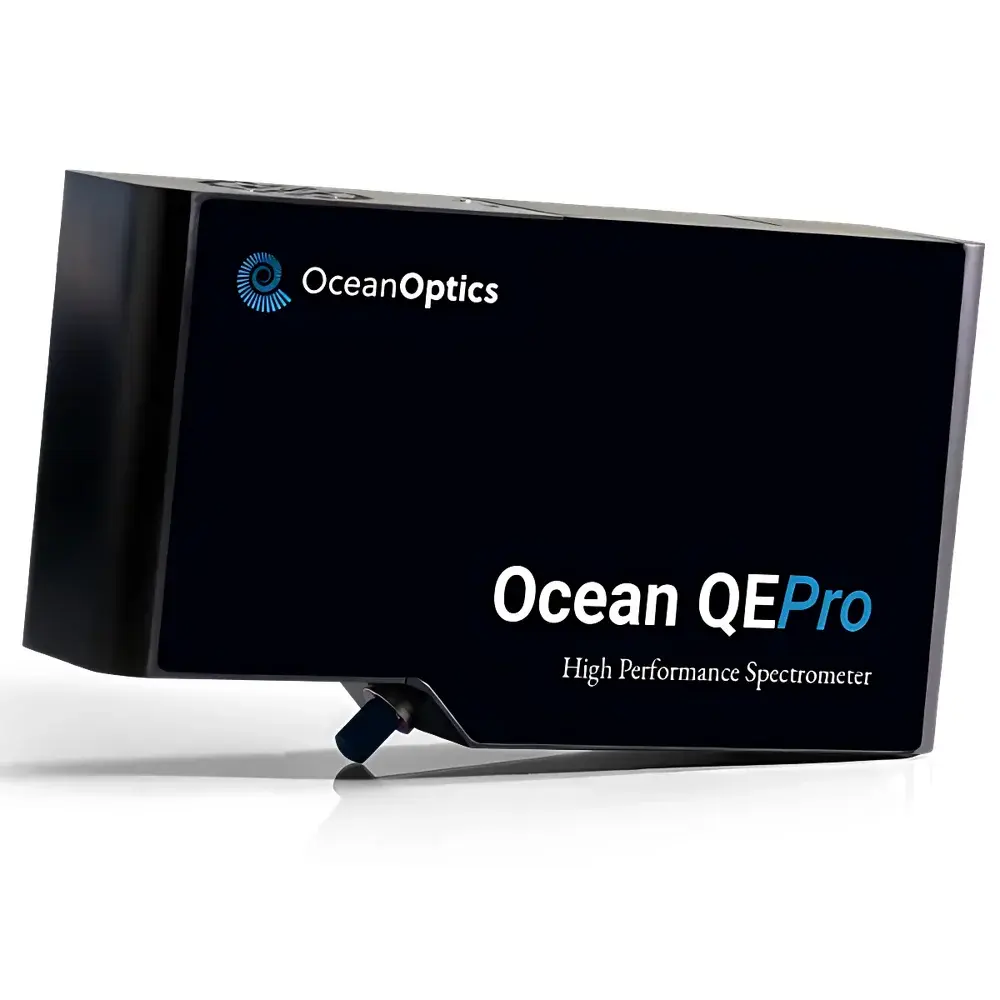
Ocean Optics QE Pro Raman+ Portable Raman Spectrometer
| Brand | Ocean Optics |
|---|---|
| Origin | Shanghai, China |
| Manufacturer Type | Original Equipment Manufacturer (OEM) |
| Product Category | Domestic |
| Model | QE Pro Raman+ |
| Instrument Type | Portable / Handheld Raman Spectrometer |
| Spectral Range | 150 cm⁻¹ – 4000 cm⁻¹ |
| Spectral Resolution | 0.42 nm (FWHM, typical) |
| Detector | TE-cooled 1044 × 64-pixel back-thinned FFT-CCD |
| Quantum Efficiency | 90% (peak) |
| Signal-to-Noise Ratio | 1000:1 (single acquisition) |
| Integration Time | 8 ms – 3600 s |
| Dynamic Range | ~85,000:1 |
| Optical Interface | SMA 905 |
| Onboard Memory | 15,000 spectra |
| Dimensions | 182 mm × 110 mm × 47 mm |
| Weight | 1.15 kg (instrument only) |
| Power Supply | 0.45 kg |
| Operating Temperature | 0 °C – 50 °C |
| Humidity | ≤90% RH (non-condensing) |
| Communication | USB 2.0 (480 Mbps, USB 1.1 compatible), RS-232 |
Overview
The Ocean Optics QE Pro Raman+ is a high-performance, portable Raman spectrometer engineered for field-deployable and laboratory-based molecular fingerprinting applications. Based on dispersive Raman spectroscopy—where monochromatic laser excitation induces inelastic scattering from vibrational modes—the instrument delivers quantitative spectral data across the Raman shift range of 150 cm⁻¹ to 4000 cm⁻¹. Its core optical architecture integrates a gold-coated concave mirror for enhanced reflectivity in the near-infrared region and a back-thinned, thermoelectrically (TE) cooled FFT-CCD detector optimized for low-noise, long-integration measurements. This design enables robust detection of weak Raman signals—particularly critical when analyzing low-concentration analytes, turbid samples, or fluorescence-prone materials such as pharmaceuticals, polymers, illicit substances, and energetic compounds. Unlike benchtop systems requiring cryogenic cooling, the QE Pro Raman+ achieves stable thermal management via solid-state TE cooling, maintaining detector dark current below 0.002 e⁻/pixel/s at –15 °C, thereby preserving spectral fidelity during extended acquisitions up to one hour.
Key Features
- Three preconfigured laser excitation options: 532 nm (visible), 638 nm (red), and 785 nm (NIR)—with the 785 nm variant offering superior fluorescence suppression and improved signal-to-background ratio for organic and biological matrices.
- High quantum efficiency (>90% peak) back-thinned CCD ensures optimal photon capture across the full Raman-shifted spectrum, minimizing integration time without sacrificing SNR.
- Optical resolution of 0.42 nm FWHM (typical) translates to ~5–7 cm⁻¹ spectral resolution in Raman shift space—sufficient to resolve closely spaced vibrational bands in complex mixtures.
- Onboard memory stores up to 15,000 full spectra, enabling autonomous operation in remote or offline environments without continuous PC tethering.
- Ruggedized aluminum chassis with IP54-rated ingress protection (when mated with optional enclosure) supports deployment in industrial QA/QC labs, customs checkpoints, forensic mobile units, and academic field studies.
- USB 2.0 and RS-232 interfaces ensure compatibility with legacy and modern control systems, including embedded platforms used in OEM integrations.
Sample Compatibility & Compliance
The QE Pro Raman+ accommodates solid, liquid, and powder samples via standard 180° backscattering geometry using fiber-coupled probes (e.g., collimating lenses, immersion probes, or standoff optics). It complies with IEC 61326-1:2013 for electromagnetic compatibility in laboratory and industrial environments. While not certified for intrinsic safety (ATEX/IECEx), its low-power design (4.5–5.5 V DC input) and absence of high-voltage components make it suitable for use in non-hazardous locations per NEC Class I, Division 2 guidelines. Data integrity meets GLP/GMP-aligned practices: spectral metadata (timestamp, integration time, laser power, calibration coefficients) is embedded in each saved spectrum file (.spc or .csv), supporting traceability requirements under FDA 21 CFR Part 11 when paired with compliant third-party software.
Software & Data Management
Ocean Insight’s OceanView spectroscopy software provides real-time spectral acquisition, baseline correction (asymmetric least squares), peak identification (NIST-compatible library matching), and multivariate analysis (PCA, PLS regression). Raw spectral data export supports HDF5, ASCII, and JDX formats for interoperability with MATLAB, Python (NumPy/Pandas), and chemometrics platforms like Unscrambler X or Pirouette. The SDK (C++, Python, LabVIEW) enables custom automation—e.g., trigger-based acquisition synchronized with sample stage movement or environmental sensors. All firmware updates and calibration files are digitally signed to prevent unauthorized modification, reinforcing audit readiness in regulated environments.
Applications
- Pharmaceutical raw material identification and counterfeit drug screening per USP and EP 2.2.48 guidelines.
- Forensic analysis of narcotics, explosives, and chemical threat agents in accordance with INTERPOL’s Raman Best Practices Framework.
- In-line process monitoring of polymer crystallinity, catalyst degradation, or solvent composition in continuous manufacturing (ICH Q5E, Q8).
- Academic research in nanomaterial characterization (e.g., graphene layer counting, CNT chirality assignment) and battery electrode phase evolution.
- Food authenticity verification—including olive oil adulteration, honey purity, and spice contamination—aligned with ISO 21569 and AOAC Official Methods.
FAQ
What laser wavelengths are available for the QE Pro Raman+?
The system ships with factory-aligned modules for 532 nm, 638 nm, or 785 nm excitation—each calibrated to its corresponding grating and optical path.
Is the spectrometer calibrated for Raman shift accuracy?
Yes; each unit includes NIST-traceable wavelength calibration using neon and argon emission lines, with residual error ≤ ±0.2 cm⁻¹ across the full range.
Can the QE Pro Raman+ operate without a connected computer?
It can acquire and store spectra autonomously using onboard memory, but real-time visualization, advanced processing, and report generation require host software.
Does the system support external triggering?
Yes—via TTL-compatible GPIO pins for synchronization with lasers, shutters, or motion controllers.
What maintenance is required for long-term stability?
No routine optical alignment is needed; periodic verification using a Raman shift standard (e.g., cyclohexane or silicon) is recommended every six months per ISO/IEC 17025 quality assurance protocols.





