
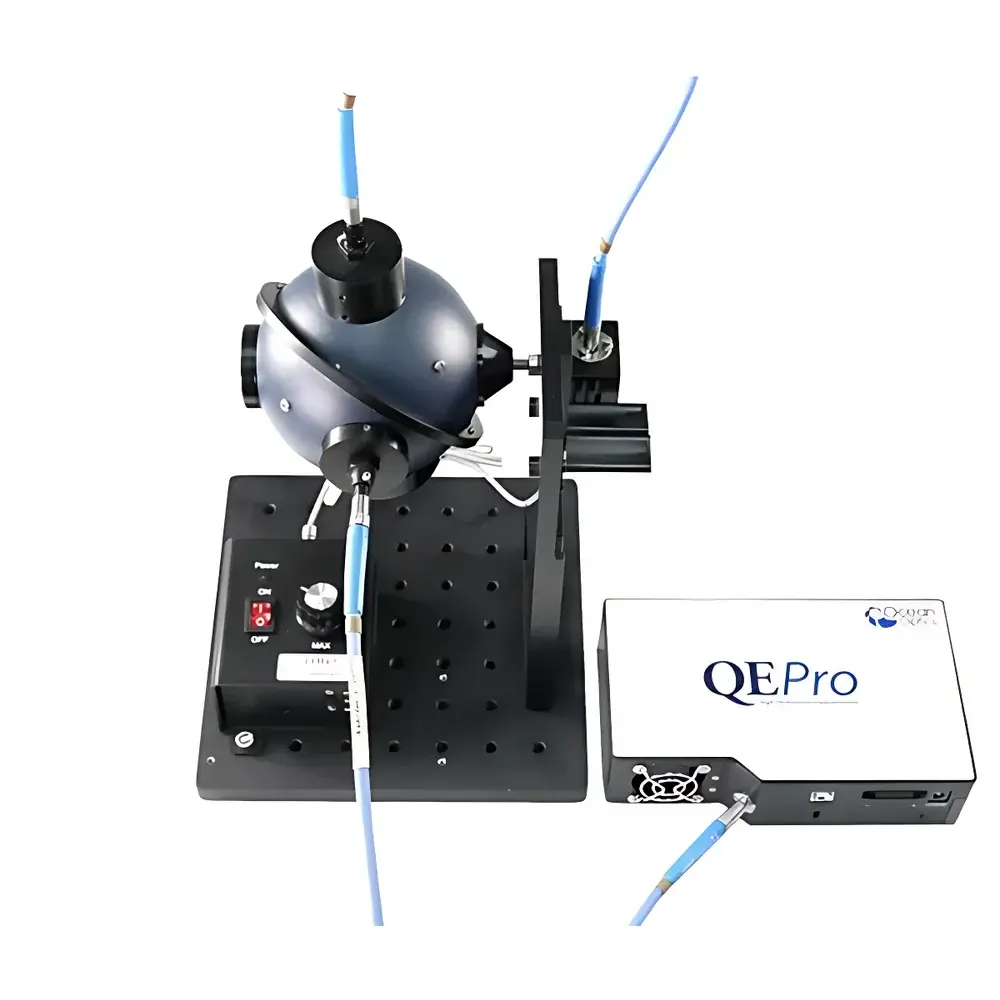
Ocean Optics SpectrumTEQ-PL & SpectrumTEQ-EL Photoluminescence and Electroluminescence Quantum Yield Measurement Systems
| Brand | Ocean Optics |
|---|---|
| Origin | USA |
| Model | SpectrumTEQ-PL, SpectrumTEQ-EL |
| Measurement Mode | AC |
| Spectrometer Options | QE Pro or QE65 Pro |
| Spectral Range | 350–1100 nm |
| Signal-to-Noise Ratio | 1000:1 |
| Optical Resolution (FWHM) | 2.5 nm |
| Dynamic Range | 85,000:1 (QE Pro, single acquisition) |
| 25,000 | 1 (QE65 Pro, single acquisition) |
| AD Conversion | 18-bit (QE Pro) |
| Integrating Sphere Diameter | 3.3″ (SpectrumTEQ-PL), 1.5″ or 3.3″ (SpectrumTEQ-EL) |
| Sphere Coating | Spectralon® |
| Excitation Source | Fiber-coupled high-power LEDs (365–880 nm), tunable intensity, typical FWHM = 14 nm @ 405 nm |
| Fiber Core Diameter | 1000 µm (interchangeable) |
| Calibration Light Source | HL-3P-INT-CAL (5 W electrical power, 50 lm output) |
| Software | Ocean QY (for PL), SpectrumTEQ-EL (for EL) |
| Sample Compatibility | Solid, liquid, powder |
| Compliance | Supports GLP/GMP-aligned data integrity workflows |
Overview
The Ocean Optics SpectrumTEQ-PL and SpectrumTEQ-EL systems are engineered for precise, reproducible quantum yield (QY) quantification of photoluminescent (PL) and electroluminescent (EL) materials and devices under controlled inert-atmosphere conditions. Both platforms operate on the absolute integrating sphere method—compliant with ASTM E2962–17 and ISO 11664-1:2019 principles—to eliminate reliance on reference standards and enable direct determination of absolute photoluminescence quantum yield (PLQY) and electroluminescence quantum yield (ELQY). The SpectrumTEQ-PL variant is optimized for excitation-driven emission analysis using calibrated broadband LED sources coupled via UV–NIR-transmitting optical fiber; the SpectrumTEQ-EL integrates a programmable source-measure unit (Keithley 2400) to deliver stable, current-regulated bias to OLEDs, PeLEDs, QD-LEDs, and thin-film EL devices while synchronizing spectral acquisition with electrical stimulus. Each system is compact (<35 cm footprint), glovebox-compatible, and designed for minimal optical realignment—reducing drift-induced uncertainty and supporting long-term stability without routine recalibration.
Key Features
- Modular architecture supporting dual-mode operation: standalone PLQY measurement (SpectrumTEQ-PL) or integrated PL/EL/QE characterization (SpectrumTEQ-EL)
- NIST-traceable radiometric calibration using HL-3P-INT-CAL broadband source, enabling absolute photon flux quantification across 350–1100 nm
- High-fidelity spectral detection via Ocean Optics QE Pro spectrometer (18-bit ADC, 1000:1 SNR, 2.5 nm FWHM resolution, 85,000:1 dynamic range) or QE65 Pro alternative
- Optimized integrating spheres: 3.3″ Spectralon®-coated sphere for PL applications; configurable 1.5″ or 3.3″ sphere for EL measurements to balance throughput and spatial uniformity
- Glovebox-integrated design: fully functional inside nitrogen- or argon-purged environments (O2 < 1 ppm, H2O < 0.1 ppm), eliminating air-sensitive sample handling
- AC-synchronized acquisition: phase-locked detection eliminates 50/60 Hz ambient noise and enables accurate low-light yield measurement at sub-mA drive currents
Sample Compatibility & Compliance
The SpectrumTEQ platforms accommodate solid-state films (spin-coated, vacuum-deposited), colloidal suspensions, crystalline powders, and encapsulated device chips. Sample holders include quartz cuvettes (10 mm path), custom-mounting stages for rigid substrates, and magnetic alignment fixtures for repeatable positioning within the 2π geometry. All optical components comply with ISO 9022-3:2015 (optical instrument environmental testing) and meet RoHS Directive 2011/65/EU. Data acquisition and reporting workflows support audit-ready documentation per FDA 21 CFR Part 11 requirements—including electronic signatures, user access control, and immutable audit trails—when deployed with validated software configurations. Calibration records and spectral responsivity files are stored in vendor-agnostic HDF5 format, ensuring long-term archival compliance with ISO/IEC 17025:2017 clause 7.7.
Software & Data Management
Ocean QY (for PL) and SpectrumTEQ-EL (for EL) provide wizard-driven, parameter-guided workflows—from initialization and dark-current subtraction to sphere correction factor application and absolute photon count conversion. Both applications compute primary metrics including PLQY (%) = (photons emitted / photons absorbed) × 100 and ELQY (%) = (photons emitted / electrons injected) × 100, with propagation-of-error analysis for uncertainty estimation. Export formats include CSV (tabular metadata + spectra), CIE 1931 xy chromaticity coordinates, CCT (correlated color temperature), dominant wavelength, radiant/photopic flux (W, lm), and luminance (cd/m²). Raw spectral datasets retain full 18-bit depth and timestamped acquisition metadata, enabling retrospective reprocessing without loss of fidelity. Software binaries are validated against IEC 62304:2015 for medical-device-grade software lifecycle management.
Applications
- Quantitative benchmarking of perovskite nanocrystals, quantum dots, and phosphors for display backlighting and solid-state lighting
- In-process evaluation of emissive layer morphology in OLED R&D—correlating PLQY decay kinetics with interfacial trap density
- Stability assessment of air-sensitive EL emitters under inert-gas aging protocols (e.g., ISOS-L-2)
- Validation of energy-transfer efficiency in Förster resonance energy transfer (FRET) donor–acceptor systems
- QC/QA of commercial phosphor blends used in LED packaging, per JEDEC JESD22-A108F reliability testing guidelines
- Academic photophysics studies requiring absolute quantum yield as input for exciton diffusion length modeling
FAQ
What is the minimum detectable quantum yield for the SpectrumTEQ-PL system?
The system achieves reliable PLQY quantification down to 0.1% under optimized integration time and signal averaging, limited primarily by spectrometer dark noise and sphere wall reflectance uniformity.
Can the same integrating sphere be used for both PL and EL measurements?
Yes—the 3.3″ Spectralon® sphere is compatible with both modes; however, EL measurements benefit from optional 1.5″ sphere configuration for improved signal-to-noise ratio when characterizing low-brightness micro-LEDs or thin-film devices.
Is spectral calibration required before each measurement session?
No—factory-applied radiometric calibration remains stable for ≥12 months under standard lab conditions (23 ± 2 °C, <60% RH); users perform only annual verification using the included HL-3P-INT-CAL source.
Does the system support pulsed excitation or transient QY analysis?
Not natively—the current firmware supports steady-state AC-synchronized acquisition only; time-resolved PLQY requires external TCSPC hardware interfaced via TTL trigger outputs.
How is electrical contact established for EL devices without introducing measurement artifacts?
Four-wire Kelvin sensing is implemented via spring-loaded probe pins or vacuum-chuck electrode arrays; all current sourcing and voltage monitoring occur within the Keithley 2400 source-measure unit to eliminate lead resistance errors.






