
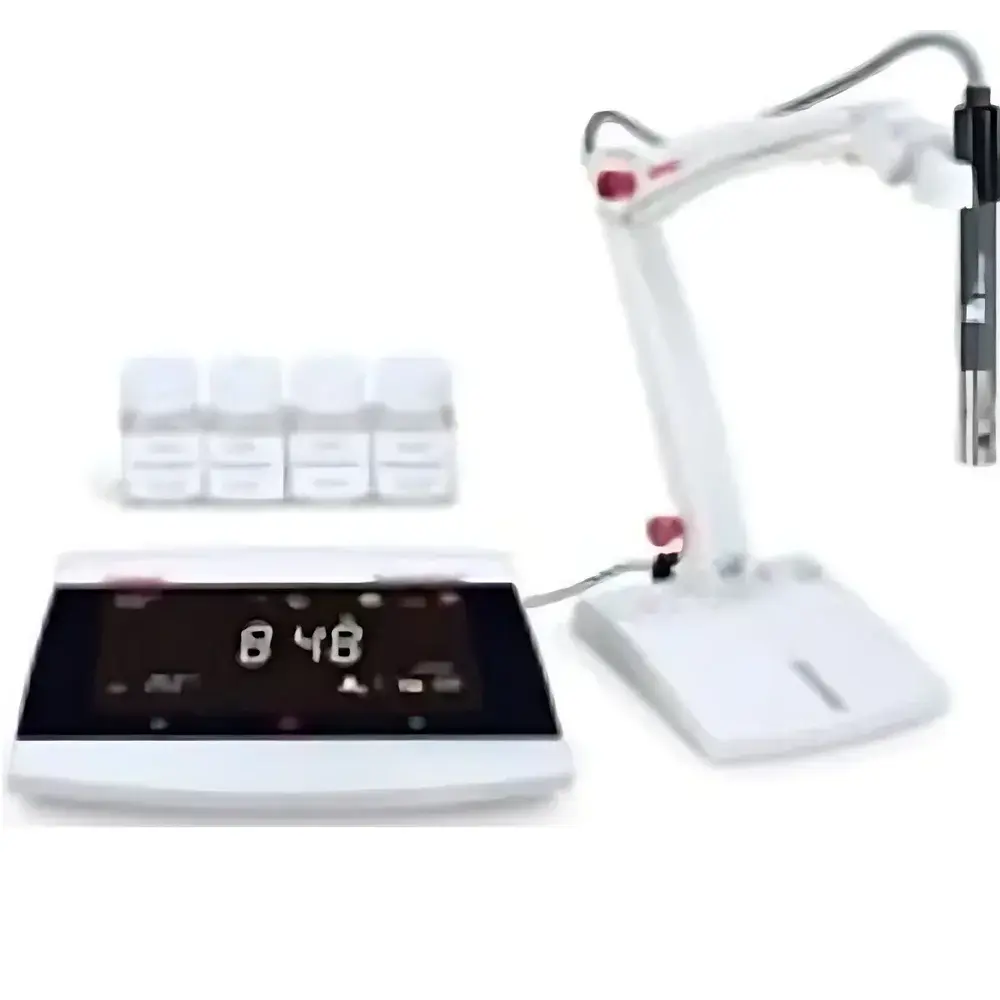
OHAUS AB33EC-F ZH Benchtop Conductivity Meter (formerly ST3100C/F)
| Brand | OHAUS |
|---|---|
| Origin | USA |
| Model | AB33EC-F ZH (formerly STARTER 3100C/F) |
| Form Factor | Benchtop |
| Application Environment | Laboratory |
| Conductivity Range | 0.001 µS/cm – 1000 mS/cm |
| TDS Range | 0.1 mg/L – 200 g/L |
| Resistivity Range | 1 Ω·cm – 100 MΩ·cm |
| Salinity Range | 0–100 PSU |
| Temperature Range | −5 °C to 110 °C |
| Accuracy | ±0.5% of reading ±2 digits |
| Minimum Conductivity Resolution | 0.001 µS/cm |
| Temperature Resolution | 0.3 °C |
| Display | 6.5-inch backlit dot-matrix LCD |
| Dimensions (L×H×W) | 210 mm × 51 mm × 142 mm |
| Net Weight | 0.5 kg |
| Power Supply | AC adapter (included) |
Overview
The OHAUS AB33EC-F ZH Benchtop Conductivity Meter (formerly ST3100C/F) is a precision-engineered electrochemical instrument designed for reliable, repeatable measurement of conductivity, total dissolved solids (TDS), resistivity, and salinity in aqueous solutions. Built upon the proven architecture of the OHAUS STARTER series, this meter employs four-wire conductivity measurement principles with automatic temperature compensation (ATC) referenced to either 25 °C or user-defined reference temperatures. Its core transducer interface supports both 1.0 cm⁻¹ and 10.0 cm⁻¹ cell constants, enabling accurate characterization across ultra-pure water (e.g., pharmaceutical water-for-injection), process streams, environmental samples, and high-salinity brines. The instrument complies with fundamental metrological requirements for laboratory-grade conductometric analysis and is routinely deployed in QC labs supporting ISO/IEC 17025-accredited testing workflows.
Key Features
- 6.5-inch backlit dot-matrix LCD display with intuitive touch-sensitive keypad — enables smartphone-like navigation for calibration, parameter selection, and data review.
- i-Steward intelligent measurement algorithm ensures stable endpoint detection and minimizes operator-induced variability during manual or semi-automated measurements.
- Three-step rapid start protocol: select parameter → immerse electrode → confirm — reducing procedural errors and training time for new users.
- Auto-buffer recognition and auto-endpoint detection optimized for pH-capable configurations; conductivity mode leverages ATC with Pt1000 or NTC thermistor input compatibility.
- Configurable TDS conversion factor (0.4–1.0) and selectable temperature coefficient (0.0–10.0 %/°C) for alignment with industry-specific standards such as ASTM D1125 or USP .
- Rugged ABS housing rated for continuous operation at 5–40 °C and ≤80% RH (non-condensing); meets IEC 61010-1 safety requirements for laboratory electrical equipment.
Sample Compatibility & Compliance
The AB33EC-F ZH accommodates standard DIN/ISO-compliant conductivity cells with BNC or mini-DIN connectors, including stainless steel, platinum black, and graphite electrodes. It supports routine analysis of deionized water, boiler feedwater, wastewater effluents, seawater dilutions, and buffer solutions per ISO 7888 and ASTM D5391. All conductivity readings are traceably referenced to NIST-traceable KCl standards (e.g., 0.01 mol/kg, 0.1 mol/kg). The device’s firmware implements audit-ready calibration logging (date/time-stamped), supporting GLP and GMP documentation requirements. While not inherently 21 CFR Part 11 compliant out-of-the-box, its calibration history export function (via USB) facilitates integration into validated electronic lab notebook (ELN) systems.
Software & Data Management
Data output is supported via USB port for direct transfer to Windows-based PCs. The meter stores up to 500 measurement records with full metadata: timestamp, measured value, unit, temperature, electrode ID (if encoded), and calibration status flag. Exported CSV files contain columns compatible with LIMS ingestion protocols and statistical process control (SPC) software. No proprietary driver installation is required — the device appears as a standard mass-storage class peripheral. Firmware updates are delivered via downloadable .bin files from the official OHAUS support portal, ensuring long-term maintainability and regulatory alignment.
Applications
- Pharmaceutical water system monitoring (PW, WFI, SWFI) per USP and EU Annex 1 requirements.
- Environmental field-lab verification of surface water conductivity for EPA Method 120.1 compliance.
- Food & beverage quality control — e.g., syrup concentration, brine strength, and cleaning-in-place (CIP) rinse validation.
- Academic teaching labs performing fundamental electrochemistry experiments on ion mobility and solution dissociation.
- Industrial process control for electroplating baths, semiconductor ultrapure water loops, and desalination plant intake screening.
FAQ
Does the AB33EC-F ZH support GLP-compliant calibration documentation?
Yes — each calibration event is automatically timestamped and stored with electrode ID, standard used, slope (%), offset (mV or µS), and pass/fail status. These logs are exportable via USB.
Can I use non-OHAUS conductivity cells with this meter?
Yes, provided the cell has a compatible analog output (BNC or mini-DIN) and falls within the supported cell constant range (1.0 or 10.0 cm⁻¹). Calibration must be performed using certified KCl standards.
What temperature sensor types are supported?
The meter accepts integrated Pt1000 sensors (standard with most OHAUS cells) or external NTC thermistors (e.g., 30 kΩ at 25 °C), with configurable beta values for custom probe matching.
Is the display readable under low-light conditions?
Yes — the 6.5-inch LCD features adjustable backlight intensity and high-contrast dot-matrix rendering optimized for ambient light ranging from 50 to 1000 lux.
How frequently should I recalibrate the instrument?
Calibration frequency depends on usage intensity and regulatory context; daily calibration is recommended for QC-critical applications, while weekly calibration suffices for educational or routine monitoring tasks — always before first use and after electrode cleaning.





