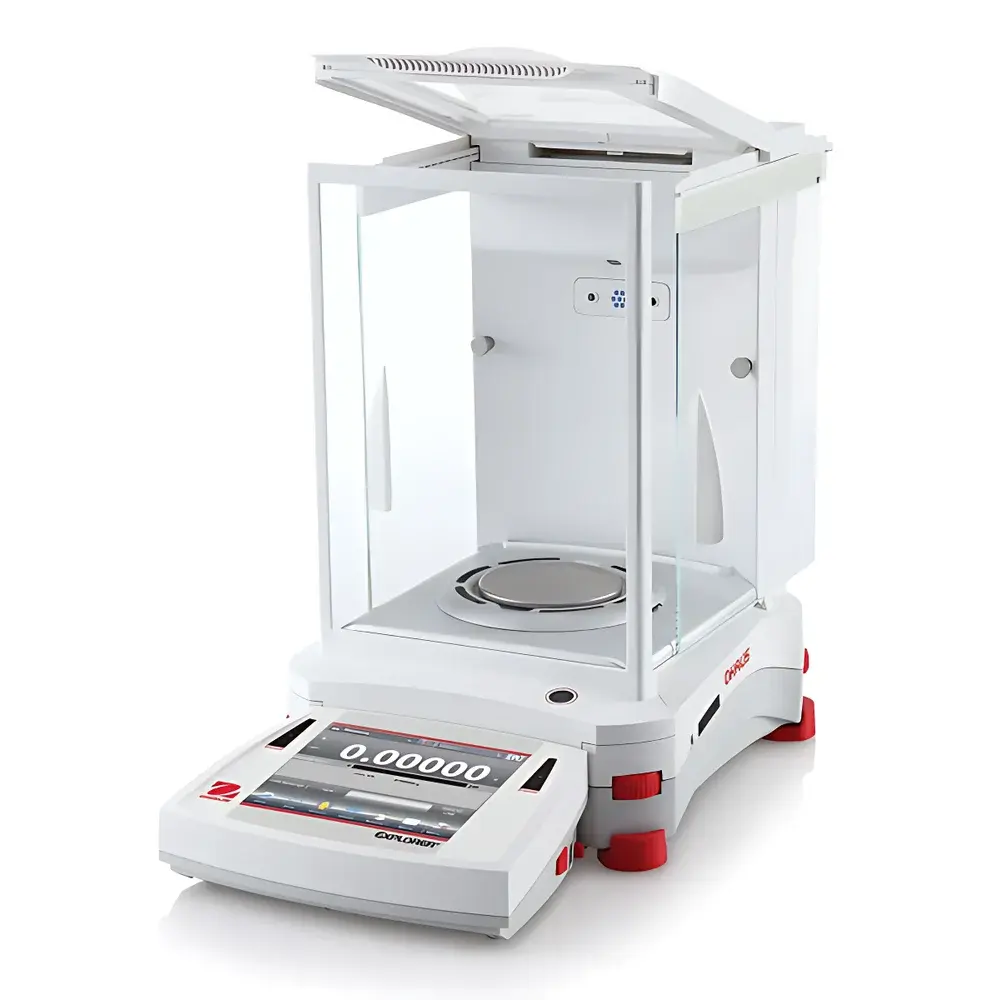
OHAUS Explorer EX125DZH Precision Microbalance
| Brand | OHAUS |
|---|---|
| Origin | Jiangsu, China |
| Manufacturer Type | Manufacturer |
| Product Category | Domestic |
| Model | EX125DZH |
| Instrument Type | Precision Balance |
| Maximum Capacity | 220 g |
| Readability | 0.01 mg |
| Repeatability | 0.015 mg |
| Calibration | Automatic, Internal, External |
| Sensor Technology | High-Speed Integrated Electromagnetic Force Restoration |
| Compliance | ISO/IEC 17025, USP <41>, ASTM E898, GLP/GMP-ready |
Overview
The OHAUS Explorer EX125DZH Precision Microbalance is an electromagnetically compensated analytical balance engineered for laboratories requiring consistent, traceable mass measurements at the 0.01 mg (10 µg) readability level. Operating on the principle of electromagnetic force restoration (EMFR), the EX125DZH maintains equilibrium by dynamically adjusting current through a coil to counteract gravitational force on the sample—enabling high reproducibility, minimal drift, and intrinsic linearity across its 220 g maximum capacity range. Designed for ISO/IEC 17025-accredited environments, this microbalance integrates metrological rigor with ergonomic workflow optimization, supporting routine QC testing, reference standard preparation, pharmaceutical formulation, and material science research where sub-10 µg resolution is critical.
Key Features
- High-Fidelity EMFR Sensor Architecture: Utilizes a proprietary high-speed integrated electromagnetic force restoration transducer with dual internal calibration masses and AutoCal™ temperature-compensated automatic recalibration—triggered by time, temperature drift (>1.5 °C), or user command—to maintain long-term accuracy without manual intervention.
- Non-Contact Operational Intelligence: Four strategically positioned capacitive proximity sensors enable touchless tare, auto-door actuation (draft shield opening/closing), and active static charge dissipation—reducing handling-induced errors and contamination risk in sensitive applications such as lyophilized powder weighing or nanomaterial dosing.
- SmarText™ 2.0 Touch Interface: A 4.3-inch full-color capacitive touchscreen running firmware with intuitive icon-driven navigation, multilingual support (EN/DE/FR/ES/ZH), and real-time graphical feedback for leveling, draft shield status, and calibration progress.
- Robust Data Integrity Framework: Built-in 2000-entry audit trail with timestamped operator ID, event type (weighing, calibration, maintenance), and result metadata—fully compliant with FDA 21 CFR Part 11 requirements when paired with OHAUS LabX® software and network authentication.
- Modular Connectivity & Expandability: Standard USB-B port for direct data export to USB storage (CSV/TXT), optional RS-232 and Ethernet interfaces for LIMS integration, and compatibility with OHAUS AC-300 printer and AP-60 adapter for GLP-compliant label printing.
Sample Compatibility & Compliance
The EX125DZH accommodates diverse sample forms—including powders, granules, small components, and volatile solutes—within its 220 g capacity and 90 mm pan diameter. Its draft shield features anti-static acrylic panels and optimized airflow geometry to minimize convective disturbances during low-mass measurements. The balance meets mechanical and metrological requirements outlined in USP “Balances”, ASTM E898 “Standard Practice for Use of Analytical Balances”, and ISO 9001:2015 clause 7.1.5. All factory calibrations are traceable to NIST-certified standards via OHAUS’ ISO/IEC 17025-accredited calibration laboratory. Optional IQ/OQ documentation packages support GxP validation in regulated pharmaceutical and biotech settings.
Software & Data Management
OHAUS LabX® software (sold separately) provides centralized control, method-based workflows, automated report generation (PDF/Excel), and electronic signature support for 21 CFR Part 11 compliance. Local data storage includes user-defined database fields (e.g., batch ID, sample ID, analyst name), automatic backup to external media, and configurable auto-save intervals. Firmware updates are delivered via USB or network push, with version history and rollback capability. Audit trails record all critical events—including weight value changes, calibration logs, parameter modifications, and user logins—with immutable timestamps and digital signatures.
Applications
- Pharmaceutical: Active pharmaceutical ingredient (API) dispensing, reference standard preparation, dissolution tablet assay, and excipient blending verification per ICH Q5C and USP .
- Materials Science: Nanoparticle mass quantification, catalyst loading precision, thin-film deposition yield calculation, and polymer additive dosing.
- Academic Research: Isotope-labeled compound handling, enzymatic reaction stoichiometry, and gravimetric analysis in analytical chemistry labs.
- Quality Control: Raw material acceptance testing, finished product net content verification, and stability study sample preparation under ISO 17025 surveillance.
- Environmental Testing: Filter membrane weighing pre/post-extraction for PM2.5/PM10 analysis per EPA Method IO-3.2 and EN 12341.
FAQ
What is the minimum sample weight for reliable measurement on the EX125DZH?
The minimum weight is determined by the balance’s repeatability (0.015 mg) and required uncertainty ratio (typically ≥2). For a 95% confidence level and ±0.1% tolerance, the recommended minimum weight is 30 mg.
Does the EX125DZH support external calibration with user-provided weights?
Yes—it accepts external calibration using Class E2 or better weights traceable to national standards; the process is guided stepwise via SmarText™ 2.0 with pass/fail verification.
Can the balance be integrated into a networked lab environment?
Yes—via optional Ethernet module and LabX® software, enabling remote monitoring, multi-user access control, and centralized data archiving with role-based permissions.
Is the draft shield removable for cleaning or large-sample accommodation?
The side panels and top sliding door are fully detachable without tools; the base platform remains fixed to preserve mechanical alignment and sensor integrity.
How often should internal calibration be performed?
AutoCal™ initiates calibration automatically after power-on, following ambient temperature shifts exceeding ±1.5 °C, or at user-defined intervals (e.g., every 2, 4, or 8 hours); manual initiation is also supported.