
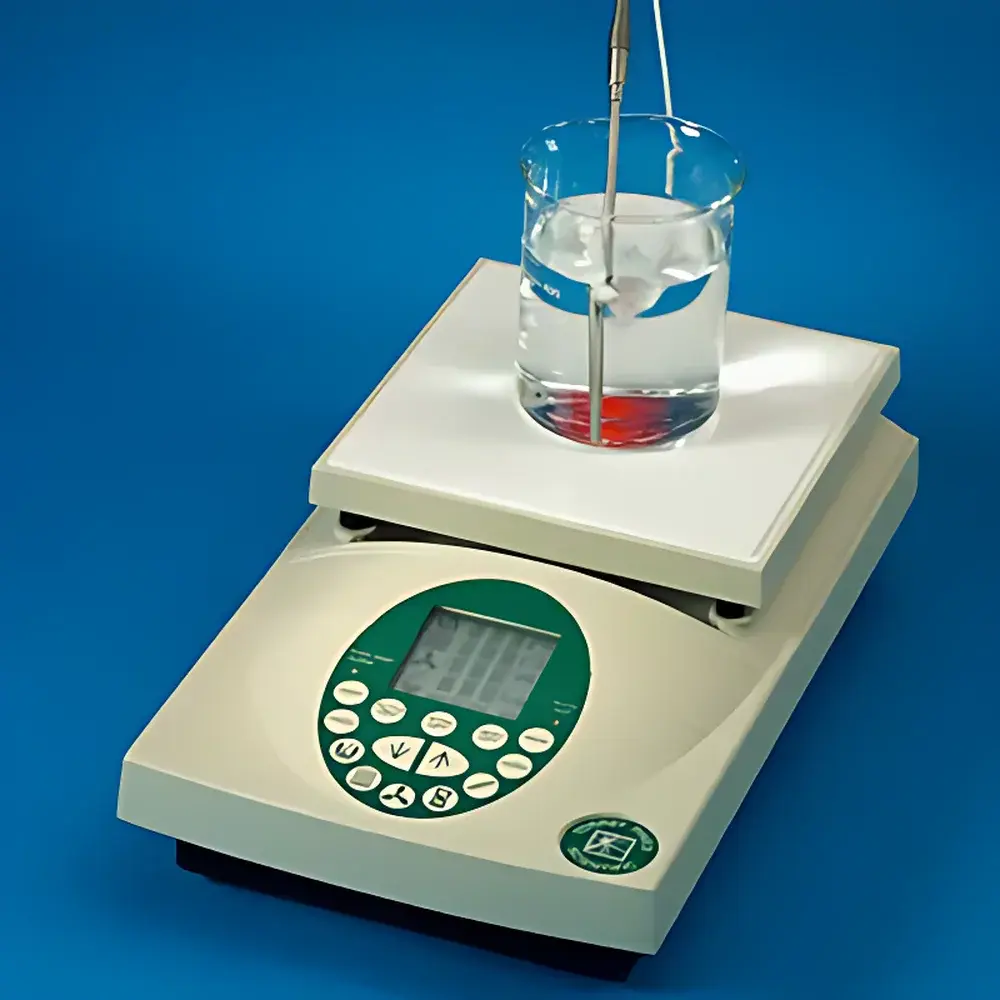
Torrey Pines HS30 Digital Magnetic Hotplate Stirrer
| Brand | Torrey Pines |
|---|---|
| Origin | USA |
| Model | HS30 |
| Heating Power | 1400 W |
| Max. Temperature | 450 °C |
| Temperature Uniformity | ±1% |
| Plate Dimensions | 30.5 × 30.5 cm |
| Heating Zone Dimensions | 30.5 × 30.5 cm |
| Control Type | Digital PID |
| Display | LCD |
| Stirring Capacity | Up to 10 L |
| Stirring Speed Range | 100–1500 rpm |
| Safety Certifications | UL, CSA, CE |
| Panel Material | Ceramic |
Overview
The Torrey Pines HS30 Digital Magnetic Hotplate Stirrer is a precision-engineered laboratory heating and mixing platform designed for reproducible thermal processing and homogeneous sample agitation in analytical, pharmaceutical, and materials science workflows. Built upon a robust ceramic-coated aluminum heating plate, the HS30 integrates high-power resistive heating (1400 W) with digitally regulated magnetic stirring—enabling simultaneous temperature control and mechanical homogenization under stable thermal conditions. Its operation relies on closed-loop PID feedback for dynamic thermal regulation, minimizing overshoot and maintaining setpoint stability within ±1% across the full 25–450 °C operating range. Unlike analog hotplates, the HS30’s digital architecture supports real-time parameter monitoring and programmable thermal profiles—critical for applications requiring defined ramp/soak sequences, such as acid digestion, polymer dissolution, or catalyst activation.
Key Features
- High-temperature ceramic heating surface (30.5 × 30.5 cm) rated for continuous operation up to 450 °C, resistant to thermal shock and chemical corrosion from common reagents including HNO₃, HCl, and HF solutions.
- Digital PID temperature controller with LCD interface providing intuitive access to setpoint, actual temperature, stirring speed, and elapsed program time.
- Programmable multi-stage heating protocol capability (up to 10 segments per program), supporting precise ramp rates (°C/min), hold durations (min), and endpoint actions—including automatic shutdown or cooldown initiation.
- Brushless DC motor-driven stirrer delivering consistent torque across the full 100–1500 rpm range, optimized for viscous media and large-volume vessels (up to 10 L in standard borosilicate glass or PTFE-lined containers).
- Integrated overtemperature protection circuitry compliant with UL 61010-1 and IEC 61010-1 safety standards, automatically disabling heating if sensor fault or thermal runaway is detected.
- UL, CSA, and CE certification ensures conformance with North American and European electrical safety, electromagnetic compatibility (EMC), and environmental directives (RoHS, REACH).
Sample Compatibility & Compliance
The HS30 accommodates a broad range of vessel types—including round-bottom flasks (50 mL to 5 L), beakers, digestion tubes, and custom reaction blocks—provided they contain ferromagnetic stir bars compatible with standard 10–40 mm dimensions. Its uniform heating zone eliminates cold spots, ensuring consistent thermal exposure critical for ASTM E2913 (standard practice for thermal analysis of polymers) and ISO 11469 (plastics identification) sample preparation. For regulated environments, the device supports GLP-compliant documentation when paired with external data loggers; while not natively 21 CFR Part 11 compliant, its deterministic control logic and non-volatile parameter storage enable audit-ready operation under GMP-aligned SOPs.
Software & Data Management
The HS30 operates as a standalone instrument without proprietary software dependencies. All configuration—including temperature setpoints, stirring speeds, and program sequences—is stored in non-volatile memory and retained after power cycling. Optional RS-232 or USB-to-serial interfaces (available via accessory module) permit integration with LabVIEW, MATLAB, or custom SCADA systems for centralized parameter logging and remote execution. Timestamped event logs (e.g., “Setpoint changed to 320 °C at 14:22:08”) can be exported for traceability in quality-controlled laboratories adhering to ISO/IEC 17025 requirements.
Applications
- Wet-chemical sample digestion for ICP-MS/OES analysis per EPA Method 3050B and ISO 15587-1.
- Controlled solvent evaporation and concentration in environmental and food testing labs.
- Polymer melt blending and thermoplastic pre-conditioning prior to rheological or DSC characterization.
- Catalyst synthesis involving reflux-based metal-organic framework (MOF) growth under inert atmosphere.
- Buffer and media preparation in microbiology and cell culture facilities requiring sterility-preserving low-shear mixing.
- Calibration verification of thermocouples and RTDs using NIST-traceable reference standards.
FAQ
Does the HS30 support external temperature probe input for vessel-bottom sensing?
No—the HS30 uses an integrated surface-mounted RTD for plate temperature feedback only. For solution-phase temperature control, users must employ a separate calibrated probe connected to an external datalogger.
Can the HS30 be operated inside a fume hood without performance degradation?
Yes—its sealed electronics and low EM emission profile meet Class B FCC limits, permitting safe installation in ventilated enclosures. Ensure adequate airflow clearance (≥5 cm) around rear ventilation grilles.
Is the ceramic plate replaceable if chipped or cracked?
Yes—Torrey Pines offers field-replaceable ceramic top assemblies (P/N HP-CERAMIC-HS30) with factory calibration documentation included.
What is the typical warm-up time from ambient to 450 °C?
Under no-load conditions, the HS30 achieves 450 °C in approximately 120 seconds; actual time varies with vessel mass, thermal mass, and ambient drafts.
Does the unit include a stir bar?
No—stir bars are sold separately. We recommend PTFE-coated SmCo or AlNiCo bars sized 25–35 mm for optimal coupling and chemical resistance.



