
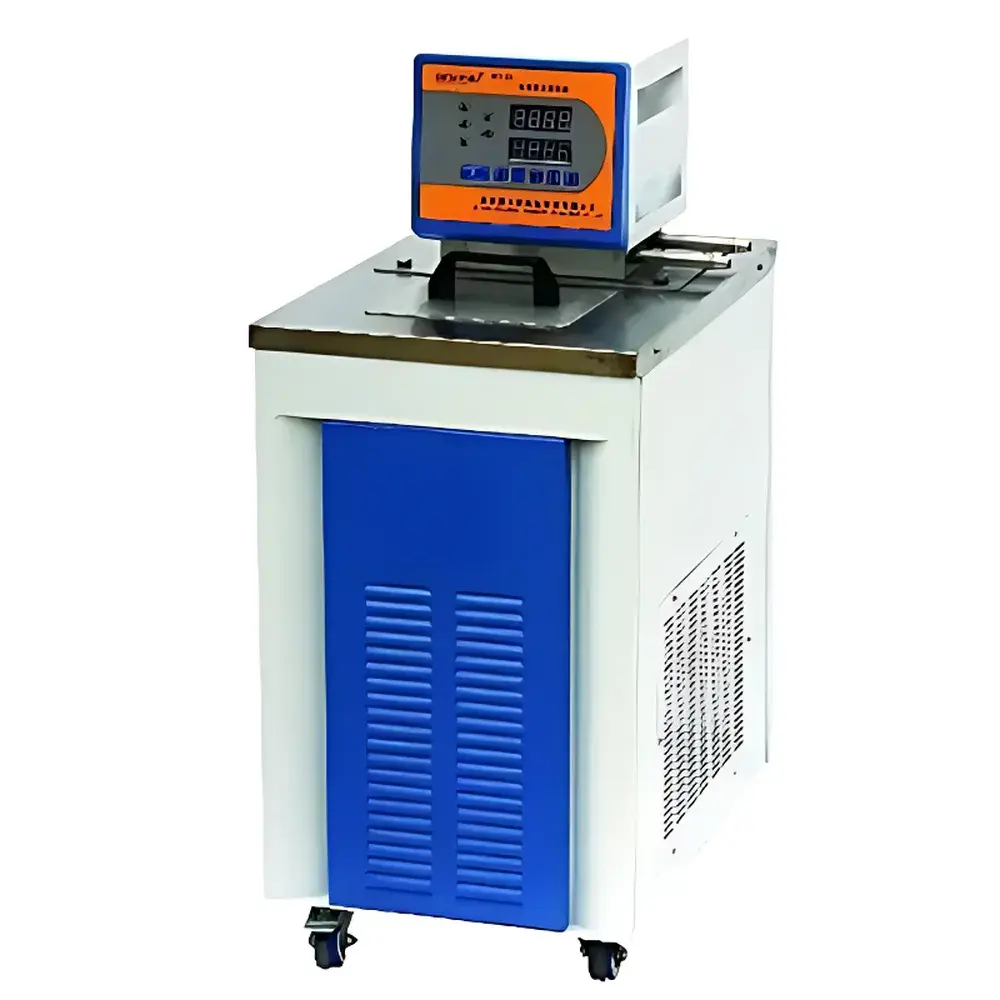
Tianfeng TF-HX-15C Precision Refrigerated/Heating Circulating Bath
| Brand | Tianfeng |
|---|---|
| Origin | Shanghai, China |
| Manufacturer Type | Direct Manufacturer |
| Product Category | Domestic |
| Model | TF-HX-15C |
| Instrument Type | Constant-Temperature Circulating Bath |
| Circulation Mode | Internal & External Circulation |
| Temperature Control | Refrigeration + Heating |
| Bath Volume | 15 L |
| Temperature Range | −30 °C to +99 °C |
| Temperature Stability | ±0.1 °C |
| Power Supply | 220 V / 50 Hz |
| Rated Power | 750 W |
| Alarm Functions | Over-Temperature & Differential-Temperature Detection |
| Dimensions (Operating) | 200 × 160 × 200 mm (L×W×H) |
| Overall Dimensions | 476 × 326 × 797 mm (L×W×H) |
Overview
The Tianfeng TF-HX-15C Precision Refrigerated/Heating Circulating Bath is a compact, self-contained temperature control system engineered for high-stability thermal management in laboratory and industrial R&D environments. Based on closed-loop liquid circulation thermodynamics, it integrates a high-efficiency air-cooled hermetic compressor with a dual-mode PID-controlled heating element to deliver precise, bidirectional temperature regulation across a wide operational range of −30 °C to +99 °C. Unlike passive water baths, this unit actively circulates temperature-regulated fluid both internally—within its 15-liter stainless steel reservoir—and externally—through standard 8–10 mm I.D. tubing—to serve as a remote thermal source or sink. Its design conforms to fundamental principles of convective heat transfer and dynamic thermal equilibrium, enabling uniform temperature distribution (<±0.1 °C stability) within the bath chamber and reproducible thermal coupling with external instrumentation.
Key Features
- Integrated refrigeration and heating system using an imported air-cooled hermetic compressor and resistive heating elements, eliminating dependency on external chillers or heaters
- High-precision digital PID temperature controller with real-time display of setpoint, actual bath temperature, and elapsed operation time
- Touch-sensitive soft-key interface with intuitive navigation, supporting programmable functions including delayed start, timed shutdown, and alarm threshold configuration
- Stainless steel inner tank (304 grade) resistant to corrosion from aqueous, organic, and mild chemical solutions—compatible with common solvents used in synthesis and extraction workflows
- Dual-circulation architecture: internal recirculation ensures homogeneous bath temperature; external circulation enables connection to rotary evaporators, viscometers, electrophoresis units, cryogenic accessories (e.g., cooling caps, hypothermia blankets), and vacuum pumps requiring active thermal load management
- Comprehensive safety system featuring over-temperature cutoff, differential-temperature alarm (indicating abnormal thermal lag or flow obstruction), and automatic fault logging
- Compact footprint (476 × 326 × 797 mm) optimized for benchtop integration in space-constrained analytical labs and QC facilities
Sample Compatibility & Compliance
The TF-HX-15C is designed for use with liquid-phase samples and thermal interfaces compatible with circulating water, ethanol/water mixtures, silicone oil, or other low-viscosity, non-aggressive heat-transfer fluids. It supports GLP-compliant workflows when deployed in regulated environments such as pharmaceutical stability testing (per ICH Q1–Q5), material property characterization (ASTM D5275, ISO 2555), or biophysical assays requiring strict thermal control. While not certified to UL/CSA or CE for medical device integration, its electrical architecture complies with GB 4793.1–2007 (equivalent to IEC 61010-1) for laboratory equipment safety. The unit’s temperature stability (±0.1 °C) meets typical requirements for viscosity calibration (ASTM D445), melting point determination (USP <741>), and enzyme kinetics studies where thermal drift must remain below ±0.2 °C over extended durations.
Software & Data Management
The TF-HX-15C operates via embedded firmware without external PC dependency. All operational parameters—including setpoint, real-time temperature, runtime, alarm status, and user-defined delay settings—are stored in non-volatile memory and retained during power interruption. Though no native USB/Ethernet interface is provided, analog voltage output (0–5 V or 4–20 mA, optional upon request) enables integration into SCADA or LIMS systems for centralized monitoring. Audit trails are maintained locally via timestamped event logging (e.g., “ALERT: ΔT > 2.0 °C at 14:22:07”), supporting basic traceability under FDA 21 CFR Part 11–aligned documentation practices when paired with procedural SOPs.
Applications
- Thermal conditioning of samples prior to spectroscopic, chromatographic, or rheological analysis
- Temperature-controlled solvent removal using rotary evaporation systems (e.g., coupled with Buchi or IKA rotavaps)
- Stabilization of electrophoresis tanks, PCR thermal cyclers, and microplate readers requiring auxiliary cooling
- Cooling support for high-power laboratory equipment: electron microscopes, diffusion pumps, RF generators, and laser diode modules
- Material testing per ASTM D648 (heat deflection), ISO 75 (load-deflection temperature), and DIN 53445 (thermal aging of polymers)
- Cell culture incubation pre-conditioning, cold-chain validation studies, and cryopreservation workflow support
- Calibration of temperature-sensitive transducers, RTDs, and thermistors against NIST-traceable references
FAQ
What is the minimum operating temperature and how quickly does it reach −30 °C?
The unit achieves −30 °C from ambient (25 °C) in approximately 45–60 minutes under no-load conditions, depending on ambient humidity and ventilation. Cooling rate decreases progressively near extreme setpoints due to thermodynamic limitations of air-cooled compression.
Can the bath be used with flammable solvents like acetone or ether?
No. The internal chamber and circulation pump are rated for aqueous and polar non-flammable media only. Use of flammable liquids poses fire hazard and voids warranty and safety compliance.
Is external circulation flow rate adjustable?
Yes. A calibrated bypass valve allows manual modulation of external flow between ~0.5–3.0 L/min, ensuring compatibility with low-flow instruments (e.g., capillary viscometers) and high-demand devices (e.g., condenser jackets).
Does the unit support RS232 or Modbus communication?
Standard configuration includes no digital communication port. Optional RS485 Modbus RTU interface is available for OEM integration under custom order (lead time: +10 working days).
What maintenance is required to sustain ±0.1 °C stability over time?
Biannual inspection of compressor oil level, condenser coil cleaning, and verification of PID tuning parameters using a calibrated reference thermometer (e.g., Fluke 1523) is recommended. Deionized water replacement every 3 months prevents mineral deposition and maintains thermal conductivity.



