
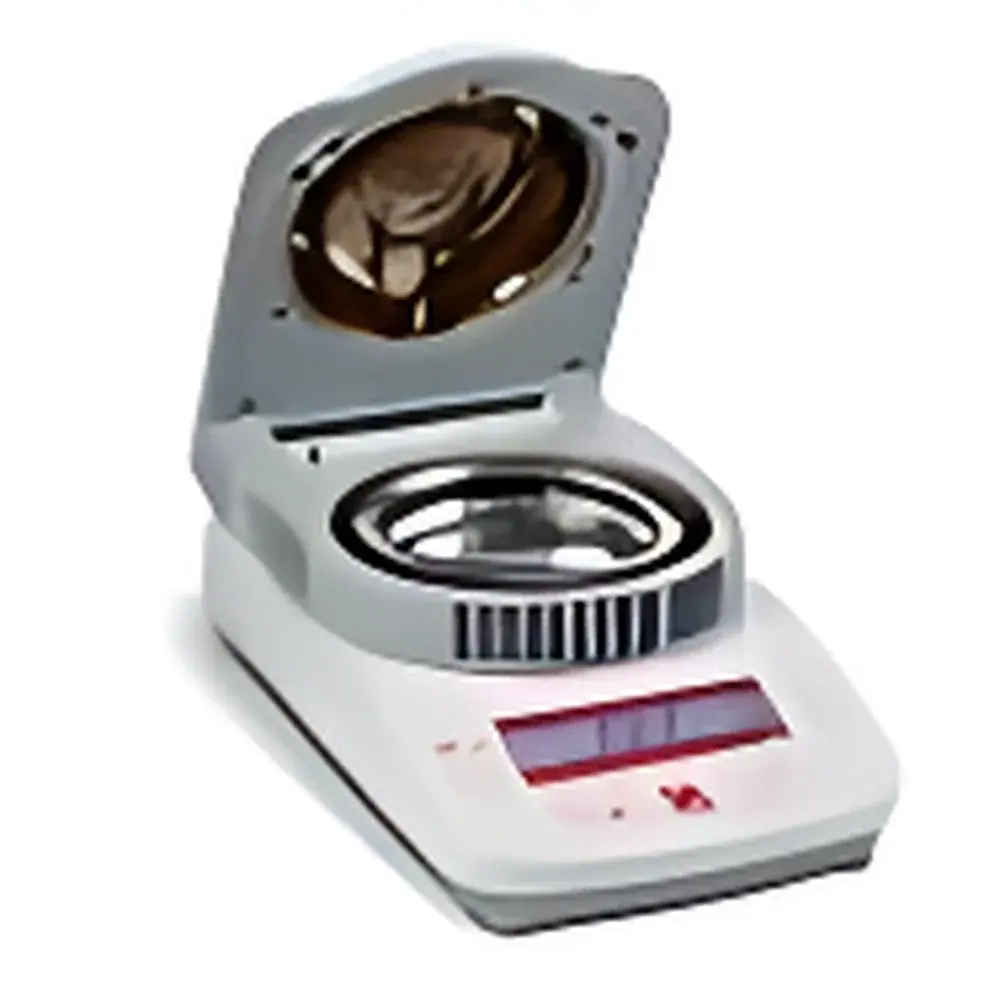
OHAUS MB23ZH Infrared Moisture Analyzer
| Brand | OHAUS |
|---|---|
| Origin | USA |
| Heating Method | Infrared |
| Maximum Capacity | 110 g |
| Readability | 0.01 g |
| Moisture Readability (for >10 g sample) | 0.1% |
| Repeatability (SD) | 0.3% for 3 g sample, 0.2% for 10 g sample |
| Minimum Sample Mass | 0.5 g |
| Recommended Sample Mass | 3–20 g |
| Pan Diameter | 90 mm |
| Temperature Range | 50–160 °C (in 5 °C increments) |
| Heating Time | 1–60 min (30 s steps), 60–90 min (1 min steps) |
| Endpoint Control | Timed & Automatic |
| Display | Backlit LCD showing moisture %, solids %, weight, time, temperature |
| Interface | Bidirectional RS232 |
| Operating Environment | 10–30 °C |
| Dimensions (W×H×D) | 165 × 127 × 280 mm |
| Net Weight | 2.1 kg |
| Sample Pan Handle | Standard |
| Heating Source | Infrared Lamp |
Overview
The OHAUS MB23ZH Infrared Moisture Analyzer is a precision laboratory instrument engineered for rapid, reliable quantification of moisture content in solid and semi-solid samples using infrared (IR) heating coupled with high-resolution analytical weighing. Unlike traditional oven-drying methods requiring hours, the MB23ZH applies controlled IR radiation to accelerate surface and subsurface water evaporation while continuously monitoring mass loss in real time. Its core architecture integrates a thermally isolated electromagnetic force restoration (EMFR) load cell—designed to minimize thermal drift during heating—ensuring stable weighing performance even under dynamic thermal conditions. This principle aligns with gravimetric moisture determination standards defined in ASTM D4442, ISO 712, and AOAC 950.46, where moisture is calculated as the mass difference before and after drying, expressed as a percentage of the initial wet mass.
Key Features
- Thermally Isolated Weighing System: Proprietary isolation design mitigates heat transfer from the IR source to the load cell, preserving measurement integrity throughout the drying cycle.
- Intuitive Six-Button Interface: Eliminates nested menu navigation; all operational functions—including method selection, start/stop, tare, and parameter adjustment—are accessible via dedicated physical keys.
- Backlit Monochrome LCD Display: Provides simultaneous readouts of moisture %, solids %, current mass (g), elapsed time (min:s), and chamber temperature (°C) with high contrast and wide viewing angles.
- Flexible Endpoint Control: Supports both fixed-duration drying and automatic termination based on mass stabilization criteria (e.g., ≤0.1 mg change over 30 s), accommodating diverse sample behaviors.
- Bidirectional RS232 Port: Enables direct connection to serial printers for GLP-compliant hardcopy reports or to PCs running third-party data acquisition software for audit-trail generation and long-term trend analysis.
- Optimized IR Heating Profile: Adjustable temperature range (50–160 °C, 5 °C increments) and programmable heating duration (1–90 min) allow method development for thermally sensitive matrices—including high-sugar foods, pharmaceutical granules, and polymer powders—that may degrade under halogen or convection heating.
Sample Compatibility & Compliance
The MB23ZH is validated for use across regulated and non-regulated environments involving foodstuffs (e.g., flour, spices, dairy powders), active pharmaceutical ingredients (APIs), excipients, catalysts, and industrial chemicals. Its IR heating mode minimizes charring risk in caramelizing or Maillard-prone samples, offering superior fidelity compared to higher-intensity halogen sources. While not inherently 21 CFR Part 11 compliant out-of-the-box, the device supports traceable operation when integrated with compliant software platforms that enforce electronic signatures, audit trails, and user access controls. It meets general requirements for Good Laboratory Practice (GLP) and Good Manufacturing Practice (GMP) environments where documented, repeatable moisture testing is required per USP <921>, EP 2.2.32, and JP 2.07.
Software & Data Management
Data export occurs via ASCII-formatted RS232 transmission, compatible with spreadsheet applications and LIMS interfaces. The analyzer stores no internal method history or user logs; therefore, external software is recommended for full compliance with FDA 21 CFR Part 11 Annex 11 or ISO/IEC 17025 documentation requirements. Optional OHAUS AC-300 software (sold separately) provides method library management, calibration logging, and PDF report generation with timestamped operator ID fields—facilitating routine IQ/OQ validation protocols.
Applications
- Quality control of hygroscopic raw materials in pharmaceutical manufacturing
- Moisture specification verification for dietary supplements and nutraceutical blends
- In-process monitoring of spray-dried milk powder and coffee extract granules
- Batch release testing of catalyst supports and ceramic precursors
- Research-scale dehydration kinetics studies in food science laboratories
- Environmental testing of desiccant efficiency and packaging barrier performance
FAQ
What distinguishes infrared heating from halogen heating in moisture analyzers?
Infrared heating uses longer-wavelength radiation that penetrates deeper into porous or heterogeneous samples, enabling more uniform thermal energy distribution and reduced surface overheating—critical for sugar-rich or low-thermal-conductivity materials.
Can the MB23ZH be calibrated for traceable moisture results?
Yes; it supports external calibration using certified weights (Class M2 or better) and moisture reference standards (e.g., sodium tartrate dihydrate, USP Reference Standard). Calibration intervals should follow internal SOPs aligned with ISO/IEC 17025 Clause 6.5.
Is the sample pan interchangeable with other OHAUS models?
The 90 mm diameter stainless steel pan with integrated handle is mechanically and thermally optimized for the MB23ZH’s IR geometry and is not cross-compatible with MB25/MB27/MB90/MB120 due to differences in heater alignment and pan support design.
Does the MB23ZH meet IP rating requirements for lab environments?
It carries no formal IP rating; however, its sealed keypad and vented housing are suitable for standard analytical laboratories per IEC 61010-1 safety requirements for electrical equipment used in measurement, control, and laboratory use.
How is repeatability verified during routine operation?
Users perform daily repeatability checks using a minimum 3 g test load (e.g., certified stainless steel weight) dried at 105 °C for 5 minutes; observed standard deviation must remain ≤0.3% per manufacturer specification and internal quality thresholds.





