
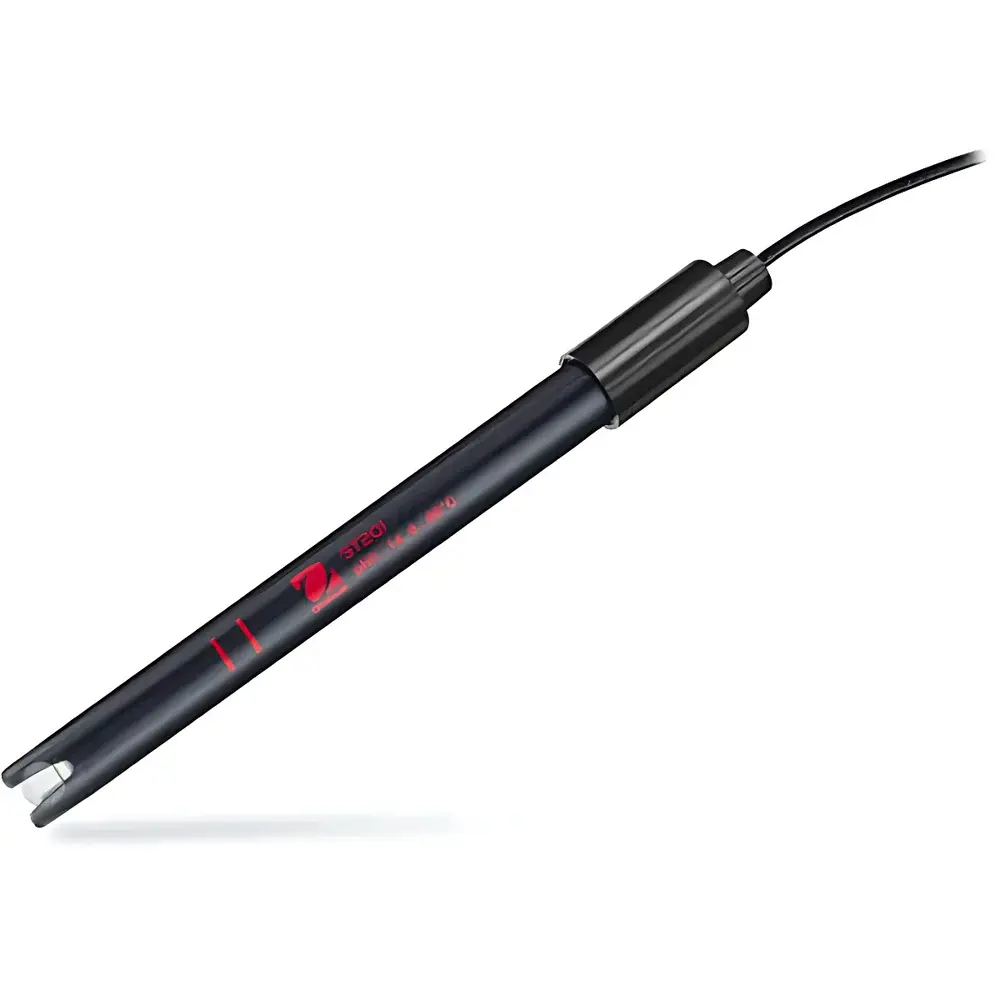
OHAUS ST201 pH Electrode
| Brand | OHAUS |
|---|---|
| Origin | Jiangsu, China |
| Manufacturer Type | Manufacturer |
| Product Origin | Domestic (China) |
| Model | ST201 |
| Price | Upon Request |
| pH Measurement Range | 0.00 – 14.00 pH |
| Cable Length | 1.1 m |
| Electrode Body Material | Plastic |
| Dimensions (L × Ø) | 120 mm × 12 mm |
| Net Weight | 70 g |
| Temperature Operating Range | 0 °C – 80 °C |
| Integrated Temperature Sensor | No |
Overview
The OHAUS ST201 pH electrode is a robust, general-purpose combination pH sensor engineered for reliable and reproducible measurements in routine laboratory, educational, and quality control environments. Designed according to standard potentiometric principles, the ST201 employs a glass pH-sensitive membrane and an integrated Ag/AgCl reference system housed within a single, compact plastic body. Its measurement principle relies on the Nernst equation—generating a millivolt potential proportional to hydrogen ion activity across the glass membrane—enabling accurate determination of aqueous solution acidity or alkalinity. With a full-scale range of 0.00–14.00 pH and operational stability from 0 °C to 80 °C, the ST201 supports consistent performance across diverse sample matrices, including buffers, process streams, environmental water samples, and basic pharmaceutical formulations. Its design prioritizes mechanical durability and chemical resistance while maintaining compatibility with standard benchtop and portable pH meters equipped with BNC input connectors.
Key Features
- Combination design integrating pH sensing element and double-junction Ag/AgCl reference system in one housing for simplified handling and reduced calibration drift
- Chemically resistant plastic body (polypropylene or similar thermoplastic) suitable for routine use in acidic, neutral, and mildly alkaline solutions
- 1.1-meter shielded PVC cable with molded BNC connector ensures stable signal transmission and minimizes electromagnetic interference
- Compact cylindrical form factor (120 mm × 12 mm) enables access to narrow-neck containers, reaction vessels, and small-volume samples
- No built-in temperature sensor—requires external temperature compensation via meter or manual input for precise pH reporting per ISO 7027 and ASTM D1293
- Designed for compliance with standard electrochemical metrology practices; suitable for GLP-aligned workflows when paired with validated instrumentation
Sample Compatibility & Compliance
The ST201 exhibits broad compatibility with aqueous samples encountered in academic teaching labs, municipal water testing, food & beverage QA, and industrial process monitoring. It is not recommended for non-aqueous solvents, highly viscous media, or samples containing sulfides, heavy metals (e.g., Ag⁺, Pb²⁺), or high concentrations of proteins or colloids without frequent cleaning and reconditioning. The electrode meets fundamental requirements outlined in ISO 3696 (Grade 3 water), USP (pH measurement), and CLSI EP15-A3 for precision verification under controlled conditions. While not intrinsically certified for hazardous area use or sterilization, its construction supports routine cleaning with deionized water, mild detergent, or 0.1 M HCl followed by thorough rinsing—procedures aligned with manufacturer-recommended maintenance protocols.
Software & Data Management
As a passive analog sensor, the ST201 does not incorporate digital electronics, firmware, or onboard memory. It interfaces exclusively via analog voltage output (mV) to compatible pH meters—including OHAUS Starter series, as well as third-party instruments supporting standard BNC inputs and manual or automatic temperature compensation (ATC). When used with compliant meters featuring audit-trail functionality (e.g., those adhering to FDA 21 CFR Part 11 requirements), measurement data—including timestamped pH values, calibration history, and operator ID—can be exported via USB, RS-232, or Bluetooth for integration into LIMS or ELN platforms. No proprietary software or driver installation is required for basic operation.
Applications
- Routine pH calibration and verification using NIST-traceable buffer standards (pH 4.01, 7.00, 10.01)
- Quality assurance testing of purified water, cleaning solutions, and rinse baths in pharmaceutical manufacturing
- Environmental monitoring of surface water, wastewater effluents, and soil leachates
- Academic instruction in general chemistry, analytical chemistry, and environmental science laboratories
- Process pH monitoring in food processing (e.g., dairy, brewing, juice production) where continuous sterilization is not required
- Supporting ORP and ion-selective measurements when used with appropriate meters capable of mV mode and slope verification
FAQ
Is the ST201 compatible with non-OHAUS pH meters?
Yes—the ST201 uses a standard BNC connector and outputs a conventional mV signal conforming to the IUPAC pH scale; it functions with any meter supporting combination pH electrodes and manual or external temperature compensation.
Does this electrode include automatic temperature compensation (ATC)?
No—the ST201 lacks an integrated temperature sensor. Accurate pH results require either manual temperature entry or connection to a separate ATC probe supported by the host meter.
What is the expected service life under normal lab use?
With proper storage (in 3 M KCl or pH 4 buffer), regular cleaning, and avoidance of drying out, typical functional lifespan ranges from 12 to 24 months depending on frequency of use and sample aggressiveness.
Can the ST201 be used for measuring pH in organic solvents?
Not recommended—glass membrane response deviates significantly in low-dielectric media; dedicated non-aqueous electrodes with specialized filling solutions are required for such applications.
How should the electrode be cleaned after exposure to protein-rich or oily samples?
Rinse thoroughly with deionized water, then soak for 15–30 minutes in a pepsin/HCl solution (1 % pepsin in 0.1 M HCl) or enzymatic cleaner, followed by extensive rinsing and rehydration in storage solution prior to recalibration.
Related Products





