
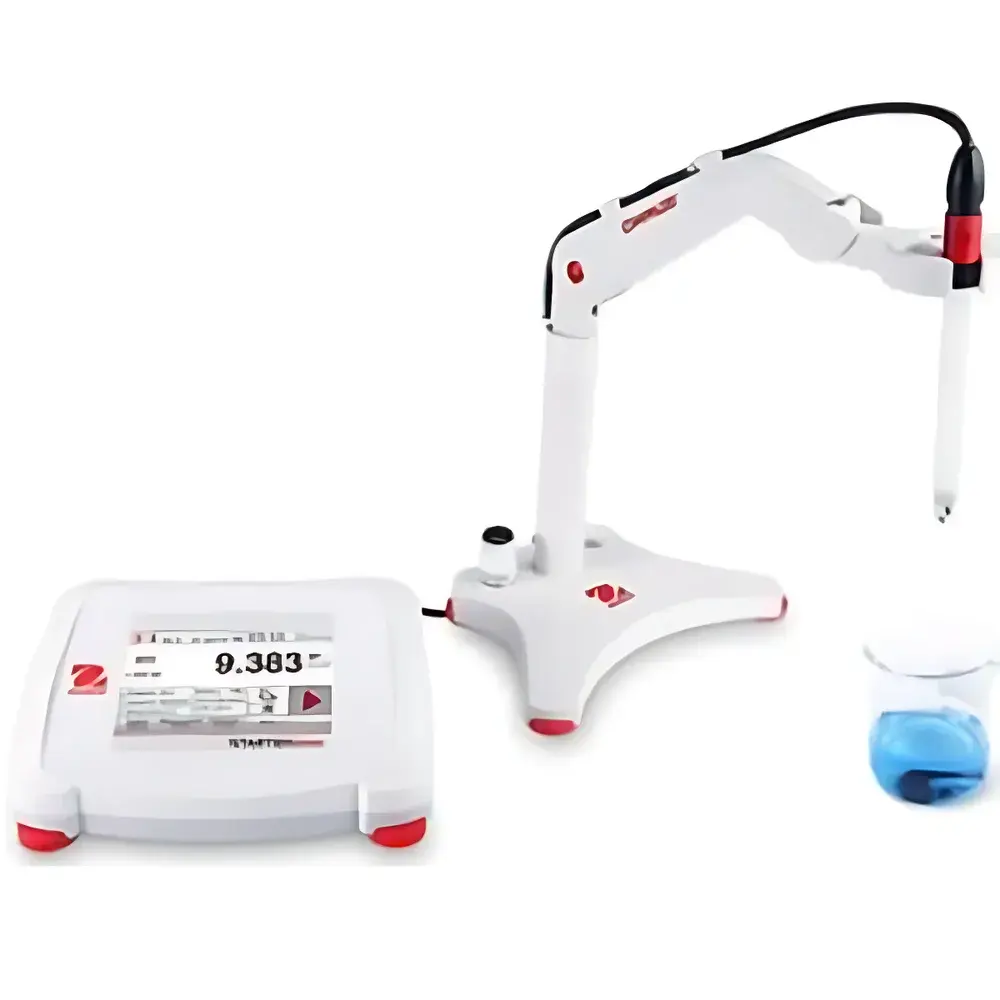
OHAUS ST5000/F ZH Benchtop pH Meter
| Brand | OHAUS |
|---|---|
| Origin | USA |
| Model | ST5000/F ZH |
| Instrument Type | Benchtop |
| Parameter Type | Single-Parameter (pH/ORP) |
| Measurement Range | −2.00 – 20.00 pH |
| Resolution | 0.001 pH |
| Accuracy | ±0.002 pH |
| Temperature Range | −30 – 130 °C |
| Temperature Resolution | 0.1 °C |
| Temperature Accuracy | ±0.1 °C |
| mV Range | −2000.00 – +2000.00 mV |
| mV Accuracy | ±0.03% of reading |
| Calibration Standards | NIST-traceable buffers |
| Calibration Points | Up to 9-point pH calibration |
| Buffer Sets | 8 pre-defined + 1 user-definable |
| Calibration Modes | 3-point, endpoint, continuous |
| Data Storage | 1000 measurements with timestamp, electrode ID, and temperature |
| GLP Compliance | Full audit trail, calibration history, user login, and instrument settings log |
| Display | 4.3-inch color TFT touchscreen |
| Enclosure Material | ABS |
| IP Rating | IP54 |
| Power | Included AC adapter (9 V DC) |
| Net Weight | 550 g |
| Operating Environment | 10–40 °C, ≤85% RH (non-condensing) |
Overview
The OHAUS ST5000/F ZH Benchtop pH Meter is a high-precision electrochemical measurement system engineered for demanding laboratory environments where trace-level pH accuracy, regulatory compliance, and operational reproducibility are critical. Built on a dual-sensor potentiometric architecture, the instrument measures hydrogen ion activity via glass electrode potential difference relative to a stable reference electrode—conforming to IUPAC-recommended pH scale conventions and NIST-traceable calibration protocols. With a measurement range spanning −2.00 to 20.00 pH and resolution of 0.001 pH, the ST5000/F ZH supports applications beyond conventional aqueous systems—including low-ionic-strength samples, highly alkaline caustic solutions, and non-aqueous or mixed-solvent matrices when paired with compatible electrodes. Its integrated ATC (Automatic Temperature Compensation) uses a 30 kΩ NTC thermistor to correct pH readings in real time across −30 °C to 130 °C, ensuring thermodynamic consistency per ISO 3696 and ASTM E70 standards.
Key Features
- 4.3-inch full-color TFT capacitive touchscreen interface with intuitive icon-driven navigation and multi-language support (English, Spanish, French, German, Chinese)
- GLP-compliant data management: timestamped storage of up to 1000 measurements, including electrode serial number, calibration date/time, buffer IDs, slope/mV offset, and user credentials
- Advanced calibration flexibility: up to 9-point pH calibration; support for 8 factory-defined buffer sets (including DIN, JIS, US, NIST, and technical buffers) plus one fully customizable set
- Dual-mode measurement: endpoint mode with adjustable stability criteria (±0.001–±0.010 pH over 1–60 sec), and continuous monitoring mode with configurable update intervals (0.5–10 sec)
- Comprehensive ORP capability: −2000.00 to +2000.00 mV range with ±0.03% reading accuracy and millivolt stability monitoring
- Rugged ABS housing rated IP54 for resistance to dust ingress and water splashes—suitable for shared lab benches and QC environments
- Built-in electrode diagnostics: real-time impedance monitoring, slope calculation (typically 95–105% for new electrodes), and asymmetry potential assessment
Sample Compatibility & Compliance
The ST5000/F ZH is validated for use with standard combination glass electrodes (e.g., included ST350 tri-function electrode) and compatible with specialized sensors for low-conductivity water, high-temperature sterilization cycles, or aggressive chemical media. It meets essential regulatory requirements for quality-controlled environments: full alignment with FDA 21 CFR Part 11 electronic record/electronic signature (ERES) principles through secure user authentication, audit-trail-enforced calibration logs, and immutable data export (via USB). The instrument’s firmware and calibration routines are designed to satisfy ISO/IEC 17025 accreditation criteria for testing laboratories, as well as USP and EP 2.2.3 guidelines for pH measurement validation. All calibrations utilize NIST-traceable reference materials, and certificate-of-analysis documentation is supported for internal SOPs and external audits.
Software & Data Management
Data export is performed via USB-A port to FAT32-formatted drives in CSV format—retaining all metadata (date/time, operator ID, electrode ID, calibration status, temperature, and raw mV/pH values). No proprietary software is required; exported files are directly importable into LIMS platforms, Excel, or statistical analysis tools (e.g., JMP, Minitab). The onboard memory maintains independent records for each registered user, enforcing role-based access control (administrator, technician, reviewer). Audit trails include full change history for instrument configuration, calibration parameters, and data deletion events—meeting ALCOA+ (Attributable, Legible, Contemporaneous, Original, Accurate, Complete, Consistent, Enduring, Available) data integrity expectations.
Applications
- Pharmaceutical formulation development and stability testing (aqueous suspensions, lyophilized reconstitutes, parenteral solutions)
- Environmental water analysis per EPA Method 150.1 and ISO 10523
- Food & beverage QA/QC: dairy titratable acidity, brewing wort pH, juice acidification control
- Chemical synthesis monitoring: hydrolysis reactions, catalyst activation, polymerization initiation
- Academic research requiring high-fidelity pH kinetics, such as enzyme activity profiling or membrane transport studies
- Calibration laboratory verification of secondary pH standards and electrode performance qualification
FAQ
Does the ST5000/F ZH support automatic electrode recognition?
Yes—it reads embedded EEPROM chips in OHAUS Smart Electrodes (e.g., ST350) to auto-configure measurement parameters, calibration history, and service life tracking.
Can it perform simultaneous pH and temperature logging for kinetic studies?
Yes—continuous mode captures synchronized pH and temperature values at user-defined intervals, with timestamps accurate to ±1 second.
Is the instrument compliant with ISO/IEC 17025 for accredited testing labs?
Yes—the built-in GLP framework, full calibration traceability, and audit-trail functionality meet clause 7.7 (Measurement Traceability) and 7.8 (Reporting of Results) requirements.
What buffer standards are preloaded in the instrument?
NIST, DIN 19266, JIS Z 8802, US Pharmacopeia, Technical (pH 4.01/7.00/10.01), and custom-defined sets.
How is data security enforced during multi-user operation?
Each user account requires password authentication; administrator privileges are required to modify calibration settings, delete data, or reset audit logs.






