
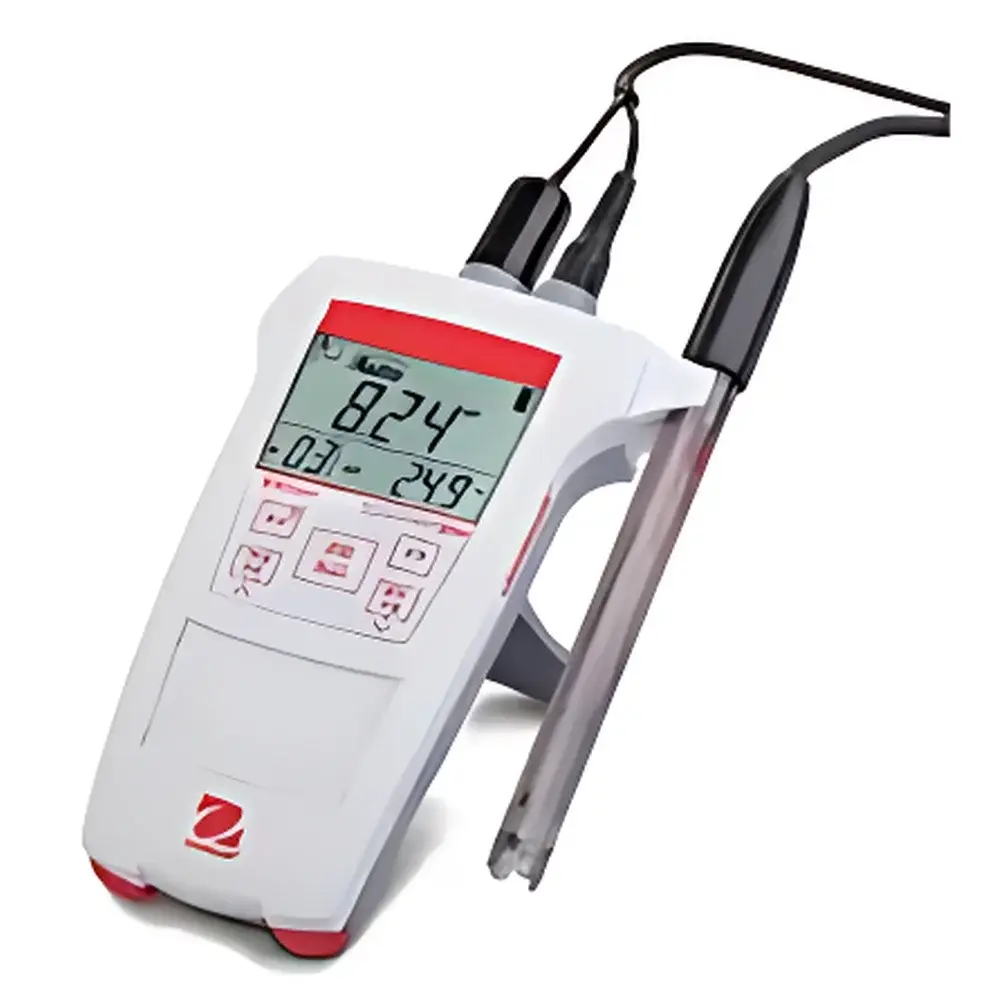
OHAUS Starter 300 Portable pH Meter
| Brand | OHAUS |
|---|---|
| Origin | USA |
| Model | Starter 300 |
| Instrument Type | Portable pH Meter |
| Parameter Types | Dual (pH/mV) |
| Measurement Accuracy | ±0.01 pH, ±1 mV, ±0.5 °C |
| Measurement Range | 0.00–14.00 pH |
| Resolution | 0.01 pH |
| Calibration | Up to 3-point, with standard buffers at pH 4.01, 7.00, and 10.01 |
| Temperature Compensation | Automatic or manual (NTC 3 kΩ sensor) |
| IP Rating | IP54 |
| Display | Backlit LCD |
| Input Impedance | >5 × 10¹² Ω (BNC) |
| Data Storage | 30 measurement records + last calibration data (with timestamp) |
| Power Supply | 9 V DC adapter (included) |
| Dimensions | 160 × 200 × 65 mm |
| Weight | 0.65 kg |
| Housing Material | ABS plastic |
| Operating Environment | 0–50 °C, ≤85% RH non-condensing |
Overview
The OHAUS Starter 300 Portable pH Meter is an engineered solution for reliable, field-ready electrochemical measurements in industrial quality control, academic teaching labs, food safety inspections, and environmental monitoring. Built on a robust potentiometric principle, the instrument measures hydrogen ion activity via a glass electrode coupled with a reference electrode—converting the resulting potential difference (in mV) into pH values using the Nernst equation. Its dual-parameter capability enables simultaneous pH and redox (mV) readings, supporting both routine acidity/alkalinity assessment and oxidation-reduction potential (ORP) analysis. Designed for operational resilience, the unit features an IP54-rated enclosure—protecting internal circuitry against dust ingress and water splashes—making it suitable for use in production floors, outdoor sampling sites, and classroom demonstrations where portability and durability are essential.
Key Features
- Intuitive electrode health feedback: real-time visual indicators (smiley, neutral, or frowning face icons) reflect calibration status and electrode responsiveness based on slope and offset diagnostics.
- Ergonomic, one-handed operation: textured anti-slip surface combined with optimized button layout and integrated fold-out stand allows stable upright or horizontal placement on any surface.
- Smart self-diagnostic system: automatically detects common faults—including open-circuit electrodes, low battery, temperature sensor failure, and out-of-range buffer recognition—and displays context-specific error codes.
- User-defined labeling: customizable ID tags support asset tracking, multi-user environments, and ISO/IEC 17025-compliant equipment management protocols.
- High-impedance input (>5 × 10¹² Ω): ensures minimal loading effect on high-resistance pH electrodes, preserving signal integrity across diverse sample matrices including low-conductivity aqueous solutions.
- Real-time clock with timestamped data logging: stores up to 30 measurement entries plus full calibration history—including date, time, buffer IDs, slope (%), and offset (mV)—facilitating traceability and audit readiness.
Sample Compatibility & Compliance
The Starter 300 accommodates standard BNC-compatible pH electrodes and NTC 3 kΩ temperature probes, enabling compatibility with most commercially available combination electrodes. It supports automatic or manual temperature compensation across 0–100 °C, critical for accurate pH measurement in variable-temperature samples such as pasteurized dairy products or heated wastewater streams. While not certified for hazardous locations, its IP54 rating meets IEC 60529 requirements for non-critical industrial environments. The device complies with general electrical safety standards (IEC 61010-1) and is suitable for use under GLP and GMP frameworks when operated within documented procedures—including defined calibration intervals, electrode maintenance logs, and data review workflows aligned with FDA 21 CFR Part 11 principles (when paired with compliant data export practices).
Software & Data Management
Data retrieval is performed via manual transcription from the backlit LCD display; the Starter 300 does not feature USB, Bluetooth, or PC connectivity. However, its structured on-device storage architecture—retaining timestamps, calibration parameters, and measurement values—enables efficient manual recordkeeping in paper-based or LIMS-integrated workflows. All stored entries include metadata necessary for regulatory traceability: calibration date/time, buffer pH values used, measured slope (%), asymmetry potential (mV), and ambient temperature. This design aligns with laboratories operating under ISO/IEC 17025 Clause 7.7 (Results Reporting) and ASTM D1293 (Standard Test Method for pH of Water), where verifiable instrument performance history is required for method validation.
Applications
- Food & beverage QC: rapid verification of pH in fermented products (yogurt, sauerkraut), canned goods, and beverage formulations to ensure microbial stability and regulatory compliance (e.g., USDA-FSIS, FDA Food Code).
- Education: ideal for undergraduate chemistry and biology labs due to its intuitive interface, visual electrode diagnostics, and tolerance to student handling—supporting curriculum-aligned experiments on acid-base equilibria and buffer capacity.
- Environmental field testing: deployment in surface water, wastewater effluent, and soil leachate analysis per EPA Method 150.1 and APHA Standard Methods 4500-H⁺ B.
- Pharmaceutical manufacturing: monitoring of cleaning-in-place (CIP) rinse water pH and excipient solution preparation within non-sterile ancillary processes.
- Aquaculture & hydroponics: routine checks of nutrient solution pH to maintain optimal ion availability and prevent metal precipitation or pathogen proliferation.
FAQ
What calibration buffers are supported?
The Starter 300 is configured for three-point calibration using standardized NIST-traceable buffers at pH 4.01, 7.00, and 10.01. Custom buffer sets are not programmable.
Does the meter support automatic temperature compensation (ATC)?
Yes—when connected to a compatible NTC 3 kΩ temperature probe, the instrument applies real-time ATC across 0–100 °C. Manual temperature entry is also available if no probe is attached.
Can measurement data be exported electronically?
No—the Starter 300 lacks digital communication interfaces. Data must be recorded manually from the display or logged via the built-in memory review function.
Is the device suitable for measuring low-ionic-strength samples?
Yes, its input impedance exceeds 5 × 10¹² Ω, minimizing measurement drift in deionized water, rainwater, or purified solvents—though users should employ low-drift electrodes and minimize air exposure during measurement.
What is the expected service life of the included electrode?
Electrode longevity depends on usage frequency, sample matrix, and storage conditions. With proper maintenance (storage in KCl solution, regular cleaning), typical service life ranges from 6 to 18 months. The meter’s diagnostic icons assist in timely electrode replacement decisions.






