
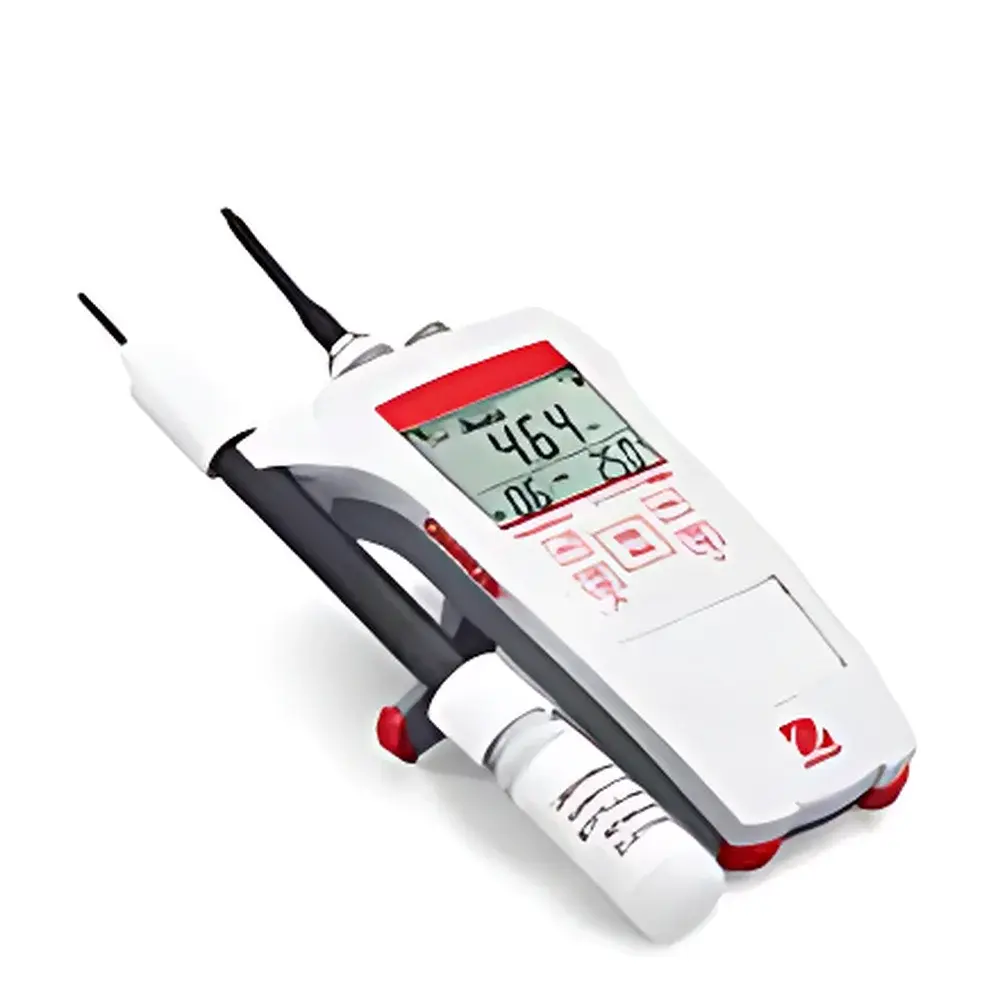
OHAUS STARTER 300D Portable Dissolved Oxygen Meter
| Brand | OHAUS |
|---|---|
| Origin | USA |
| Model | STARTER 300D (ST300D) |
| Instrument Type | Portable |
| Measurement Principle | Galvanic Cell Electrochemical Probe |
| DO Range | 0.00–19.99 mg/L (and 20.0–45.0 mg/L), 0–400% saturation |
| Accuracy | ±0.3 mg/L (DO), ±1% (saturation), ±0.3 °C (temperature) |
| Repeatability | 0.1% |
| Temperature Range | 0–50 °C |
| Resolution | 0.01 mg/L (0–19.99 mg/L), 0.1 mg/L (20–45 mg/L), 0.1 °C |
| Display | LCD |
| Power | 4 × AAA batteries (included) |
| Battery Life | Up to 250 hours |
| Dimensions (H×L×W) | 35 × 170 × 90 mm |
| Weight | 0.16 kg |
| IP Rating | IP54 |
| Data Storage | 30 measurement records |
| Temperature Compensation | Automatic, NTC 30 kΩ sensor |
| Operating Environment | 5–40 °C, ≤80% RH (non-condensing) |
| Included Electrodes | STDO11 dissolved oxygen probe, STTEMP30 temperature probe |
Overview
The OHAUS STARTER 300D Portable Dissolved Oxygen Meter is an engineered solution for field-based and routine water quality assessment, designed specifically for environmental monitoring, wastewater treatment, aquaculture, and educational laboratory applications. It operates on the galvanic cell electrochemical principle—utilizing a self-polarizing, membrane-covered sensor that generates a current proportional to the partial pressure of dissolved molecular oxygen (O₂) in aqueous solution. Unlike polarographic sensors requiring external polarization voltage, the galvanic cell design enables immediate measurement without warm-up time, ensuring operational readiness at any moment. The instrument automatically compensates for temperature and salinity (via manual input), converting raw sensor output into standardized units: mg/L (ppm), % saturation, or partial pressure (kPa or mmHg). Its compact form factor, robust IP54-rated housing, and ergonomic single-hand operation make it suitable for extended outdoor use under variable ambient conditions.
Key Features
- Galvanic cell DO probe (STDO11) with integrated temperature sensor (STTEMP30) for simultaneous, compensated measurements
- True portable architecture: lightweight (0.16 kg), palm-sized footprint (35 × 170 × 90 mm), and 250-hour battery life using standard AAA cells
- IP54-rated enclosure providing protection against dust ingress and water splashes from any direction—validated for field deployment in humid or rain-prone environments
- Intuitive menu-driven interface with backlit LCD display showing DO concentration, % saturation, temperature, and electrode status simultaneously
- No warm-up requirement: measurement begins instantly upon immersion—critical for rapid site surveys and compliance sampling protocols
- Ergonomic design including textured grip surface, recessed keypad layout, and foldable stand for benchtop or angled viewing during handheld use
- Onboard data logging for up to 30 measurement entries, each timestamped and stored with DO value, temperature, and saturation percentage
Sample Compatibility & Compliance
The STARTER 300D is validated for use across freshwater, seawater (with salinity correction), wastewater effluents, and aquaculture ponds. It meets the functional requirements of ASTM D888-22 (“Standard Test Methods for Dissolved Oxygen in Water”) for field-deployable electrochemical methods. While not certified to ISO/IEC 17025 as a standalone analytical system, its measurement traceability aligns with NIST-traceable calibration practices when used with OHAUS-certified standards (e.g., Winkler titration reference solutions or air-saturated water at known temperature/salinity). The device supports GLP-compliant workflows through manual record-keeping of calibration dates, probe serial numbers, and environmental parameters—though it does not include electronic audit trails or 21 CFR Part 11-compliant user authentication.
Software & Data Management
Data retrieval is performed manually via on-screen review and transcription; the STARTER 300D does not feature USB, Bluetooth, or RS-232 connectivity. All stored entries remain accessible until overwritten or cleared. Calibration is conducted using two-point methodology: zero-oxygen (sodium sulfite solution) and air-saturation (temperature-equilibrated ambient air) or water-saturated air standards. The instrument retains calibration coefficients across power cycles. Firmware is non-upgradable—configuration remains fixed per factory specification to ensure long-term measurement stability and regulatory consistency in uncontrolled field settings.
Applications
- Regulatory field sampling for EPA Method 360.1 and equivalent national water quality directives
- Real-time DO profiling in rivers, lakes, and estuaries during ecological assessments
- Process control in municipal and industrial wastewater treatment plants (aeration basin monitoring, effluent discharge verification)
- Health management in aquaculture systems—including hatcheries, recirculating aquaculture systems (RAS), and pond farming
- Undergraduate and graduate teaching labs where durability, simplicity, and pedagogical transparency are prioritized over advanced connectivity
- Benchmarking studies requiring comparative DO mapping across spatially distributed sampling points
FAQ
Does the STARTER 300D support automatic salinity compensation?
No—it requires manual salinity input (0–50 ppt) prior to measurement to correct for ionic strength effects on oxygen solubility.
Can the STDO11 probe be used in high-turbidity or sludge-laden samples?
Yes, but frequent cleaning of the Teflon membrane is recommended to prevent biofouling; the probe is not rated for continuous submersion in abrasive or highly particulate media.
Is calibration verification possible without standard solutions?
Air-saturation verification at known temperature and barometric pressure is acceptable per ASTM D888, provided atmospheric O₂ concentration is assumed at 20.95% and local pressure is entered accurately.
What is the expected service life of the STDO11 galvanic probe?
Typical functional lifespan is 12–18 months under regular field use; performance degradation manifests as reduced slope (60 s to 90% step change).
Does the instrument meet IP67 or higher ingress protection?
No—its IP54 rating confirms limited dust resistance and protection against water splashes only; submersion or high-pressure washing is not supported.







