
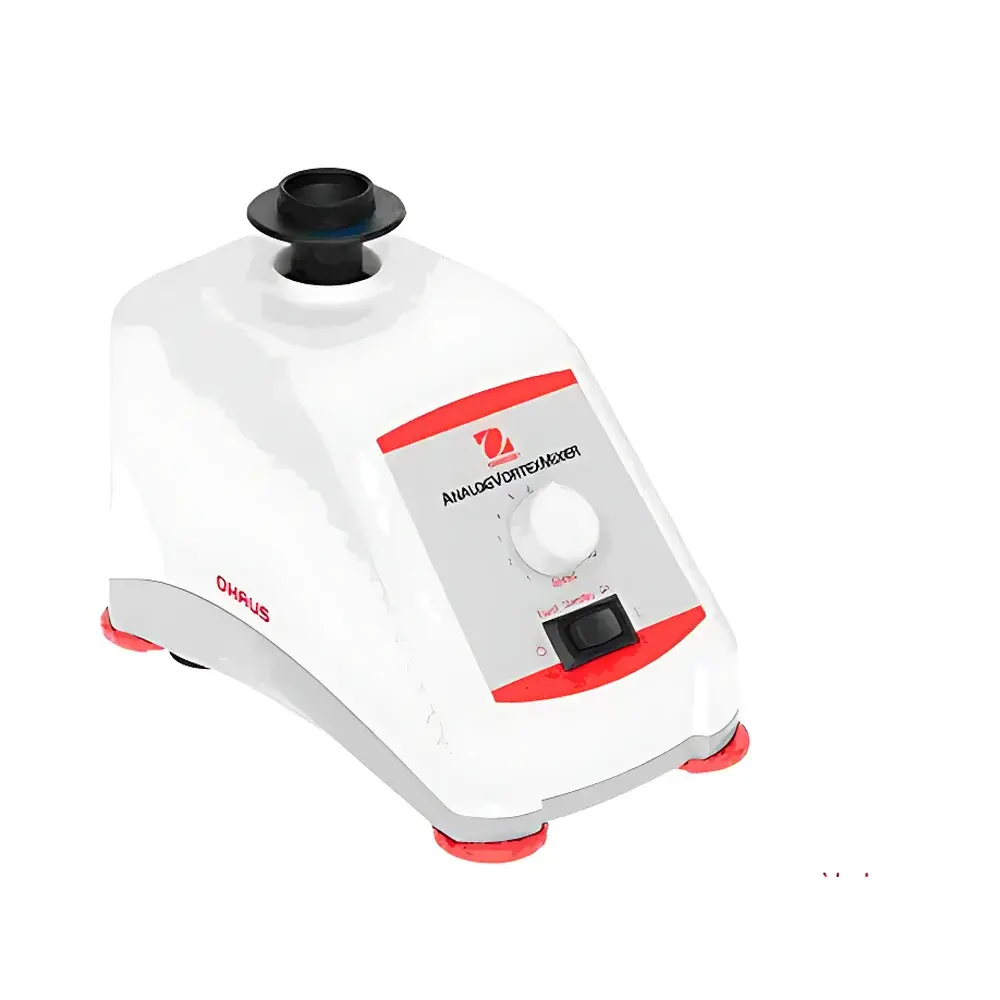
OHAUS VXMNAL Mini Vortex Mixer
| Brand | OHAUS |
|---|---|
| Origin | USA |
| Manufacturer Type | Original Equipment Manufacturer (OEM) |
| Product Category | Imported Instrument |
| Model | VXMNAL |
| Instrument Type | General-Purpose Vortex Mixer |
| Timer Range | 1–999 min |
| Speed Range | 300–2500 rpm |
| Orbit Diameter | 4.9 mm |
| Operating Temperature Range | 4°C–40°C |
| Relative Humidity Range | 20–85% RH (non-condensing) |
| Platform Type | Single 7.6 cm flat platform with conical cup adapter |
| Dimensions (W × D × H) | 16.5 cm × 21.0 cm × 12.3 cm |
| Net Weight | 4.4 kg |
| Power Supply | 230 V, 0.6 A, 50/60 Hz |
| Power Consumption | 135 W |
| Safety Certifications | CE, TÜV |
| Control Mode | Analog (dual independent knobs for speed and timer) |
| Operation Mode | Non-continuous (on-demand) |
| Platform Compatibility | Compatible with beakers, Erlenmeyer flasks, test tubes, microcentrifuge tubes (with optional stainless-steel 12-tube rack), and vials |
Overview
The OHAUS VXMNAL Mini Vortex Mixer is a compact, analog-controlled laboratory vortex shaker engineered for precision re-suspension, homogenization, and rapid mixing of small-volume liquid samples in life science, clinical diagnostics, and pharmaceutical research environments. Utilizing a fixed-orbit eccentric drive mechanism with a 4.9 mm orbital diameter, the instrument generates consistent, reproducible vortex motion across a wide speed range (300–2500 rpm), enabling effective agitation of viscous solutions, cell suspensions, immunoassay reagents, and extraction buffers without sample foaming or splashing when operated within recommended vessel fill levels. Its non-continuous, foot-switch–optional (not included) or manual push-button activation supports on-demand mixing protocols—ideal for workflows requiring intermittent, operator-initiated agitation during multi-step assays such as ELISA, nucleic acid extraction, protein solubilization, and chromatographic sample preparation.
Key Features
- Independent analog control: Dual precision knobs allow simultaneous, tactile adjustment of speed (300–2500 rpm) and timer (1–999 min), eliminating menu navigation and reducing setup time.
- Dedicated dual LED display: Real-time readout of both set speed (rpm) and remaining timer duration provides immediate visual feedback without mode switching.
- Robust mechanical architecture: Heavy-duty motor and balanced eccentric drive ensure long-term stability and minimal vibration transmission to adjacent benchtop equipment.
- Universal platform design: Includes a 7.6 cm diameter flat platform with integrated conical cup for tubes up to 50 mL, plus compatibility with standard glassware (e.g., 15 mL and 50 mL conical tubes, 125 mL Erlenmeyer flasks).
- Lab-grade environmental tolerance: Rated for continuous operation at ambient temperatures from 4°C to 40°C and relative humidity up to 85% RH (non-condensing), supporting use inside cold rooms or near biosafety cabinets.
- Compliance-ready construction: CE and TÜV certified; meets IEC 61010-1 safety requirements for laboratory electrical equipment.
Sample Compatibility & Compliance
The VXMNAL accommodates a broad range of common lab vessels—including polypropylene and glass test tubes (0.2–50 mL), microcentrifuge tubes (0.5–2.0 mL), PCR strips, deep-well plates (with optional adapters), and small-volume flasks—without requiring tube-specific attachments. While not a refrigerated or heated unit, its operational envelope (4°C–40°C) permits placement in temperature-controlled environments where sample integrity must be preserved pre- or post-mixing. The device complies with ISO/IEC 17025 general requirements for calibration traceability of supporting instrumentation and aligns with GLP documentation practices for routine QC mixing steps. It does not incorporate active temperature regulation, and therefore is not intended for applications requiring thermal control during agitation.
Software & Data Management
As an analog-operated instrument, the VXMNAL does not feature embedded software, USB connectivity, or digital data logging capabilities. All operational parameters are set manually and retained only for the duration of the active cycle. This architecture eliminates firmware dependencies, cybersecurity concerns, and validation overhead associated with regulated environments—making it suitable for FDA-regulated labs operating under 21 CFR Part 11 where electronic records are not required for mixing steps. For audit trails, users may record settings manually in lab notebooks or integrate timer activation into SOP-driven paper-based workflows. No driver installation, cloud synchronization, or remote monitoring is supported or necessary.
Applications
- Re-suspension of lyophilized reagents, bacterial pellets, and cryopreserved cells
- Homogenization of tissue lysates and membrane protein extracts prior to centrifugation
- Mixing ELISA plate wells during coating, blocking, and detection steps
- Accelerating solvent-based drug extractions (e.g., solid-phase extraction eluates)
- Equilibrating buffer-additive combinations in formulation development
- Preparing uniform dilutions for qPCR master mixes and NGS library normalization
- Agitating immunoaffinity capture beads in magnetic separation workflows
FAQ
Is the VXMNAL compatible with microcentrifuge tubes?
Yes—when used with the optional stainless-steel 12-position microtube rack (sold separately), the VXMNAL efficiently vortexes 0.5–2.0 mL tubes. Without the rack, direct placement of individual tubes on the conical cup yields reliable results for volumes ≥1.5 mL.
Does this unit support continuous operation?
No—the VXMNAL operates in non-continuous (momentary or timed) mode only. It lacks a “hold” function and automatically stops when the timer expires or the activation button is released.
Can it be used inside a cold room at 4°C?
Yes—its specified operating temperature range includes 4°C, provided ambient humidity remains below 85% RH and condensation does not form on internal components or the platform surface.
What safety certifications does it carry?
The instrument bears CE marking and TÜV certification per IEC 61010-1, confirming compliance with international electrical safety standards for laboratory equipment.
Is calibration required or supported?
OHAUS recommends annual verification of speed accuracy using a calibrated tachometer. No user-accessible calibration routine is provided; field service or authorized calibration labs should perform adjustments if deviation exceeds ±5% of setpoint.



