
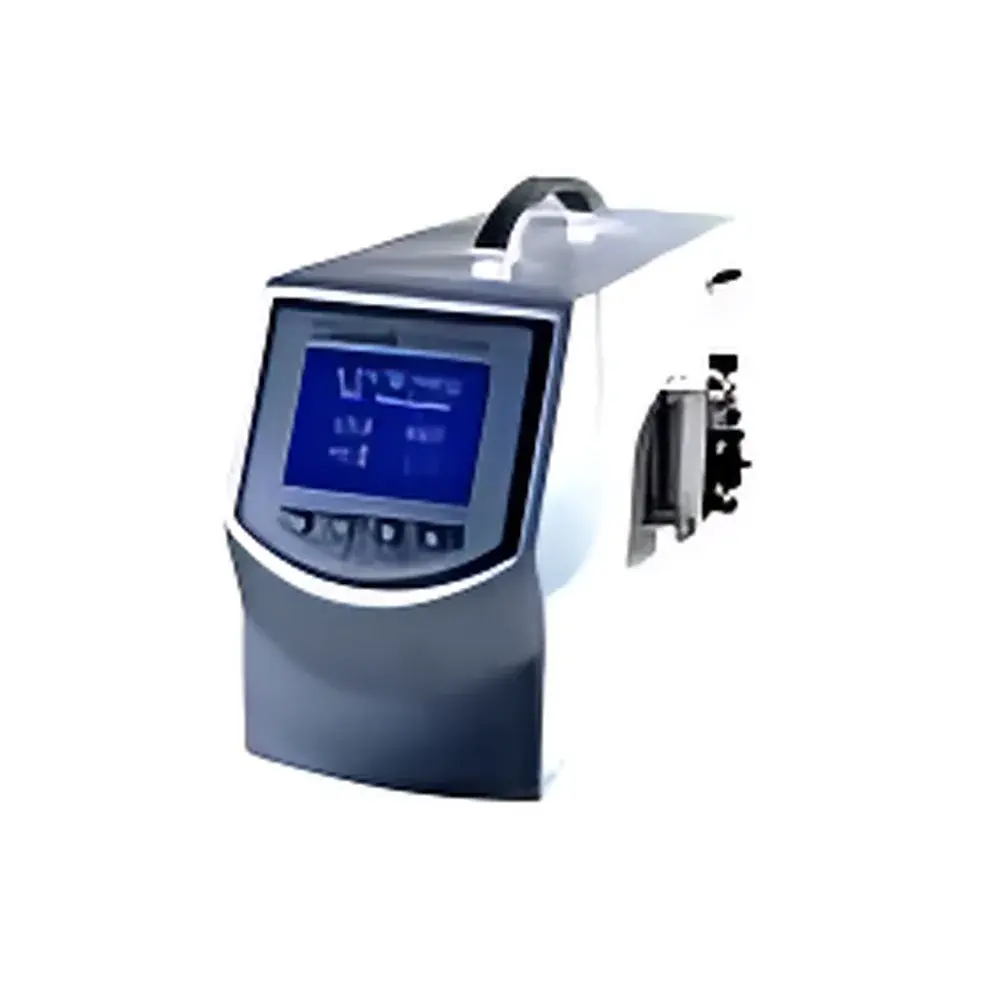
OI Analytical DI1000 Total Organic Carbon Analyzer
| Brand | OI Analytical |
|---|---|
| Origin | Beijing, China |
| Manufacturer Type | Authorized Distributor |
| Country of Origin | China |
| Model | DI1000 |
| Power Supply | AC 220 V ± 10%, 50 Hz ± 1 Hz |
| Rated Power | 100 W (max), 40 W (standby) |
| Dimensions | 440 mm × 180 mm × 260 mm |
| Weight | 10 kg |
| Detection Limit | 0.001 mg/L |
| Quantification Range | 0.001–1.000 mg/L |
| Accuracy | ±5% |
| Repeatability | ≤3% |
| Zero Drift | ±5% |
| Span Drift | ±5% |
| Linearity | ±5% |
| Analysis Time | 4 min per sample |
| Response Time | ≤15 min |
| Sample Temperature Range | 1–95 °C |
| Internal Flow Rate | 0.5 mL/min |
| Relative Humidity | ≤85% RH |
| Display | 320 × 234 pixel full-color TFT LCD |
| Communication Interfaces | RS-232, built-in thermal printer port |
| Data Storage | 12-month continuous logging with date/time stamping |
| Compliance | USP <643>, Ph. Eur. 2.2.44, ChP TOC method |
Overview
The OI Analytical DI1000 Total Organic Carbon Analyzer is a compact, benchtop ultraviolet (UV) persulfate oxidation–conductivity detection system engineered for high-precision quantification of total organic carbon (TOC), total inorganic carbon (TIC), and total carbon (TC) in ultrapure water and low-conductivity aqueous matrices. It operates on the principle of catalytic UV oxidation: dissolved organic compounds are photochemically mineralized to CO2 under 185/254 nm UV irradiation in the presence of persulfate, followed by selective CO2 detection via high-sensitivity, temperature-compensated conductivity measurement. The instrument calculates TOC as the arithmetic difference between TC and TIC—where TIC is measured in a parallel acidification–sparging step prior to oxidation. This dual-measurement architecture ensures trace-level accuracy without interference from carbonate/bicarbonate equilibria, making the DI1000 particularly suited for pharmaceutical water systems (PW, WFI, Purified Water), semiconductor rinse water, and power plant condensate monitoring.
Key Features
- Reagent-free operation: Eliminates requirement for acid reagents, carrier gases, or chemical oxidants—only UV lamp and peristaltic pump tubing require periodic replacement.
- Pharmaceutical-grade validation support: Preconfigured system suitability test protocols aligned with USP , Ph. Eur. 2.2.44, and Chinese Pharmacopoeia TOC methodology—including sucrose and 1,4-benzoquinone challenge tests, oxidation efficiency verification, and system blank assessment.
- Low-power, space-efficient design: 10 kg footprint (440 × 180 × 260 mm) with standby power consumption of only 40 W; suitable for laminar flow hoods, cleanroom utility cabinets, and mobile QC labs.
- Real-time data integrity: Onboard non-volatile memory stores 12 months of timestamped results (TOC, TIC, TC, date/time, operator ID); supports audit-ready export via RS-232 to LIMS or SCADA systems.
- Integrated alarm management: Programmable upper-limit TOC threshold with relay output for process interlock or PLC notification—compliant with GMP alarm classification requirements.
- Optimized for ultrapure water: Dedicated low-conductivity cell design minimizes background noise; automatic compensation for sample temperature (1–95 °C) and conductivity drift ensures stability across variable feed conditions.
Sample Compatibility & Compliance
The DI1000 is validated for use with Type I ultrapure water (resistivity ≥18.2 MΩ·cm), purified water (PW), water for injection (WFI), and steam condensate per ISO 8573-1, ASTM D5127, and EP 2.2.44. It meets the performance criteria for TOC analyzers specified in FDA 21 CFR Part 11 when operated with enabled electronic signature and audit trail functions (via optional software module). All calibration, system suitability, and maintenance records are stored with immutable timestamps and user attribution—supporting GLP/GMP documentation requirements for regulated environments. The instrument’s electrical safety complies with IEC 61010-1; electromagnetic compatibility conforms to IEC 61326-1 Class A.
Software & Data Management
Data acquisition and reporting are managed through an embedded real-time operating system with a 320 × 234-pixel full-color TFT display and intuitive icon-driven interface. No external PC is required for routine operation. All measurements include automatic calculation of %RSD, recovery rates, and deviation from setpoint. Raw conductivity signals, oxidation kinetics curves, and sparging profiles are accessible for root-cause analysis. Export formats include CSV and fixed-width ASCII via RS-232; optional firmware upgrade enables HL7 or OPC-UA protocol support for enterprise integration. Audit trails record every critical event—including method changes, calibration entries, alarm triggers, and user logins—with tamper-evident hashing.
Applications
- Pharmaceutical manufacturing: Continuous TOC monitoring of PW/WFI distribution loops per EU Annex 1 and FDA guidance on water system qualification.
- Semiconductor fab utilities: Real-time detection of organic contamination in UPW used for wafer rinsing and photolithography.
- Power generation: Condensate polishing loop surveillance to prevent organic-induced corrosion in steam cycles.
- Research laboratories: Method development for low-level TOC quantification in environmental reference materials and synthetic standards.
- Contract testing labs: High-throughput batch analysis of purified water samples under ISO/IEC 17025-accredited procedures.
FAQ
What oxidation method does the DI1000 employ?
It uses low-pressure mercury UV lamps (185 nm + 254 nm) with sodium persulfate as a co-oxidant to achieve >90% oxidation efficiency for refractory organics such as ethanolamine and EDTA.
Can the DI1000 perform online, unattended operation?
Yes—it supports continuous flow mode with programmable sampling intervals (1–60 min), integrated auto-flush cycles, and remote status monitoring via dry-contact alarms and RS-232 polling.
Is the conductivity detector temperature-compensated?
Yes—the cell incorporates a Pt100 RTD sensor and applies NIST-traceable temperature correction algorithms to maintain ±0.02 µS/cm baseline stability over 1–95 °C.
How often must the UV lamp be replaced?
Lamp lifetime is rated at ≥12,000 hours; typical replacement interval is 12–18 months under continuous operation, with onboard usage-hour tracking and predictive maintenance alerts.
Does the instrument meet FDA 21 CFR Part 11 requirements?
When configured with password-protected user roles, electronic signatures, and full audit trail logging (enabled via firmware v3.2+), it satisfies Part 11 technical controls for electronic records and signatures in regulated environments.
Related Products







