
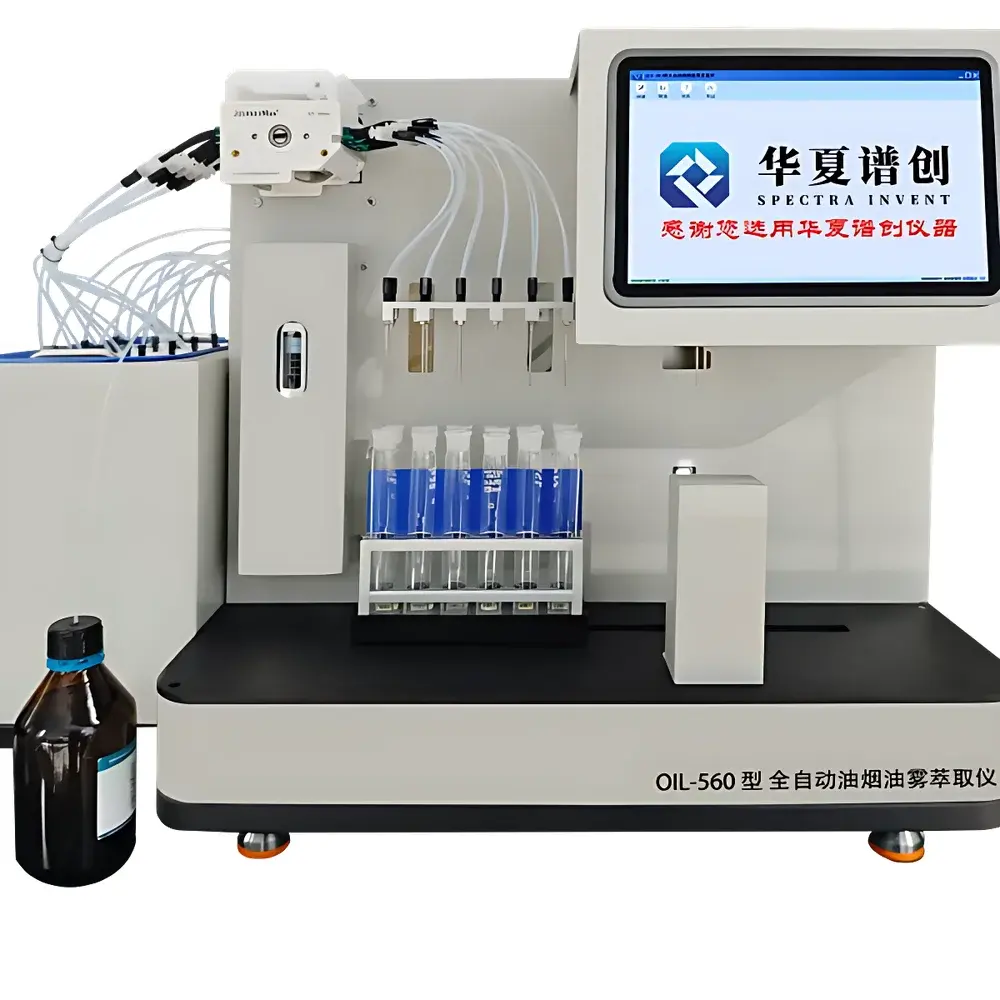
OIL-560 Automated Oil Fume and Oil Mist Extraction & Analysis System
| Brand | Spectra Invent |
|---|---|
| Origin | Zhejiang, China |
| Model | OIL-560 |
| Portability | Portable |
| Detection Principle | Infrared Spectrophotometry (Triple-Wavelength Absorption at 2930 cm⁻¹, 2960 cm⁻¹, 3030 cm⁻¹) |
| Sample Processing Capacity | 12-position automated extraction |
| Interface | 10-inch Windows-based touch display |
| Compliance | Designed for EPA Method 202 / HJ 637-2018 / ISO 12103-1 (adapted) |
| Application Scope | Stationary source emission monitoring, kitchen exhaust, metalworking fluid mist, food processing fumes |
Overview
The Spectra Invent OIL-560 Automated Oil Fume and Oil Mist Extraction & Analysis System is an integrated laboratory-grade instrument engineered for standardized, high-throughput quantification of total hydrocarbon-based aerosols—specifically cooking oil fumes and industrial oil mists—in stationary source exhaust streams. It implements the infrared spectrophotometric method defined in China’s HJ 637–2018 standard and aligns with the technical framework of U.S. EPA Method 202 for semi-volatile organic particulate matter. The system automates the full analytical workflow: solvent addition (tetrachloroethylene), ultrasonic-assisted extraction from pre-weighed glass fiber filter cartridges, quantitative transfer of extract, and spectral acquisition at three critical wavenumbers (2930 cm⁻¹, 2960 cm⁻¹, 3030 cm⁻¹). These absorbance values (A2930, A2960, A3030) are used in a calibrated matrix equation to compute total oil fume concentration (mg/m³), correcting for CH2, CH3, and aromatic C–H contributions. Unlike manual or semi-automated systems, the OIL-560 eliminates operator-induced variability in extraction time, solvent volume, and transfer efficiency—ensuring reproducibility required for regulatory reporting and QA/QC audits.
Key Features
- 12-position fully automated extraction module: Simultaneously processes up to 12 standard EPA/GB-compliant glass fiber filter cartridges (e.g., Whatman GF/F or equivalent), enabling batch analysis for stack testing campaigns.
- Programmable reagent dispensing: Precise delivery of tetrachloroethylene (or alternative IR-transparent solvent per method adaptation) with ±1% volumetric accuracy across all positions.
- Controlled ultrasonic extraction: Adjustable frequency (40 kHz), power (50–200 W), and duration (1–30 min) to optimize recovery of both volatile and semi-volatile triglyceride esters and mineral oil fractions.
- Automated liquid handling: Integrated peristaltic pumps and valve manifolds perform extract transfer, dilution (if required), and cell filling for FTIR or dedicated IR spectrometer coupling.
- Self-cleaning fluidic pathway: Post-run solvent flush and air purge sequence minimizes cross-contamination between samples and extends system longevity.
- 10-inch industrial-grade Windows touchscreen: Rugged capacitive interface with glove-compatible operation; embedded control firmware supports offline method storage, real-time status monitoring, and audit trail logging.
Sample Compatibility & Compliance
The OIL-560 accommodates standard 47-mm or 90-mm diameter glass fiber filters used in EPA Method 202, HJ 637–2018, and GB/T 16157–1996 sampling protocols. It is validated for use with emissions from commercial kitchen hoods, frying operations, metal machining coolant mists, and thermal processing exhausts containing vegetable, animal, or synthetic lubricant aerosols. While not certified to ISO/IEC 17025 by default, the system’s hardware architecture and software logging capabilities support GLP-compliant deployment when integrated into accredited laboratories. Data integrity features—including user authentication, electronic signatures, and immutable timestamped audit logs—align with FDA 21 CFR Part 11 expectations for regulated environments requiring traceable analytical records.
Software & Data Management
The embedded Windows OS hosts Spectra Invent’s OIL-Analyzer Suite v3.x—a dedicated application for method configuration, run scheduling, spectral acquisition, and concentration calculation. Raw absorbance data (A2930, A2960, A3030) are stored in .CSV and .XML formats compliant with LIMS import requirements. Calibration curves are managed via polynomial or multi-point linear regression with residual error reporting. All instrument actions—including solvent dispense volumes, ultrasonic cycle parameters, and cleaning sequences—are logged with ISO 8601 timestamps and operator ID. Export options include PDF reports with embedded spectra, QC charts (control charting per ASTM D6708), and raw spectral files compatible with third-party chemometric tools (e.g., MATLAB, Unscrambler).
Applications
- Regulatory compliance testing for municipal and provincial environmental protection bureaus conducting routine inspections of catering establishments under China’s GB 18483–2001.
- Occupational hygiene assessments in machine shops, forging facilities, and automotive manufacturing lines where metalworking fluid mist exposure must be evaluated against OSHA PEL or ACGIH TLV limits.
- Research studies on aerosol formation mechanisms during high-temperature food preparation, including oxidation product profiling and particle size distribution correlation.
- Method validation and inter-laboratory comparison exercises within national metrology institutes or reference material producers developing certified oil fume standards.
- Pre-compliance screening for industrial clients preparing for ISO 14001 certification or ESG reporting on air emission inventories.
FAQ
Does the OIL-560 include an integrated infrared spectrometer?
No—the OIL-560 is an automated sample preparation system only. It prepares extracts for analysis on external FTIR or dedicated mid-IR spectrometers compliant with HJ 637–2018 spectral resolution requirements (≤4 cm⁻¹). Optional integration kits are available for select PerkinElmer and Thermo Fisher models.
Can it process filters collected using isokinetic sampling trains?
Yes—filter cartridges mounted in standard EPA Method 5 or Method 17 holders are directly compatible after removal and placement in the OIL-560’s filter cradles.
Is tetrachloroethylene the only supported extraction solvent?
The system is calibrated for tetrachloroethylene per HJ 637–2018, but method adaptation protocols for alternatives (e.g., carbon disulfide or cyclohexane) can be implemented with revalidation of calibration matrices and recovery studies.
What maintenance intervals are recommended?
Ultrasonic bath degassing every 48 hours; solvent line filtration every 200 runs; annual verification of pump calibration and valve actuation timing per manufacturer’s PM checklist.
Is remote monitoring or network connectivity supported?
Yes—Ethernet and optional Wi-Fi enable secure remote access via VPN for system diagnostics, log review, and method updates, meeting IT security policies in centralized lab networks.
Related Products







