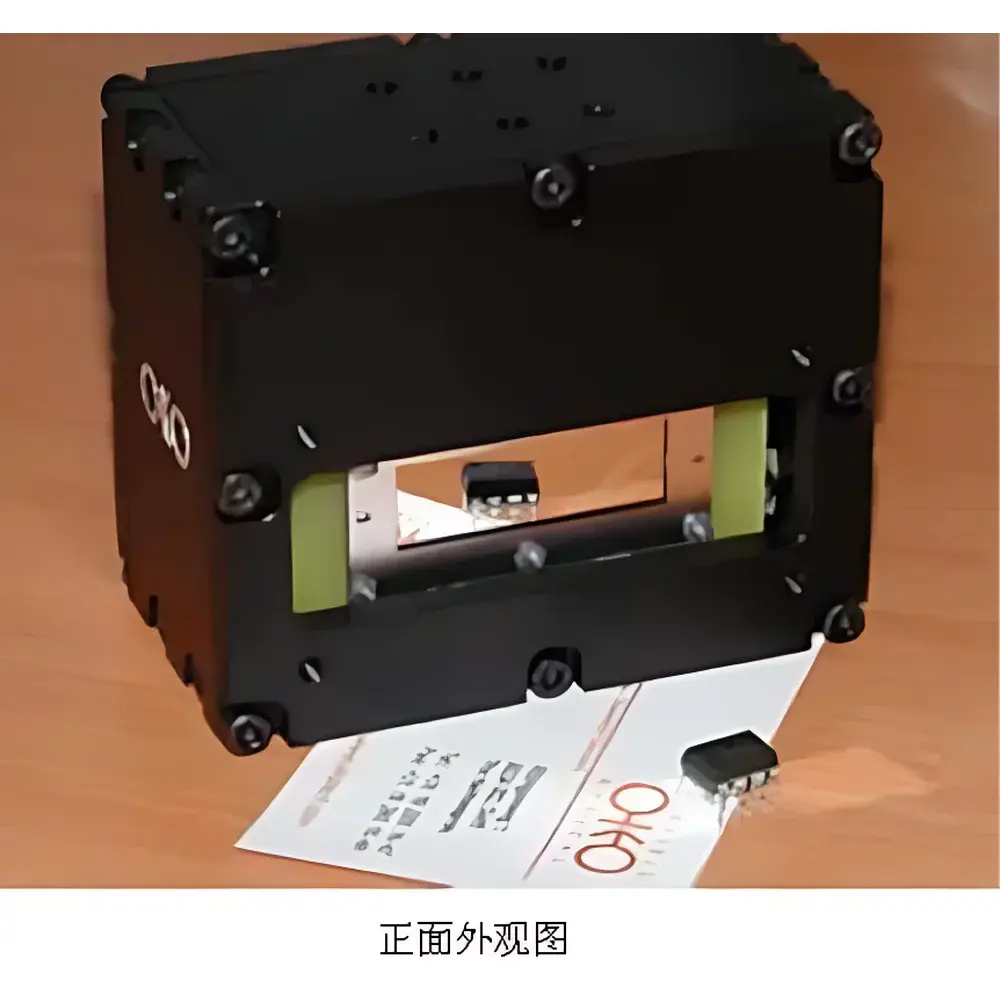
OKO 11×39 mm Linear Micro-Mechanical Deformable Mirror (MMDM)
| Origin | Netherlands |
|---|---|
| Manufacturer Type | Authorized Distributor |
| Import Status | Imported |
| Model | Linear Micro-Mechanical Deformable Mirror (MMDM) |
| Aperture Shape | Rectangular |
| Coating Material | Metallic or Metallic + Dielectric |
| Aperture Size | 11 × 39 mm |
| Actuator Count | 19 or 38 |
| Drive Voltage Range | 0–300 V |
| Surface Figure Error (RMS, Flat/Cylindrical) | <1 µm |
| Maximum Central Displacement | 10 µm |
| Mass | 500 g |
Overview
The OKO 11×39 mm Linear Micro-Mechanical Deformable Mirror (MMDM) is a high-precision adaptive optics component engineered for real-time wavefront correction and ultrafast pulse shaping in advanced laser systems. Based on monolithic micro-machined silicon architecture with electrostatic actuation, this MMDM operates on the principle of localized surface deformation induced by voltage-controlled electrostatic forces between fixed electrodes and a continuous, reflective membrane. Its linear actuator array—configured in either 19- or 38-channel variants—enables controlled, sub-micron-resolution phase modulation along a single spatial dimension, making it especially suited for spectral phase control in chirped-pulse amplification (CPA) systems and dispersion compensation in femtosecond oscillator-amplifier chains. Unlike segmented or piezoelectric mirrors, the MMDM’s continuous membrane design ensures diffraction-limited wavefront fidelity and eliminates inter-actuator discontinuities, supporting high-Strehl-ratio beam correction and stable temporal pulse reconstruction.
Key Features
- Rectangular optical aperture of 11 × 39 mm, optimized for horizontal beam expansion in CPA compressors and stretcher geometries.
- Two configurable actuator densities: 19-channel for coarse, low-order phase correction; 38-channel for higher spatial frequency compensation including third- and fourth-order dispersion terms.
- Electrostatic drive architecture enabling fast response times (<100 µs settling) and zero hysteresis, critical for closed-loop adaptive optics with kHz-bandwidth feedback.
- Surface figure error <1 µm RMS in both flat and cylindrical reference states—verified via interferometric calibration traceable to NIST-traceable standards.
- Maximum central displacement of 10 µm under full 300 V bias, providing sufficient dynamic range for compensating up to ±500 fs² of group delay dispersion (GDD) in Ti:sapphire amplifier systems.
- Reflective coating options include protected aluminum (broadband UV–NIR), enhanced silver (650–1100 nm), or custom dielectric stacks for specific laser wavelengths (e.g., 1030 nm Yb-based systems).
- Robust mechanical housing with kinematic mounting interface (M4 threaded holes on baseplate) and vacuum-compatible construction (outgassing rate <1×10⁻⁹ Pa·m³/s per ASTM E595).
Sample Compatibility & Compliance
The OKO MMDM is compatible with standard optical breadboard mounting (30 mm or 50 mm rail systems) and integrates seamlessly into commercial ultrafast laser platforms including Coherent Astrella, Spectra-Physics Solstice, and Light Conversion Pharos/Carbo systems. It meets ISO 10110-7 surface quality specifications (scratch-dig 20–10) and complies with RoHS 2011/65/EU directives. All units undergo factory calibration with interferometric verification of actuator coupling matrix and cross-talk <3% between adjacent channels. Device documentation includes full metrology reports compliant with ISO/IEC 17025 requirements for accredited calibration laboratories.
Software & Data Management
The mirror is supported by OKO’s proprietary MMDM Control Suite v4.2, a Windows/Linux-compatible application providing real-time voltage mapping, Zernike mode decomposition, and closed-loop operation via external wavefront sensor input (Hartmann-Shack or interferometric). The software exports actuator voltage tables in ASCII and HDF5 formats, supports scripting via Python API (pyOKO), and logs all operational parameters—including timestamped voltage history, thermal drift compensation values, and system health diagnostics—with audit trail functionality aligned with FDA 21 CFR Part 11 requirements for regulated R&D environments. Firmware updates are delivered via secure HTTPS with SHA-256 signature verification.
Applications
- Pulse compression and spectral phase shaping in femtosecond Ti:sapphire and Yb-doped fiber laser systems.
- Adaptive correction of low-to-mid-spatial-frequency aberrations in multi-pass amplifier cavities and regenerative amplifiers.
- Dynamic wavefront tuning in optical parametric chirped-pulse amplification (OPCPA) pump beam conditioning.
- Beam collimation stabilization in high-power industrial laser delivery lines subject to thermal lensing drift.
- Research-grade wavefront engineering for coherent control experiments, attosecond pulse generation, and nonlinear microscopy.
FAQ
What is the maximum operating voltage, and is overvoltage protection built in?
The absolute maximum drive voltage is 300 V DC or peak AC. The integrated driver board includes active current limiting and hardware-level overvoltage cutoff at 310 V to prevent membrane pull-in failure.
Can this MMDM be used in vacuum or UHV environments?
Yes—the device is rated for operation down to 1×10⁻⁶ mbar. Optional bake-out compatible versions (up to 120 °C) are available upon request with certified outgassing data.
Is there cross-talk between adjacent actuators, and how is it characterized?
Cross-talk is measured interferometrically and remains below 3% for nearest neighbors; full coupling matrix characterization is provided with each unit.
Does the mirror support analog or digital control interfaces?
Both: 16-bit analog voltage inputs (±10 V range) and USB 2.0 digital command interface with real-time streaming capability at up to 1 kHz update rate.
How is thermal stability maintained during extended operation?
The baseplate incorporates copper heat-spreading layers and optional thermistor feedback for closed-loop temperature regulation (±0.1 °C stability), minimizing thermal drift-induced wavefront error.