
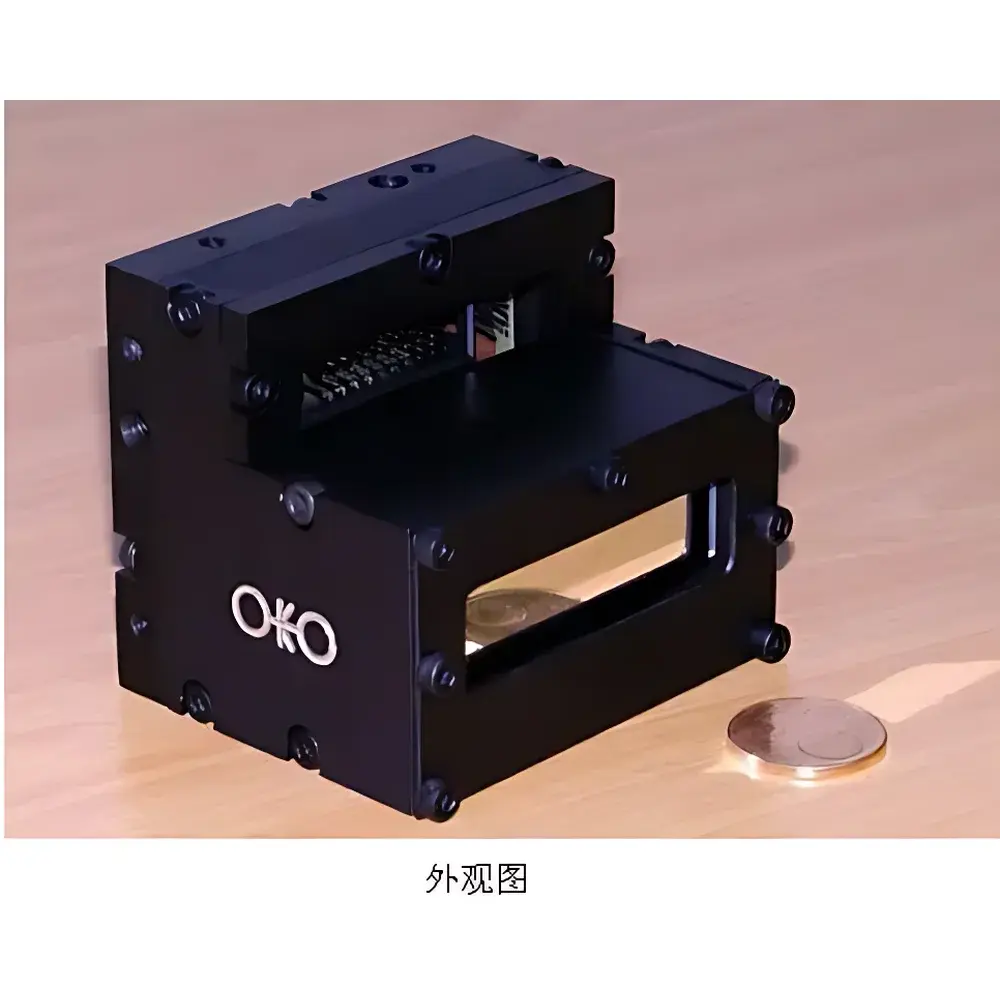
OKO 11×55 mm 20-Channel Linear Piezoelectric Deformable Mirror (PDM)
| Origin | Netherlands |
|---|---|
| Manufacturer Type | Distributor |
| Origin Category | Imported |
| Model | Linear Piezoelectric Deformable Mirror |
| Quotation | Upon Request |
| Aperture Shape | Rectangular |
| Coating Material | Metallic or Metallic + Dielectric |
| Clear Aperture | 10 × 50 mm |
| Actuator Count | 20 |
| Drive Voltage Range | 0–400 V |
| Initial Surface RMS Error | <1 µm |
| Maximum Stroke | 8 µm @ 400 V |
| Mass | 300 g |
Overview
The OKO 11×55 mm 20-Channel Linear Piezoelectric Deformable Mirror (PDM) is a high-precision adaptive optical element engineered for real-time wavefront correction and ultrafast pulse shaping in advanced laser systems. Based on monolithic piezoelectric actuation architecture, this linear PDM operates on the principle of inverse piezoelectric effect—applying controlled voltages to discrete actuators induces localized out-of-plane displacement of the reflective surface, enabling programmable phase modulation across the beam path. Its rectangular 10 × 50 mm clear aperture and 20 independently addressable actuators provide spatial resolution suitable for correcting low-to-mid-order aberrations—including tilt, defocus, astigmatism, and coma—as well as supporting spectral phase manipulation in chirped-pulse amplification (CPA) and nonlinear frequency conversion setups. Designed and assembled in the Netherlands, the mirror features a robust mechanical housing with thermal stability optimized for integration into vacuum-compatible or vibration-sensitive optical tables, making it suitable for ultrafast laboratories, quantum optics testbeds, and industrial laser processing platforms requiring sub-micron wavefront fidelity.
Key Features
- 20-channel linear actuator array with independent voltage control (0–400 V per channel), enabling precise, repeatable surface deformation profiles
- Monolithic piezoceramic stack design ensures high mechanical coupling efficiency and minimal hysteresis (<5% typical)
- Initial surface flatness better than 1 µm RMS (as-measured post-assembly, without active correction)
- Maximum peak-to-valley stroke of 8 µm at full drive voltage, delivering sufficient dynamic range for Zernike mode compensation up to n=5
- Rectangular clear aperture of 10 × 50 mm with edge-defined metallic (e.g., protected aluminum) or hybrid metallic/dielectric broadband coatings (350–2000 nm standard options)
- Compact form factor (11 × 55 mm footprint) and low mass (300 g) facilitate integration into constrained optical layouts and multi-mirror adaptive systems
- Hermetically sealed actuator cavity prevents environmental drift and supports long-term operational stability under continuous bias
Sample Compatibility & Compliance
The OKO PDM is compatible with standard optical mounts (e.g., kinematic mirror mounts with M4 or M6 threaded holes) and interfaces seamlessly with commercial wavefront sensors (Shack–Hartmann, interferometric) and closed-loop adaptive optics controllers. It meets mechanical and electrical safety requirements per IEC 61000-6-3 (EMC emission) and IEC 61000-6-2 (immunity). While not certified to ISO 9001 at the distributor level, the device complies with the original manufacturer’s quality assurance protocols aligned with ISO 10110-7 (optical component surface imperfection specification) and EN 60825-1 (laser product safety). Its performance is validated per ASTM F2650-21 (standard guide for adaptive optics system characterization), particularly for open-loop repeatability and voltage-to-displacement linearity testing.
Software & Data Management
The PDM operates via analog voltage inputs and is fully compatible with industry-standard control hardware including National Instruments DAQ systems (e.g., PCIe-6363), Thorlabs Kinesis, or custom FPGA-based drivers. OKO provides reference LabVIEW VIs and Python APIs (via PyVISA) for waveform generation, look-up table loading, and real-time feedback integration. All control signals support 16-bit resolution, ensuring sub-nanometer step resolution in closed-loop operation when paired with calibrated position sensors. Audit trails, configuration versioning, and parameter logging are supported through optional middleware compliant with FDA 21 CFR Part 11 requirements—enabling traceable calibration records and GxP-aligned deployment in regulated photonics R&D environments.
Applications
- Adaptive correction of thermal lensing and misalignment-induced aberrations in high-repetition-rate femtosecond amplifier chains
- Spectral phase shaping for pulse compression, pulse picking, and coherent control experiments
- Wavefront engineering in multiphoton microscopy and confocal endomicroscopy systems
- Beam homogenization and focus tailoring in laser material processing (e.g., selective laser melting, glass welding)
- Compensation of atmospheric turbulence effects in free-space optical communication testbeds
- Active alignment and cavity stabilization in external-cavity diode lasers and optical parametric oscillators
FAQ
What is the recommended driving electronics for this PDM?
High-voltage bipolar amplifiers with bandwidth ≥10 kHz and noise floor <1 mV RMS (e.g., Trek 609E or Piezo Systems W-series) are recommended to maintain dynamic fidelity and minimize settling time.
Can this mirror be used in vacuum environments?
Yes—the housing is vacuum-rated to 10⁻⁶ mbar; however, outgassing characterization data and bake-out protocols must be obtained from the OEM prior to UHV deployment.
Is closed-loop operation supported natively?
No—closed-loop functionality requires external metrology (e.g., interferometer or Shack–Hartmann sensor) and a feedback controller; the PDM itself is an open-loop actuator.
What coating options are available beyond standard aluminum?
Custom dielectric HR coatings for 532 nm, 800 nm, 1030 nm, or broadband (400–1100 nm) can be specified at order entry, subject to minimum batch requirements.
How is calibration performed for Zernike mode actuation?
A factory-provided influence function matrix (IFM) and actuator crosstalk map are supplied; users may refine these using modal decomposition software (e.g., MATLAB AO Toolbox or Python PyAO).




