
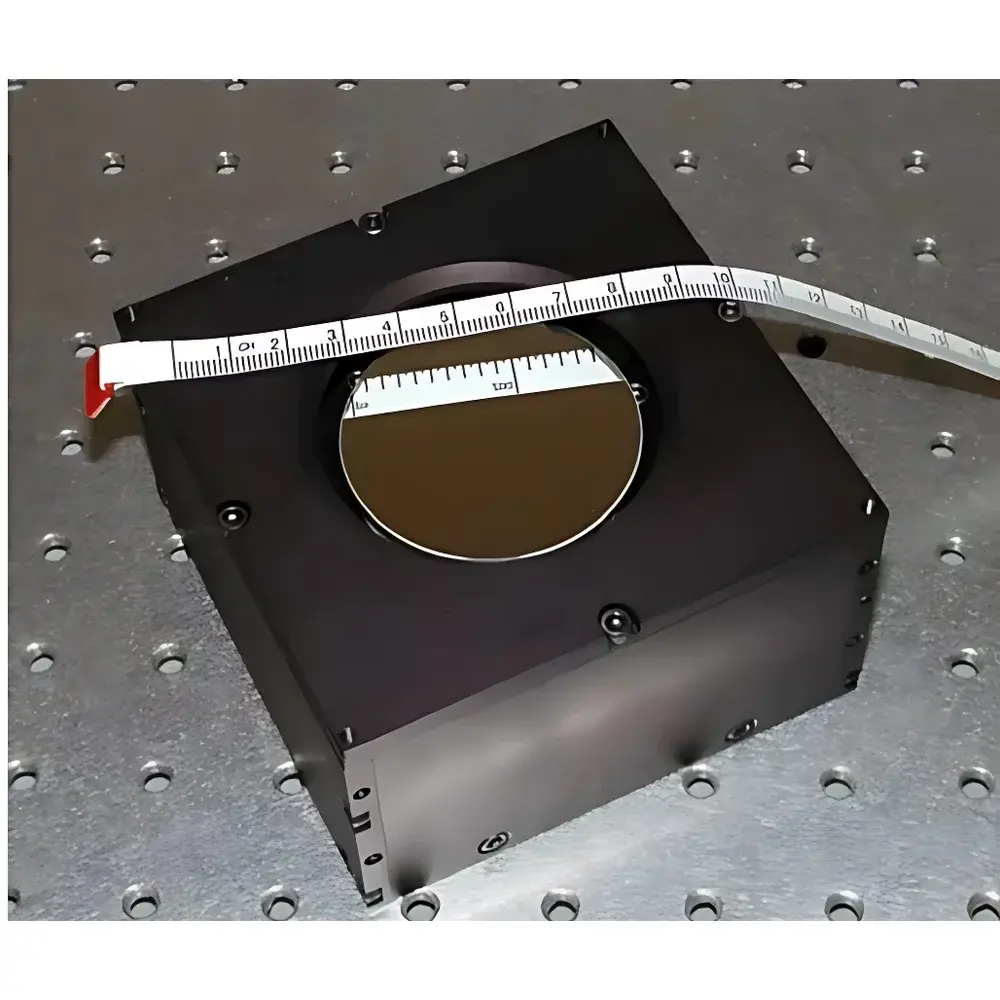
OKO N50mm 37/79/109-Channel Piezoelectric Deformable Mirror (PDM)
| Origin | Netherlands |
|---|---|
| Manufacturer Type | Authorized Distributor |
| Import Status | Imported |
| Model | Piezoelectric Deformable Mirror |
| Pricing | Upon Request |
| Aperture Shape | Circular |
| Coating Material | Metallic or Metallic + Dielectric |
| Aperture Diameter | 50 mm |
| Actuator Count | 37 / 79 / 109 |
| Drive Voltage Range | 0–400 V |
| Maximum Surface Deformation | 8 µm @ 400 V |
| Mass | 650 g |
Overview
The OKO N50mm Piezoelectric Deformable Mirror (PDM) is a high-precision adaptive optics component engineered for real-time wavefront correction in demanding optical systems. Based on monolithic piezoelectric actuation architecture, it enables closed-loop compensation of low- to mid-spatial-frequency aberrations—including defocus, astigmatism, spherical aberration, and coma—by dynamically reshaping its reflective surface in response to applied voltage signals. Designed and manufactured in the Netherlands, this PDM integrates a continuous-faceplate mirror substrate bonded to an array of co-located piezoceramic actuators, delivering nanometer-level surface control fidelity with sub-millisecond mechanical response time. Its 50 mm clear aperture and robust mechanical design support integration into laser cavities, astronomical adaptive optics benches, ophthalmic imaging platforms (e.g., AO-SLO and AO-OCT), and high-resolution display calibration systems where stability, repeatability, and vacuum compatibility are critical.
Key Features
- Three configurable actuator densities: 37-channel (coarse correction), 79-channel (balanced resolution/stability), and 109-channel (high-fidelity wavefront shaping) — all sharing identical mechanical footprint and electrical interface.
- Continuous, optically polished metallic or hybrid metallic/dielectric coating optimized for broadband reflectivity (UV–NIR, customizable per application).
- High-voltage drive capability (0–400 V) enabling up to 8 µm peak-to-valley surface deformation, calibrated and traceable under ISO 10110-5 surface form metrology protocols.
- Low hysteresis (< 3% full-scale) and excellent long-term positional stability (< 0.5 nm/h drift under constant bias), verified per ISO 21254–1 for optical component reliability.
- Compact, rigid aluminum housing with integrated thermal management and kinematic mounting interface compliant with standard Ø50 mm lens tube and optical cage systems.
- No internal electronics — designed for seamless integration with industry-standard high-voltage DACs (e.g., OKO’s DM Controller Series or third-party systems supporting ±10 V analog input and TTL synchronization).
Sample Compatibility & Compliance
The OKO N50mm PDM is compatible with both collimated and convergent beam geometries and supports operation in ambient, controlled cleanroom (ISO Class 5), and moderate vacuum environments (≤10⁻³ mbar). Its metallic/dielectric coatings meet MIL-C-48497A spectral durability requirements and pass ASTM B117 salt-spray testing for corrosion resistance. The device complies with RoHS 2015/863/EU and REACH SVHC regulations. While not certified as medical device hardware per FDA 21 CFR Part 820, it is routinely deployed in Class I and IIa ophthalmic research instruments subject to ISO 13485 quality system audits. Full mechanical drawings, coating spectral data, and voltage–displacement calibration matrices are supplied with each unit for GLP/GMP traceability.
Software & Data Management
The PDM operates as a hardware component within established adaptive optics control frameworks. It is fully supported by OKO’s open-architecture DM Control Software Suite (v4.2+), which provides real-time Zernike mode decomposition, modal basis mapping, and closed-loop Shack–Hartmann feedback integration. The software exports configuration files in HDF5 format and supports API access via Python (PyOKO) and MATLAB (OKO-MAT) toolboxes. All control commands, voltage logs, and timestamped actuator state histories are recorded with microsecond precision and include embedded metadata compliant with FAIR data principles. Audit trails meet FDA 21 CFR Part 11 requirements when used with validated electronic signature modules and network-attached secure storage.
Applications
- Astronomical adaptive optics: Tip/tilt and higher-order correction in laser guide star systems and segmented telescope wavefront control loops.
- Ophthalmic research: Dynamic aberration correction in confocal scanning laser ophthalmoscopy (cSLO) and adaptive optics optical coherence tomography (AO-OCT) for cellular-resolution retinal imaging.
- Industrial laser processing: Beam shaping and focus stabilization in ultrafast laser micromachining and EUV lithography illumination systems.
- Free-space optical communications: Atmospheric turbulence mitigation in ground-to-satellite and inter-satellite links.
- Microscopy & holography: Phase modulation in digital holographic microscopy and programmable point-spread-function engineering.
FAQ
What is the recommended driving electronics for this PDM?
OKO recommends using high-voltage bipolar amplifiers with ≥100 V/µs slew rate and noise floor < 1 mV RMS (e.g., OKO HV-700 series or Thorlabs MDT694B). All models support standard ±10 V analog input with optional TTL-triggered frame sync.
Is vacuum-compatible packaging available?
Yes — optional UHV-compatible versions (with non-outgassing adhesives, gold-coated housing, and ceramic feedthroughs) are available upon request and qualified to ISO 14644–1 Class 4 cleanroom assembly standards.
Can the PDM be used with Shack–Hartmann wavefront sensors?
Yes — the device includes factory-measured influence functions and Zernike coupling matrices required for direct integration into commercial and custom Shack–Hartmann-based AO systems.
What is the typical lifetime under continuous operation?
Accelerated life testing per IEC 60747–17 indicates >1 × 10⁹ actuation cycles at 400 V with 10 years of daily lab use under nominal conditions.
Do you provide OEM integration support?
Yes — OKO offers mechanical, electrical, and firmware co-design services including custom mounting flanges, embedded controller integration, and application-specific calibration reports aligned with ISO/IEC 17025 accredited laboratories.




