OL459 Tunable LED Spectral Standard Source
| Brand | Optronic Laboratories |
|---|---|
| Origin | USA |
| Manufacturer Type | Authorized Distributor |
| Import Status | Imported |
| Model | OL459 |
| Pricing | Available Upon Request |
Overview
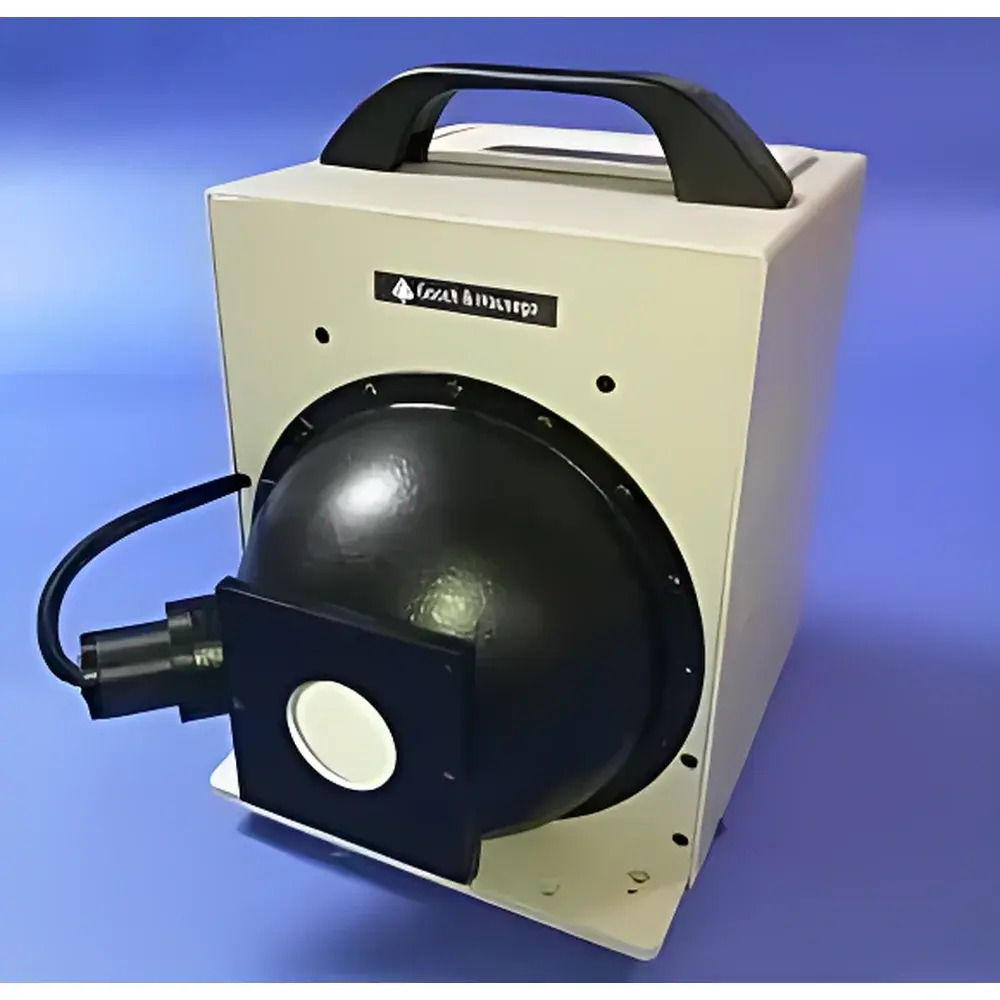
The OL459 Tunable LED Spectral Standard Source is a precision-engineered radiometric and photometric calibration instrument designed for traceable, repeatable spectral irradiance and radiance generation across the visible (380–780 nm) and near-infrared (780–1050 nm) spectral ranges. Built upon a five-channel high-stability LED architecture—comprising blue, green, red, deep-red, and near-infrared emitters—the OL459 enables programmable synthesis of user-defined spectral power distributions (SPDs) via independent current control of each channel. Its core optical engine integrates a 6-inch integrating sphere with >98% Lambertian uniformity (measured per CIE Publication 84), ensuring spatially homogeneous output suitable for imaging sensor characterization, spectroradiometer validation, and photometric/colormetric instrument calibration. The system operates on the principle of additive spectral synthesis: by digitally modulating the drive current to each LED channel with 16-bit resolution, users generate SPDs that emulate standard illuminants (e.g., CIE D65, A, F-series), blackbody spectra (2000 K–10000 K), or application-specific profiles—including display backlight spectra, vegetation reflectance signatures, or biomedical excitation bands. All spectral outputs are radiometrically calibrated against NIST-traceable standards, with full uncertainty budgets provided in the certificate of calibration.
Key Features
- Five independently controlled high-power LED channels (450 nm, 525 nm, 625 nm, 660 nm, 850 nm) enabling continuous SPD coverage from 380 nm to 1050 nm
- Integrated 6-inch PTFE-coated integrating sphere delivering <±0.5% spatial non-uniformity at the output port (per ISO/CIE 19476)
- On-board temperature monitoring and active thermal stabilization for each LED channel to maintain spectral stability (<0.1 nm drift over 8 h at constant ambient)
- Dual-mode operation: front-panel LCD interface for local configuration, or USB 2.0 host control via Windows-compatible software suite with full API (C/C++, Python SDK included)
- Internal storage for up to 10 user-defined spectral profiles and 4 sets of radiometric calibration coefficients; external profile library unrestricted under PC control
- Built-in silicon photodiode monitor with real-time luminance/radiance feedback loop for closed-loop intensity stabilization (±0.2% short-term repeatability)
- Compliance-ready architecture supporting audit trails, electronic signatures, and configuration change logging per FDA 21 CFR Part 11 requirements when used in regulated environments
Sample Compatibility & Compliance
The OL459 is compatible with flat-field calibration of CCD/CMOS imaging systems (including scientific cameras, machine vision sensors, and multispectral/hyperspectral line-scan devices), as well as absolute calibration of handheld and benchtop spectroradiometers, luminance meters, and colorimeters. Its output port meets ANSI Z80.3-2020 and ISO/CIE 19476 geometric constraints for uniform field illumination. Radiometric calibrations are performed in accordance with NIST SP 250-94 and ISO/IEC 17025-accredited procedures. Traceability documentation includes full spectral responsivity curves, uncertainty analysis per GUM (JCGM 100:2008), and compliance statements for ISO 17025, ASTM E308, CIE S 026/E:2018, and IEC 62471 photobiological safety testing workflows.
Software & Data Management
The OL459 Control Suite (v3.x) provides intuitive GUI-based spectral profile design, real-time monitoring of LED junction temperatures and drive currents, and automated calibration coefficient loading. It supports import/export of SPD data in IES, CIE 15:2018, and plain-text CSV formats. The included Software Development Kit (SDK) enables integration into automated test benches (ATE), custom QA/QC pipelines, and GLP/GMP-compliant validation protocols. All software operations generate timestamped logs with user ID, parameter changes, and hardware status—enabling full 21 CFR Part 11 compliance when paired with validated Windows domain authentication and audit trail review functionality.
Applications
- Factory and laboratory calibration of imaging radiometers and spectral cameras used in remote sensing and agricultural monitoring
- Verification of display measurement systems (e.g., for OLED, microLED, and AR/VR headset luminance uniformity testing)
- Development and validation of spectral correction algorithms in computational photography and hyperspectral reconstruction
- Reference source for inter-laboratory comparison studies under ILAC MRA frameworks
- Generation of non-standard illuminants for material appearance evaluation (e.g., metamerism assessment per ISO 2720)
- Supporting traceable validation of optical coherence tomography (OCT) system sensitivity across NIR wavelengths
FAQ
Is the OL459 NIST-traceable?
Yes—each unit ships with a NIST-traceable calibration certificate covering spectral irradiance (W·m⁻²·nm⁻¹) and luminous flux (lm) at the sphere exit port, with uncertainties reported per GUM guidelines.
Can I extend the spectral range beyond 1050 nm?
Custom configurations with extended-NIR LEDs (up to 1700 nm) are available upon request, subject to thermal management redesign and recalibration.
Does the OL459 support automated calibration routines for camera sensor non-uniformity correction?
Yes—the included software provides batch-mode flat-field acquisition sequences synchronized with precise exposure timing and spectral ramping, fully compatible with IEEE 1858 PMD and EMVA 1288 workflows.
What is the warm-up time required for spectral stability?
Full thermal equilibrium is achieved within 15 minutes after power-on; stable operation (±0.3% radiometric drift) is maintained for ≥8 hours without recalibration.
Are firmware updates provided post-purchase?
Yes—Optronic Laboratories offers free firmware and software updates for the lifetime of the product, delivered via secure HTTPS portal with version-controlled release notes and validation reports.