
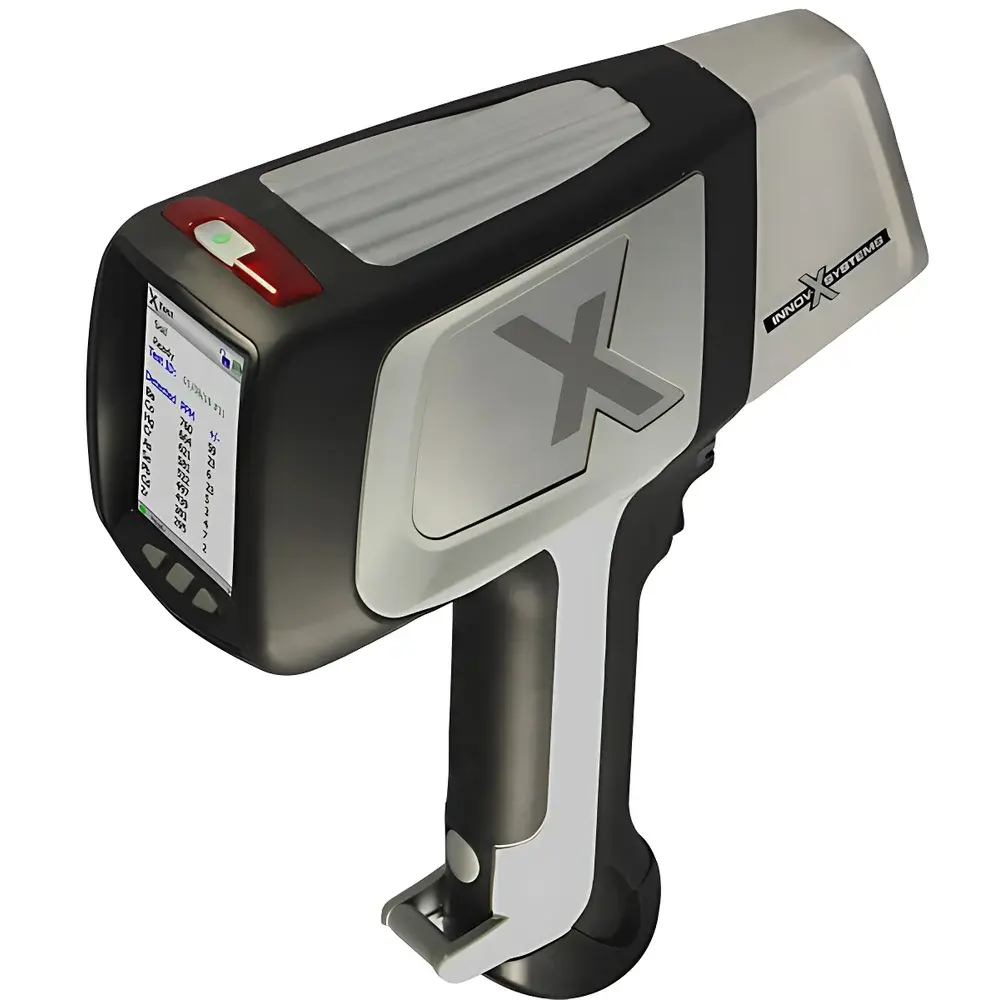
Olympus Delta DC2000 Handheld X-ray Fluorescence (XRF) Alloy Analyzer
| Brand | Olympus |
|---|---|
| Origin | USA |
| Model | DC2000 |
| Detector Type | Si-PIN |
| Excitation Source | Microfocus X-ray Tube (8–40 kV) |
| Cooling System | Peltier Thermoelectric (operable down to −35 °C) |
| Filter Set | 8-position automatic filter changer |
| Display | High-resolution Blanview transmissive backlight color touchscreen |
| Dimensions | 245 × 250 × 88 mm |
| Weight | <1.5 kg |
| Operating Temperature | −10 °C to +50 °C |
| Relative Humidity | 0–95% (non-condensing) |
| Battery | Dual hot-swappable Li-ion batteries |
| Data Storage | SD card (≥100,000 spectra) |
| Connectivity | USB 2.0, Bluetooth 2.1 (Microsoft-compatible stack) |
| OS | Windows CE 6.0 |
| Compliance | Meets IEC 61000-4 EMC standards |
| Sample Compatibility | Solid metals, welds, castings, forgings, and scrap alloys up to 480 °C surface temperature |
Overview
The Olympus Delta DC2000 is a field-deployable, handheld energy-dispersive X-ray fluorescence (EDXRF) analyzer engineered for rapid, non-destructive elemental composition analysis of metallic materials. Based on fundamental XRF physics—where primary X-rays excite characteristic secondary (fluorescent) X-rays from sample atoms—the DC2000 quantifies elements from titanium (Ti, Z=22) through bismuth (Bi, Z=83), with optimized sensitivity for alloying elements critical in industrial metallurgy. Its core application lies in Positive Material Identification (PMI), where regulatory compliance (e.g., ASME B31.3, API RP 578, NACE MR0175/ISO 15156) mandates verification of material grade prior to fabrication or service. Unlike laboratory-based techniques requiring sample dissolution or vacuum environments, the DC2000 delivers lab-grade repeatability (<2% RSD for major alloying elements) in ambient conditions—including elevated-temperature surfaces up to 480 °C—enabling real-time validation during welding, heat treatment, or in-service inspection.
Key Features
- Multi-Matrix Alloy Classification Engine: Preloaded library of >500 standardized alloy grades (e.g., ASTM, AMS, UNS, DIN, JIS), with support for user-defined custom grade templates for proprietary or legacy specifications.
- Dual-Beam SmartSort Technology: Automatically selects optimal excitation voltage (8–40 kV), filter configuration, and counting time based on preliminary spectral screening—minimizing operator decision latency while maintaining detection limits ≤0.01 wt% for Ni, Cr, Mo in stainless steels.
- High-Temperature Operational Capability: Integrated thermal management system—including copper-alloy heat sinks and active Peltier cooling—stabilizes detector temperature during prolonged exposure to hot components, ensuring spectral resolution integrity at surface temperatures up to 480 °C.
- Weld-Specific Grade Library: Dedicated weld metal and filler classification module with preconfigured AWS, EN, and ISO-compliant weld deposit chemistries, enabling direct comparison of base metal, HAZ, and weld bead compositions.
- Robust Field Ergonomics: IP54-rated enclosure; drop-tested to 1 m onto concrete; integrated accelerometer and barometric sensor for real-time atmospheric pressure correction during light-element (Mg, Al, Si) quantification.
- Continuous Operation Architecture: Dual hot-swappable Li-ion batteries enable uninterrupted analysis; onboard charger supports simultaneous battery and main unit charging without system shutdown.
Sample Compatibility & Compliance
The DC2000 analyzes solid-phase metallic samples including wrought, cast, forged, and welded components across aluminum, nickel, titanium, copper, cobalt, zirconium, and precious metal families. It complies with ASTM E1599 (Standard Guide for XRF Analysis of Metals), supports GLP/GMP documentation requirements via audit-trail-enabled PC software, and facilitates 21 CFR Part 11–compliant electronic records when paired with Olympus’ proprietary data management suite. Its measurement uncertainty profiles are traceable to NIST SRM reference materials (e.g., SRM 1250, 1251), and analytical protocols align with ISO/IEC 17025 calibration and verification frameworks used by accredited third-party testing laboratories.
Software & Data Management
Data acquisition, reporting, and fleet management are handled via Olympus’ Delta PC Software—a Windows-based application supporting remote instrument control, method deployment, spectral review, and customizable report generation (PDF, CSV, XML). All measurements include embedded metadata: GPS coordinates, operator ID, timestamp, environmental parameters (T, P, RH), and instrument calibration status. Raw spectra are stored unprocessed on removable SD cards, preserving full spectral fidelity for retrospective reprocessing. The software enforces role-based access controls and maintains immutable audit logs for all method modifications and result exports—critical for FDA-regulated QA/QC environments.
Applications
- PMI in Process Industries: Verification of piping, valves, flanges, and pressure vessel materials in oil & gas, power generation, and chemical processing per API RP 578 and ASME Section II.
- Scrap Sorting & Recycling: On-site discrimination of mixed ferrous/non-ferrous streams, identification of high-value alloys (e.g., Inconel 718, Ti-6Al-4V), and detection of regulated contaminants (Pb, Cd, Hg).
- Manufacturing QA/QC: Incoming raw material inspection, in-process weld verification, and final product release testing to prevent costly mix-ups in aerospace, medical device, and nuclear component supply chains.
- Maintenance & Integrity Assessment: Corrosion-resistant alloy verification during turnaround inspections; detection of chromium depletion in sensitized stainless steels; monitoring of cladding integrity.
FAQ
Does the DC2000 require annual recalibration?
No—its factory-calibrated detector and tube output are stabilized via continuous internal reference checks. However, daily verification using certified check standards (e.g., Olympus Alloy Check Standard) is recommended per ASTM E1599.
Can it quantify light elements like magnesium or aluminum in aluminum alloys?
Yes—using low-kV excitation (8–12 kV) and helium purge mode (optional accessory), it achieves reliable Mg and Al quantification with typical precision of ±0.15 wt% RSD in AA6061-type matrices.
Is radiation safety training required to operate this instrument?
Yes—operators must complete site-specific radiation safety training per local regulatory authority (e.g., NRC, state radiation control program) and wear personnel dosimeters during routine use.
How does it handle surface contamination or paint coatings?
The instrument’s “Coating Mode” applies matrix-matched fundamental parameter algorithms to correct for thin organic or oxide layers (<50 µm), though mechanical cleaning is advised for highest accuracy.
What is the typical detection limit for molybdenum in duplex stainless steel?
Under standard 30-second test conditions, the DC2000 achieves a practical detection limit of 0.012 wt% Mo, validated against ASTM E2857 consensus values.





