
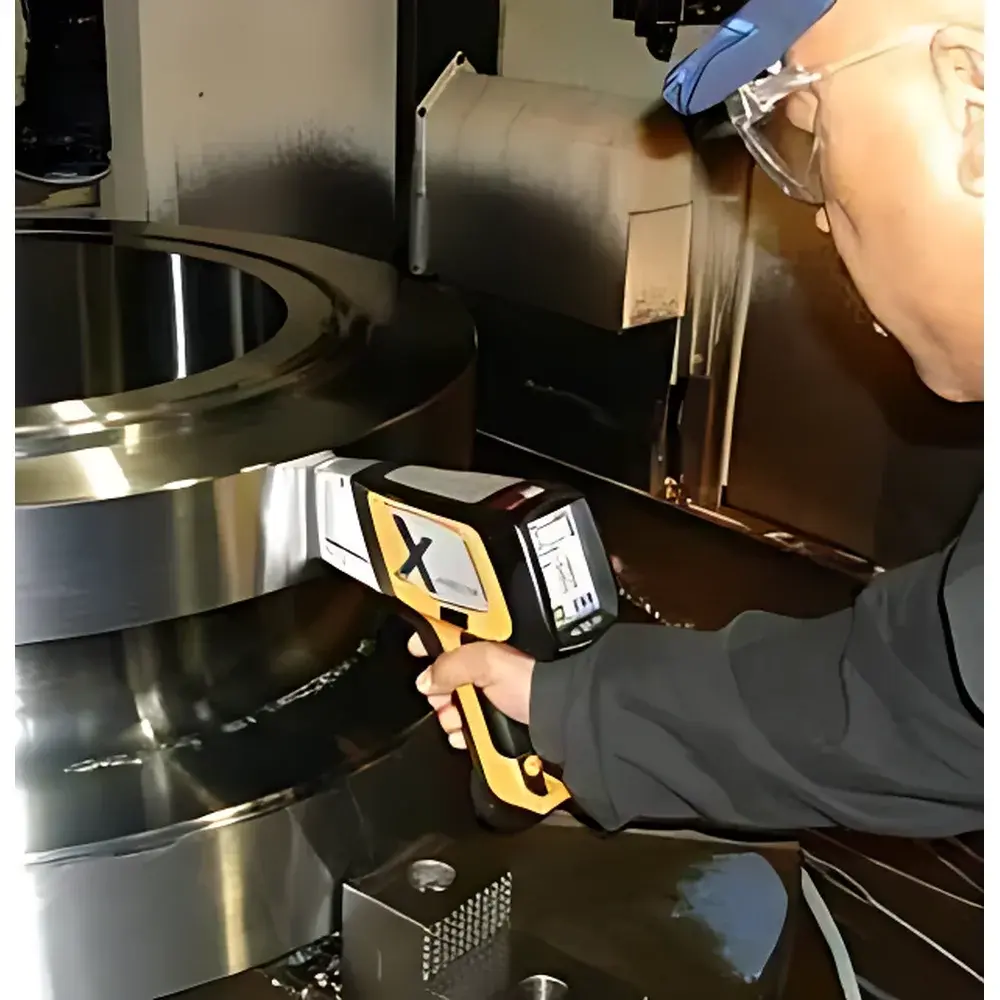
Olympus Delta DPO200 Handheld XRF Alloy Analyzer
| Brand | Olympus |
|---|---|
| Origin | USA |
| Model | DPO200 |
| Detector | 25 mm² SDD Silicon Drift Detector |
| Excitation Source | Micro-focus X-ray Tube (8–40 kV) |
| Cooling System | Peltier Thermoelectric Cooling (operable down to −35 °C) |
| Filter Set | 8-position automatic filter changer |
| Display | High-resolution transflective color touchscreen |
| Weight | <1.5 kg |
| Dimensions | 245 × 250 × 88 mm |
| Operating Temperature | −10 °C to 50 °C |
| Relative Humidity | 0–95% non-condensing |
| Battery | Dual hot-swappable Li-ion batteries |
| Data Storage | SD card (≥100,000 spectra) |
| Connectivity | USB 2.0, Bluetooth v2.1 + EDR |
| OS | Windows CE 6.0 |
| Software | Olympus Delta PC Suite (remote control, report generation, spectral review) |
Overview
The Olympus Delta DPO200 Handheld XRF Alloy Analyzer is an industrial-grade, field-deployable energy-dispersive X-ray fluorescence (EDXRF) spectrometer engineered for rapid, non-destructive elemental composition analysis of metallic materials. Based on fundamental XRF physics—where primary X-rays excite characteristic secondary (fluorescent) X-rays from sample atoms—the DPO200 quantifies elemental concentrations from magnesium (Mg) to uranium (U) in solid metal matrices with high spectral resolution and repeatability. Its core application lies in Positive Material Identification (PMI), a critical requirement under ASME B31.3, ASTM E1479, and API RP 1160 for process safety and regulatory compliance in pressure-bound systems. Designed for operation in demanding environments—from refinery pipe racks to offshore platforms—the instrument integrates thermal management, ruggedized housing, and real-time atmospheric pressure compensation to maintain analytical integrity across variable ambient conditions.
Key Features
- High-Performance Detection Architecture: Equipped with a 25 mm² silicon drift detector (SDD) cooled to −35 °C via Peltier thermoelectric system, enabling superior count-rate capability, low electronic noise, and enhanced light-element sensitivity (e.g., Mg, Al, Si).
- Multi-Voltage Excitation & Adaptive Filtering: Adjustable tube voltage (8–40 kV) and eight-position automatic filter wheel optimize excitation efficiency for diverse alloy classes—from low-Z aluminum alloys to high-Z cobalt superalloys—minimizing matrix effects and spectral overlaps.
- SmartSort™ Intelligent Sorting Logic: Embedded algorithm automates grade identification by comparing measured spectra against user-configurable libraries, reducing operator dependency and supporting ISO/IEC 17025-compliant decision workflows.
- Hot-Swappable Dual-Battery System: Enables uninterrupted operation during extended field shifts; batteries charge in situ without powering down the instrument, meeting IEC 60529 IP54 ingress protection requirements.
- High-Temperature Capability: Integrated thermal dissipation architecture allows direct measurement of components up to 480 °C—validated per ASTM E1621—for in-service inspection of steam lines, furnace tubes, and heat exchanger headers.
- Weld-Specific Analysis Mode: Preloaded weld deposit grade library (e.g., ER70S-6, ER308L, ENiCrFe-7) supports ASME Section IX-compliant weld verification, including dilution estimation and filler-metal matching.
Sample Compatibility & Compliance
The DPO200 is validated for direct analysis of flat, curved, or irregularly shaped metallic surfaces—including castings, forgings, extrusions, welds, and clad materials—without surface preparation beyond standard cleaning. It complies with IEC 61000-6-3 (EMC) and IEC 61000-6-2 (immunity), and its radiation safety design meets ANSI N43.3 and IEC 62495 requirements for handheld X-ray devices. Firmware supports audit-trail logging aligned with FDA 21 CFR Part 11 principles (user authentication, electronic signatures, immutable data records). All factory calibrations are traceable to NIST SRMs, and routine performance verification follows ASTM E2857 protocols for precision and bias assessment.
Software & Data Management
Olympus Delta PC Suite provides full remote instrument control, spectral deconvolution, custom library creation, and PDF report generation with embedded spectra, calibration history, and GPS-tagged location metadata. Data export formats include CSV, DXF, and XML for integration into LIMS (e.g., LabWare, Thermo SampleManager) and ERP systems (SAP PM, Maximo). The onboard Windows CE 6.0 OS supports secure user-role configuration (operator, supervisor, administrator), configurable passcode policies, and encrypted SD card storage. Spectral data undergoes real-time atmospheric correction using integrated barometric and accelerometer sensors—critical for accurate Mg and Al quantification in aerospace-grade 5xxx and 7xxx aluminum alloys.
Applications
- PMI in Process Industries: Verification of piping, valves, flanges, and structural components prior to hydrotesting per ASME B31.1/B31.3; detection of chromium depletion in sensitized stainless steels.
- Scrap Sorting & Recycling: Real-time discrimination of mixed ferrous/non-ferrous scrap streams (e.g., 304 vs. 316 stainless, Monel 400 vs. Inconel 600) to maximize recovery value and minimize contamination.
- QA/QC in Metal Fabrication: Incoming raw material inspection, lot-to-lot consistency checks, and final product certification against ASTM, UNS, or customer-specific specifications.
- Aerospace & Power Generation: Analysis of turbine blades (Ni-based superalloys), airframe titanium alloys (Ti-6Al-4V), and nuclear-grade zirconium cladding—supporting NADCAP AC7101 and ISO 9001 documentation requirements.
- Failure Analysis Support: Rapid screening for intergranular corrosion susceptibility (e.g., Cr/Mo depletion), galvanic coupling risks (Zn/Ni/Cu ratios), and counterfeit material detection.
FAQ
Does the DPO200 require annual recalibration?
No—factory calibration is stable for 12 months under normal use. However, daily verification using certified check standards (e.g., SS316, Ti-6Al-4V) is recommended per ASTM E2857 to ensure ongoing measurement validity.
Can it analyze coated or plated metals?
Yes—thin coatings (<25 µm) can be resolved using fundamental parameter (FP) modeling; thicker coatings require cross-sectional validation or removal per ASTM E1086 guidelines.
Is spectral data export compliant with 21 CFR Part 11?
While the device itself does not provide full electronic signature functionality, Delta PC Suite supports ALCOA+ data integrity principles (Attributable, Legible, Contemporaneous, Original, Accurate), and all raw spectra are stored with immutable timestamps and operator IDs.
What alloys are covered out-of-the-box?
The standard library includes >500 UNS-designated alloys across 18 categories—including ASTM A240 stainless grades, AMS 5504 titanium, and DIN 17175 pressure-vessel steels—with provision for user-defined custom grades.
How is light-element accuracy maintained at high ambient temperatures?
The Peltier-cooled SDD maintains detector stability independent of ambient fluctuations, while real-time barometric correction compensates for air attenuation effects on Mg Kα and Al Kα emissions—ensuring ±0.05 wt% repeatability for Al in 6061-T6.
Related Products






