
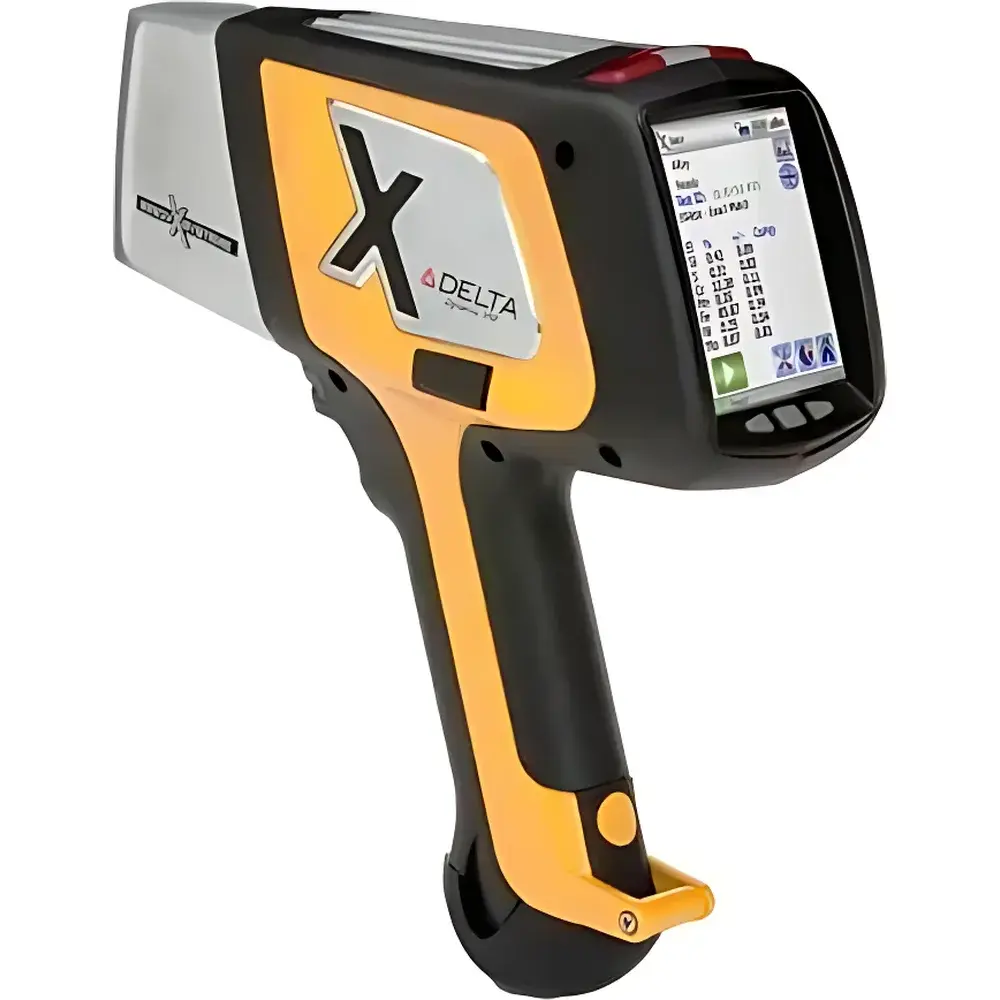
Olympus Delta DPO4050 Portable XRF Soil Heavy Metal Analyzer
| Brand | Olympus |
|---|---|
| Origin | USA |
| Model | DPO4050 |
| Detector | 25 mm² Silicon Drift Detector (SDD) |
| Excitation Source | High-Power Micro-Focus X-ray Tube (15–50 kV) |
| Cooling System | Peltier Thermoelectric Cooler (operable down to −35 °C) |
| Filter Set | 8-position Automatic Filter Wheel |
| Weight | <1.5 kg |
| Dimensions | 245 × 250 × 88 mm |
| Operating Temperature | −10 °C to +50 °C |
| Relative Humidity | 0–95% RH (non-condensing) |
| Battery | Dual Hot-Swappable Li-ion Batteries |
| Display | High-Resolution Transflective Color Touchscreen |
| Data Storage | MicroSD card (≥100,000 spectra) |
| Connectivity | USB 2.0, Bluetooth 4.0 (Microsoft Mobile Device Center compatible) |
| Operating System | Windows CE 6.0 |
| Analysis Modes | Up to 25 User-Configurable Calibration Modes |
| Light Element Compensation | Integrated Barometric Pressure Sensor & Accelerometer for Atmospheric Correction |
Overview
The Olympus Delta DPO4050 is a field-deployable, handheld energy-dispersive X-ray fluorescence (EDXRF) analyzer engineered for rapid, non-destructive elemental quantification in soil, sediment, dust, paint chips, and industrial residues. Leveraging micro-focus X-ray tube excitation (15–50 kV) and a high-resolution 25 mm² silicon drift detector (SDD), the DPO4050 delivers laboratory-grade precision under ambient field conditions. Its analytical principle relies on characteristic X-ray emission following inner-shell ionization—enabling simultaneous detection of elements from magnesium (Mg, Z=12) through uranium (U, Z=92), with optimized sensitivity for RCRA-regulated heavy metals including Pb, As, Cd, Cr, Hg, Ni, Cu, Zn, and Se. Designed for environmental site assessment, regulatory compliance verification, and industrial hygiene monitoring, the instrument meets the physical robustness and metrological traceability requirements of ASTM E1621, ISO 12847, and EPA Method 6200.
Key Features
- High-power micro-focus X-ray tube with multi-kV selectable voltage (15–50 kV) and eight-position automatic filter wheel for optimized excitation across light, transition, and heavy elements.
- 25 mm² large-area SDD detector with Peltier thermoelectric cooling, maintaining stable spectral resolution (<145 eV Mn Kα FWHM) even at −35 °C ambient.
- Hot-swappable dual Li-ion battery system enabling continuous operation without shutdown during battery exchange—critical for extended field campaigns.
- Integrated barometric pressure sensor and 3-axis accelerometer for real-time atmospheric correction during light-element analysis (e.g., Mg, Al, Si), improving accuracy in variable elevation or weather conditions.
- Ruggedized aluminum chassis with IP54-rated sealing (dust- and splash-resistant), reinforced by interlocking convex-concave gasket design for mechanical shock absorption and long-term reliability in harsh environments.
- Dedicated thermal management architecture featuring top-mounted extruded aluminum heat sink channels—eliminating thermal drift and extending detector lifetime beyond conventional handheld XRF designs.
- Windows CE 6.0 operating system with intuitive touchscreen interface, supporting up to 25 user-defined calibration modes, on-device spectrum review, and real-time statistical reporting (mean, SD, CV%, detection limits).
Sample Compatibility & Compliance
The DPO4050 is validated for direct analysis of heterogeneous solid matrices without digestion: intact soil cores, air filter media (NIOSH 7702), painted surfaces (OSHA OSSI), slag, fly ash, construction debris, and corrosion byproducts. It complies with U.S. federal regulatory frameworks including EPA Method 6200 for field screening of RCRA metals, NIOSH Method 7702 for lead-in-dust quantification, and OSHA OSSI for surface coating lead content. Instrument firmware supports audit-ready data logging—including operator ID, GPS coordinates (via Bluetooth tethering), timestamp, measurement duration, and spectral acquisition parameters—to satisfy GLP/GMP documentation requirements and FDA 21 CFR Part 11 electronic record integrity standards when paired with validated PC software.
Software & Data Management
Olympus Delta PC Software (v4.x) provides full remote instrument control, method development, and quantitative reporting. Raw spectra are stored in standardized .SPX format; metadata fields support customizable project tagging, QA/QC flagging, and automated report generation compliant with EPA Region 9 QA/G-5 and ASTM D6919 workflows. Data export options include CSV, PDF, and XML formats compatible with LIMS integration. Firmware updates and calibration transfers occur via encrypted MicroSD card or over USB/Bluetooth, with version-controlled change logs maintained per device serial number. All spectral acquisitions include embedded hardware diagnostics (tube current/voltage stability, detector temperature, count rate saturation flags) to ensure analytical validity prior to interpretation.
Applications
- Environmental Site Assessment: Rapid delineation of contamination plumes, boundary mapping of As/Pb/Cd hotspots, and risk-based exposure modeling using in situ soil screening data.
- Mining & Smelting Surveillance: Real-time monitoring of tailings pond sediments, fugitive dust deposition, and perimeter vegetation ash for cumulative metal loading trends.
- Hazardous Waste Characterization: On-site classification of construction/demolition debris per TCLP (Toxicity Characteristic Leaching Procedure) surrogate protocols and RCRA 40 CFR Part 261 waste profiling.
- Industrial Hygiene & Regulatory Enforcement: Lead-in-paint verification on infrastructure, airborne particulate filter analysis for worker exposure assessment, and post-abatement clearance testing.
- Research & Forensics: Multi-element fingerprinting of anthropogenic vs. geogenic metal sources in urban soils, corrosion product identification in aging infrastructure, and forensic provenance analysis of contaminated building materials.
FAQ
Does the DPO4050 require sample preparation prior to analysis?
No—soil, sediment, and solid samples are analyzed directly in their native state. Homogenization (e.g., sieving to <2 mm) is recommended for improved precision, but acid digestion or pelletization is not required.
What is the typical detection limit for lead (Pb) in soil matrix?
Under standard 60-second measurement conditions, the instrument achieves a practical quantitation limit (PQL) of ~15–25 mg/kg Pb in dry soil, depending on organic content and particle size distribution.
Can the DPO4050 be calibrated for site-specific matrices?
Yes—users may develop custom calibrations using reference materials traceable to NIST SRMs (e.g., 2710a, 2711a) or site-matched certified soils, with full uncertainty propagation reporting enabled in Delta PC Software.
Is spectral data export compliant with laboratory information management systems (LIMS)?
Yes—CSV and XML exports include all raw intensity values, background-subtracted net counts, and certified reference material validation results, supporting seamless ingestion into enterprise LIMS platforms.
How is instrument performance verified between calibrations?
Built-in check sources (e.g., Fe-55, Cd-109) enable daily energy calibration verification; optional external validation standards (e.g., Olympus QC Check Sample) provide ongoing accuracy assessment per ISO/IEC 17025 internal quality control protocols.
Related Products





