
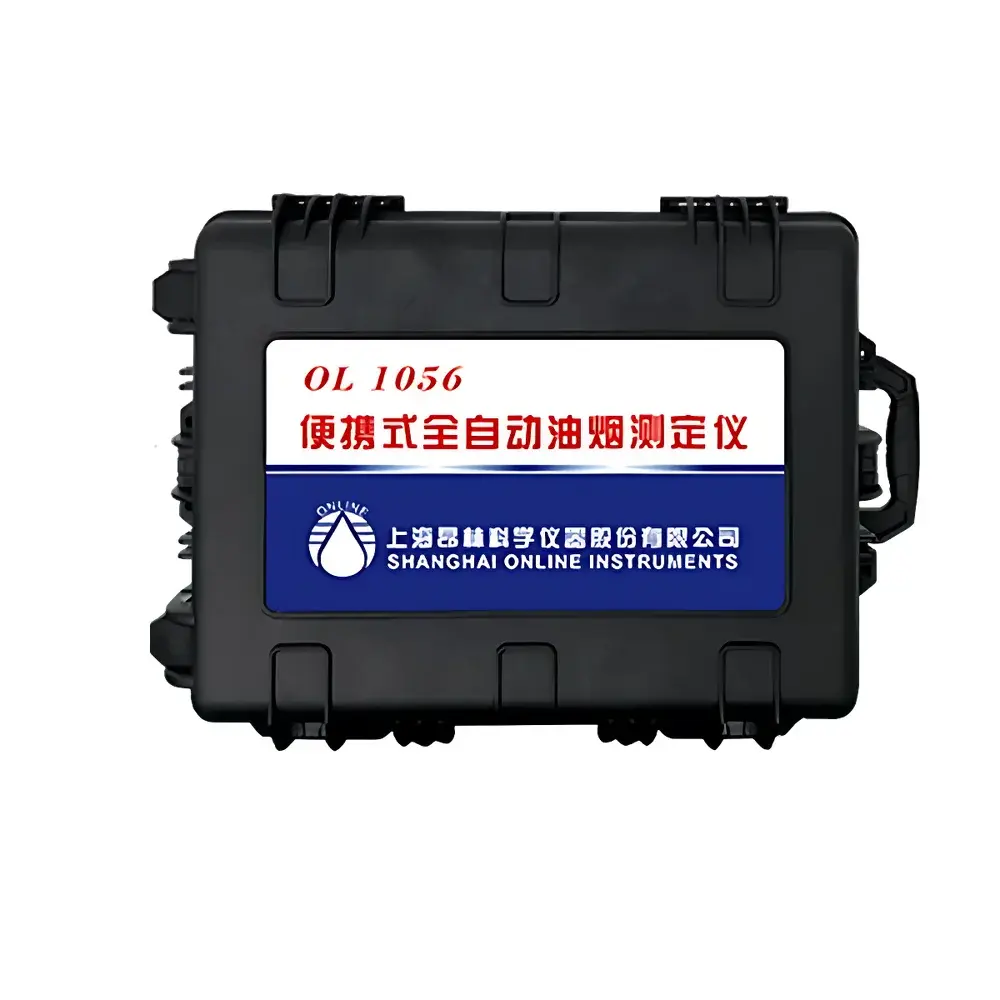
Online Instrument OL1056 Portable Fully Automated Oil Fume Analyzer
| Brand | Online Instrument |
|---|---|
| Model | OL1056 |
| Origin | Shanghai, China |
| Portability | Portable |
| Application Field | Food Service Industry (Commercial Kitchen Exhaust Monitoring) |
| Compliance Basis | HJ 646–2013, HJ 647–2013, HJ 1077–2019 (Chinese EPA Standards for Oil Fume Emission Monitoring) |
| Sample Handling | Fully Automated Reagent Dispensing, Dual-Stage Ultrasonic Extraction, Cuvette Cleaning, Volumetric Finalization, Photometric Quantification at 530 nm |
| Data Output | Excel, PDF, LIMS-Compatible Export |
| Remote Operation | Web-Based Dashboard & Mobile App Support |
| Enclosure Material | Reinforced Engineering Thermoplastic (IP54 Rated) |
Overview
The Online Instrument OL1056 Portable Fully Automated Oil Fume Analyzer is a field-deployable analytical system engineered for quantitative determination of total oil fume concentration in exhaust gas streams from commercial kitchen ventilation systems. It operates on the principle of infrared absorption spectrophotometry (per HJ 1077–2019) combined with standardized solvent extraction and colorimetric detection at 530 nm. Unlike conventional grab-sampling methods requiring off-site laboratory analysis, the OL1056 integrates sample collection, extraction, quantification, and reporting into a single compact platform—enabling real-time, on-site compliance verification against national emission limits (e.g., ≤2.0 mg/m³ for catering establishments per GB 18483–2001). Its modular architecture supports both fixed-point monitoring at hood outlets and mobile deployment via vehicle-mounted operation, with optical path stability maintained under dynamic vibration conditions (tested per ISO 10816-1 for portable instrumentation).
Key Features
- Integrated Portable Design: All functional modules—including sampling probe, extraction chamber, photometer, reagent reservoirs, waste management unit, and control electronics—are housed within a single IP54-rated reinforced thermoplastic enclosure (W × D × H: 420 × 330 × 280 mm; mass: ≤12.8 kg), enabling rapid deployment without external power or auxiliary gas supplies.
- End-to-End Automation: The system executes a fully programmed analytical sequence: automated isopropanol-based solvent dosing, dual-cycle ultrasonic-assisted extraction (40 kHz, 10 min total), precision volumetric dilution to 25.0 mL, cuvette cleaning with deionized water rinse, absorbance measurement at 530 nm using a stabilized tungsten-halogen light source and silicon photodiode detector, and automatic calibration against user-defined standard curves.
- Residual Sample Retention: Post-analysis, the extracted solution remains sealed in an inert polypropylene vial with alphanumeric labeling, allowing independent reanalysis or chain-of-custody documentation—critical for regulatory dispute resolution or QA/QC validation.
- Vibration-Tolerant Optics: The optical bench employs monolithic mounting and passive damping to maintain alignment during vehicular transport; performance validation confirms <±0.5% absorbance drift over 30 min of continuous operation on a moving test platform (simulated urban driving profile).
- Secure Remote Access: Embedded Linux-based controller supports TLS 1.2-encrypted communication via 4G LTE or Wi-Fi. Operators may initiate measurements, view live spectra, download audit logs, and trigger firmware updates through a responsive web interface compatible with Chrome, Edge, and Safari—no proprietary client software required.
Sample Compatibility & Compliance
The OL1056 is validated for use with flue gas samples containing particulate-bound and vapor-phase cooking oil aerosols (predominantly triglyceride esters, fatty acids, and thermal degradation products). It complies with Chinese environmental monitoring standards HJ 646–2013 (determination of total hydrocarbons in exhaust gas), HJ 647–2013 (determination of polycyclic aromatic hydrocarbons), and HJ 1077–2019 (standard method for oil fume concentration in catering exhaust). While not certified to ISO/IEC 17025 for accredited testing, its measurement traceability is established through NIM-traceable reference materials (CRM-OF-01 series) and documented uncertainty budgets (<8.2% k=2 at 1.0 mg/m³). System suitability checks include daily blank verification, linearity assessment (R² ≥0.999 across 0.1–10.0 mg/m³), and recovery testing (85–115% for spiked field samples).
Software & Data Management
The embedded analytical software (v3.2.1) runs natively on a Windows IoT Enterprise-compatible OS and provides full GLP-aligned data governance: electronic signatures, time-stamped audit trails, version-controlled method files, and immutable raw-data archiving. Measurement reports include instrument ID, operator credentials, ambient temperature/pressure/humidity metadata, spectral scans, calibration parameters, and calculated concentrations with expanded uncertainty. Exports support CSV, Excel (.xlsx), and PDF/A-1b formats. API endpoints conform to RESTful conventions for bidirectional integration with Laboratory Information Management Systems (LIMS), supporting HL7 v2.5 and ASTM E1384 message structures. All data transmissions comply with China’s PIPL requirements for personal information handling.
Applications
- Regulatory inspection of restaurant, canteen, and food court exhaust stacks by municipal ecological environment bureaus
- Pre-commissioning verification and periodic maintenance of electrostatic precipitators and UV-C oxidation units
- Source apportionment studies correlating oil fume levels with cooking volume, fuel type, and hood capture efficiency
- Occupational hygiene assessments in commercial kitchen environments (as supplementary data to respirable dust metrics)
- Contractor-led emissions reporting for green building certification (e.g., LEED EQ Credit 3.2)
FAQ
What regulatory standards does the OL1056 directly support?
It implements the procedural requirements of HJ 1077–2019, HJ 646–2013, and HJ 647–2013, including mandatory extraction solvents, wavelength specifications, and calibration frequency protocols.
Can the instrument operate without external power?
Yes—it includes an internal 24 V/12 Ah LiFePO₄ battery providing ≥4.5 hours of continuous operation at 25°C, sufficient for ≥12 full analytical cycles.
Is method validation documentation available?
Certificate of Conformance, Factory Acceptance Test Report, and Method Validation Summary (per CNAS-GL039) are supplied with each unit and accessible via the onboard diagnostics portal.
How is cross-contamination prevented between samples?
The system uses disposable polypropylene extraction tubes and a dedicated cleaning cycle with ultrapure water followed by air purge; carryover testing shows <0.3% residual signal for consecutive high-concentration samples.
Does the software meet FDA 21 CFR Part 11 requirements?
While designed with Part 11 principles (audit trail, electronic signature, role-based access), formal validation for pharmaceutical GxP environments requires site-specific IQ/OQ/PQ execution per user SOPs.
Related Products







