
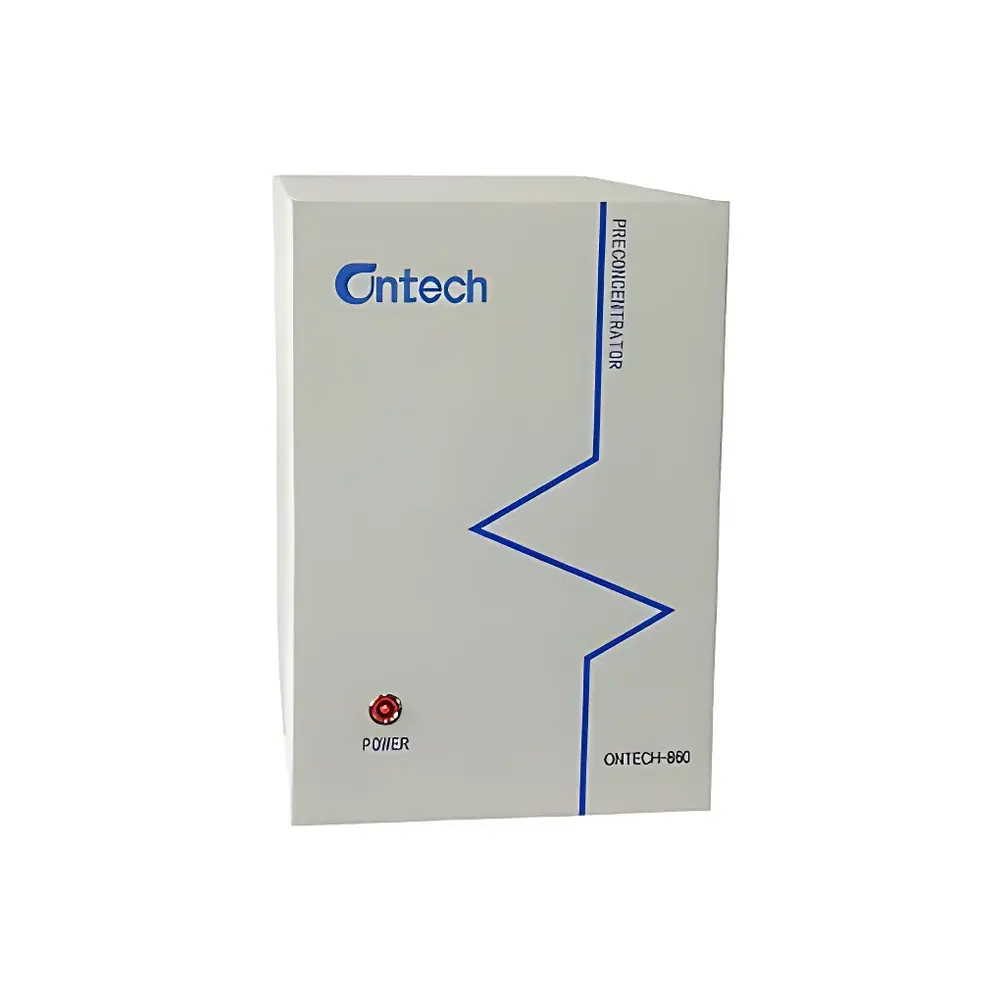
Ontech860-2 Dual-Stage Electronic Cooling Atmospheric Pre-concentrator
| Brand | Ontech |
|---|---|
| Model | Ontech860-2 |
| Origin | Beijing, China |
| Cooling Method | Solid-state thermoelectric cooling (no liquid nitrogen required) |
| Compliance | HJ 759–2023, HJ 1078–2019, GB/T 14678–1993 |
| Sample Inlets | Summa canister, Tedlar bag, standard calibration gas cylinder |
| Target Analytes | C1–C12 VOCs and SVOCs including polar (aldehydes, alcohols, esters, ketones, ethers), non-polar, sulfur- and nitrogen-containing compounds |
| Water Removal | Selective cryogenic removal with aqueous-phase polar compound retention |
| Cold Trap Stages | Two-stage — primary dehumidification/decontamination trap + secondary composite focusing trap |
| Thermal Management | Fully heated, inertized sample path (up to 200 °C), zero cold spots |
| Software | Windows 7/10/11 compatible, method-driven automation, built-in leak detection (positive/negative pressure), audit-trail-capable QA/QC reporting |
Overview
The Ontech860-2 Dual-Stage Electronic Cooling Atmospheric Pre-concentrator is an engineered solution for trace-level volatile organic compound (VOC) and semi-volatile organic compound (SVOC) analysis in ambient air, stack emissions, and indoor environments. It operates on the principle of cryogenic pre-concentration via sequential thermoelectric cooling stages, enabling quantitative enrichment of sub-part-per-trillion (pptv) analytes prior to gas chromatographic separation. Unlike liquid nitrogen–dependent systems, the Ontech860-2 employs solid-state Peltier modules for precise, stable, and maintenance-free temperature control across both cold traps—eliminating logistical constraints while maintaining thermal reproducibility critical for regulatory compliance. Its architecture is purpose-built for compatibility with all commercial GC and GC-MS platforms, supporting standardized workflows defined in HJ 759–2023 (65-species ambient air VOC analysis), HJ 1078–2019 (8 sulfur-containing compounds from fixed sources), and GB/T 14678–1993 (H2S, methanethiol, dimethyl sulfide, etc.). The system achieves selective water and CO2 removal without sacrificing recovery of water-soluble polar species—a key differentiator from membrane-based dehydration approaches that compromise TO-15 target compound integrity.
Key Features
- Dual-stage thermoelectric cooling: Primary trap removes bulk H2O, CO2, N2, and O2; secondary composite focusing trap enables sharp, symmetrical peak shapes for C1–C12 analytes—including aldehydes, alcohols, thiols, nitriles, and halogenated organics.
- Fully heated, ultra-inert sample pathway: All wetted surfaces—from Summa canister interface to transfer lines and valve manifolds—are coated with SilcoNert® or equivalent deactivated material and maintained at user-defined temperatures up to 200 °C, preventing adsorption, condensation, or catalytic degradation.
- Integrated back-flush thermal desorption: Automated hot-gas purge cycle eliminates carryover; residual contamination remains below method detection limits (MDLs) across repeated injections.
- High-speed flash vaporization: Patented rapid heating profile ensures complete and synchronous release of trapped analytes into the GC column, minimizing band broadening and maximizing signal-to-noise ratio.
- Modular electronics and self-diagnostic firmware: Field-replaceable circuit boards with real-time status monitoring reduce downtime; error logs include timestamped hardware event traces for GLP-aligned troubleshooting.
- Multi-port inlet configuration: Dedicated ports for certified standard gases, internal standards, carrier gas, and automated sample introduction—enabling fully unattended sequence operation.
Sample Compatibility & Compliance
The Ontech860-2 accepts samples collected in electropolished stainless-steel Summa canisters (EPA TO-14A/TO-15), fluorinated ethylene propylene (FEP) gas sampling bags (per HJ 1078–2019), and pressurized calibration cylinders. Its two-stage trapping design meets or exceeds performance criteria specified in Chinese national standards HJ 759–2023 and GB/T 14678–1993, as well as U.S. EPA Compendium Method TO-14A and TO-15 for ambient and source testing. The instrument supports full method validation per ISO/IEC 17025 requirements, with documented linearity (R2 ≥ 0.999), precision (85% for C2–C10 compounds). All software operations—including method execution, leak testing, and system cleaning—are logged with immutable timestamps and user authentication, satisfying FDA 21 CFR Part 11 and GLP/GMP data integrity expectations.
Software & Data Management
Control is executed via a native Windows application compatible with Windows 7, 10, and 11 (64-bit). The interface features real-time graphical schematics of pneumatic states—valve positions, cold trap temperatures, mass flow rates, and directional gas flow paths—allowing immediate visual verification of system readiness. Method development is fully scriptable: users define time-resolved events for trap cooling/heating, valve actuation, MFC ramping, and detector synchronization without hardware modification. Leak detection routines support both positive-pressure (pressurize-and-monitor) and negative-pressure (vacuum-decay) protocols, auto-generating PDF reports with pass/fail thresholds and raw pressure decay curves. Sequence management includes customizable QC flagging, bracketing standards, duplicate analysis triggers, and automated QA/QC summary exports compliant with laboratory information management systems (LIMS).
Applications
- Ambient air monitoring networks requiring high-throughput, low-MDL VOC profiling per HJ 759–2023.
- Industrial hygiene assessments targeting sulfur- and nitrogen-containing odorants (e.g., methanethiol, dimethyl disulfide, acetonitrile) in wastewater treatment plants and chemical manufacturing facilities.
- Indoor air quality (IAQ) studies involving formaldehyde, benzene, toluene, and oxygenated VOCs from building materials and consumer products.
- Method development labs validating new SVOC panels (e.g., C10–C12 aldehydes, terpenes) where conventional single-stage concentrators exhibit poor recovery.
- Reference laboratories performing proficiency testing and inter-laboratory comparisons under CNAS accreditation scopes.
FAQ
Does the Ontech860-2 require liquid nitrogen or other cryogens?
No. It uses solid-state thermoelectric cooling modules for both cold traps, eliminating dependency on LN2, dry ice, or mechanical refrigeration.
Can it retain water-soluble polar compounds during moisture removal?
Yes. Its cryogenic dehumidification selectively freezes free water while preserving analytes dissolved in the aqueous phase—unlike permeation dryers that exclude TO-15 compounds.
Is the system compatible with third-party GC and GC-MS instruments?
Yes. It interfaces via standard 1/8″ or 1/4″ VCR fittings and delivers enriched analytes directly to the GC inlet using helium or hydrogen carrier gas.
How is system integrity verified before sample analysis?
Automated leak checks are performed prior to canister valve opening, using either pressurization or vacuum decay methods, with results archived in audit-trail format.
What level of software validation support is provided?
The software includes configurable electronic signatures, session logs, method version control, and exportable audit trails—fully aligned with 21 CFR Part 11 and ISO/IEC 17025 documentation requirements.



