
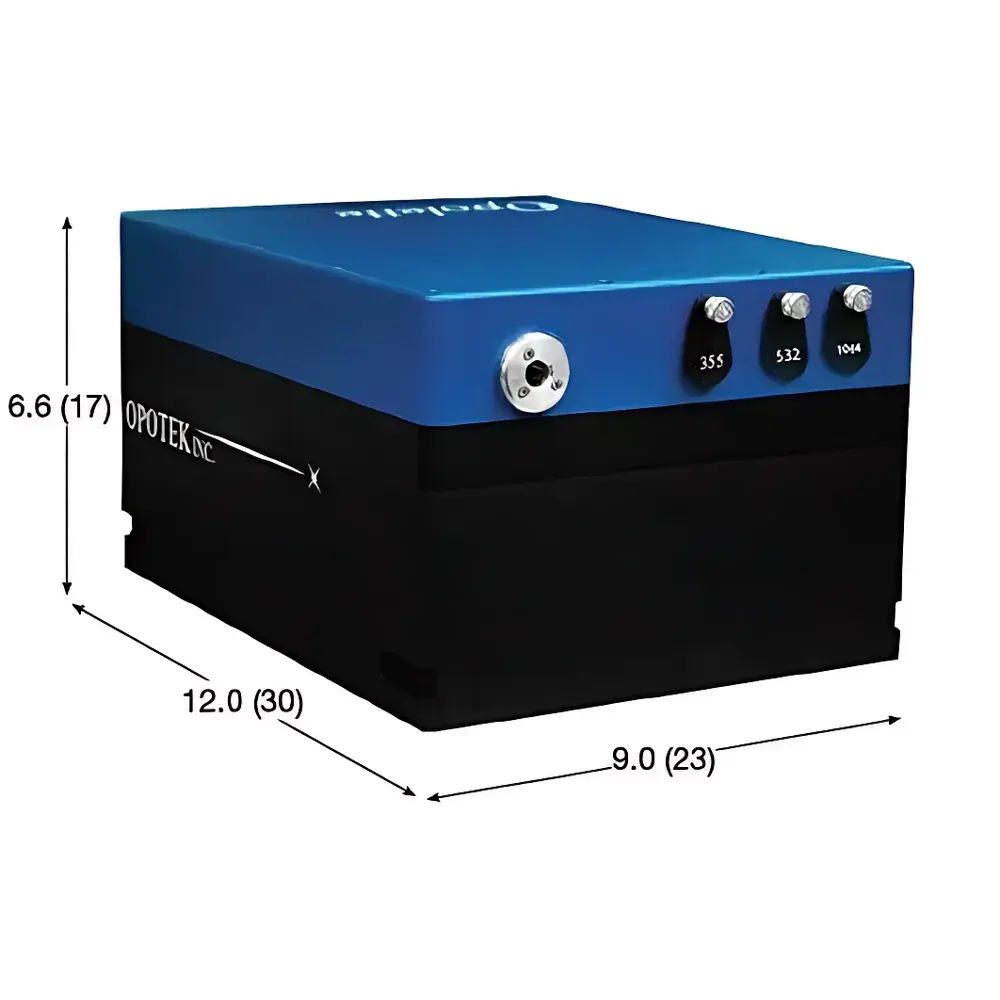
OPOTEK Opolette Compact Integrated OPO Laser System
| Brand | OPOTEK |
|---|---|
| Origin | USA |
| Model | Opolette |
| Pump Wavelengths | 1064 nm, 532 nm, 355 nm |
| Repetition Rate | up to 100 Hz |
| Output Configuration | Co-axial signal + idler beams via polarization separation |
| Tuning Range (with UV option) | 210–410 nm (UV), ~410–2600 nm (IR) |
| Dimensions | 305 × 178 × 125 mm |
| Integration | Monolithic pump + OPO cavity in sealed, alignment-free housing |
| Control | Fully automated software interface for wavelength, energy, and repetition rate adjustment |
| Compliance | Designed for laboratory integration under ISO/IEC 17025-aligned optical measurement environments |
Overview
The OPOTEK Opolette Compact Integrated OPO Laser System is a turnkey, solid-state optical parametric oscillator engineered for precision tunable laser emission in research and industrial optical measurement applications. Based on nanosecond-pulsed Nd:YAG pump technology, the system employs intracavity or external-cavity OPO architecture—depending on configuration—to generate coherent, widely tunable output across ultraviolet, visible, and near-to-mid-infrared spectral regions. Its core design principle leverages difference-frequency generation and parametric amplification within nonlinear optical crystals (e.g., BBO, KTP, or LiNbO₃), enabling continuous, mode-hop-free wavelength scanning without mechanical realignment. The monolithic integration of pump laser and OPO cavity eliminates sensitivity to environmental vibration and thermal drift, ensuring long-term pointing stability and pulse-to-pulse energy reproducibility—critical for quantitative optical diagnostics such as time-resolved spectroscopy and velocimetry.
Key Features
- Hermetically sealed, alignment-free integrated architecture: Pump source and OPO module housed in a single rigid chassis (305 × 178 × 125 mm), minimizing footprint and maximizing operational reliability in shared-lab or mobile-platform environments.
- Co-axial dual-beam output: Signal and idler waves exit through a single collimated port, separated internally by polarization optics—eliminating need for external beam combiners or re-routing during spectral scans.
- Multi-wavelength pump compatibility: Selectable fundamental harmonics (1064 nm, 532 nm, 355 nm) enable optimized nonlinear conversion efficiency across distinct tuning bands; optional UV harmonic generator extends coverage down to 210 nm.
- Full electronic control: Unified software interface enables synchronized adjustment of output wavelength, pulse energy (via attenuator feedback loop), and repetition rate (1–100 Hz), supporting automated spectral acquisition protocols.
- Thermally stabilized crystal mounts and active cavity length compensation ensure <±0.1 nm wavelength accuracy over 8-hour continuous operation, meeting requirements for GLP-compliant spectral calibration workflows.
Sample Compatibility & Compliance
The Opolette is designed for use with standard optical tables, fiber-coupled spectrometers, ICCD detectors, and scanning monochromators common in academic and industrial photonics laboratories. Its output beam characteristics (M² < 1.3, divergence < 1.5 mrad) are compatible with diffraction-limited focusing for nonlinear excitation in microscopy and photoacoustic imaging. The system complies with IEC 60825-1:2014 Class 4 laser safety standards and incorporates interlock-ready hardware interfaces for integration into ISO 14644-1 cleanroom or FDA-regulated analytical suites. While not certified for GMP manufacturing environments, its audit-trail-capable software logging (timestamped parameter sets, energy history, fault codes) supports 21 CFR Part 11 readiness when deployed with validated third-party data acquisition platforms.
Software & Data Management
OPOTEK’s proprietary Opolette Control Suite provides native support for Windows-based lab PCs and offers API-level integration via TCP/IP and LabVIEW VIs. All wavelength calibration data—including grating position vs. output λ, crystal temperature maps, and harmonic phase-matching curves—are stored in vendor-validated HDF5 format. Software logs include full metadata (date/time, user ID, ambient temperature/humidity from optional sensor input, pump diode current), enabling traceable spectral data provenance per ISO/IEC 17025 clause 7.7. Export options include CSV, ASCII, and SPC formats compatible with Igor Pro, MATLAB, and OriginLab for post-acquisition fitting of fluorescence decay kinetics or Raman peak deconvolution.
Applications
- Particle Image Velocimetry (PIV): High-repetition-rate (up to 100 Hz), narrow-linewidth (<0.3 cm⁻¹) tunable output enables dual-pulse illumination at optimal absorption bands for tracer seeding (e.g., TiO₂, oil droplets) in turbulent flow characterization.
- Laser-induced photoacoustic imaging: Sub-10 ns pulse duration and adjustable 680–950 nm idler output facilitate depth-resolved optical absorption mapping in biological tissue with minimal photothermal damage.
- Nonlinear optical spectroscopy: Broad IR tuning range (1.4–2.6 µm) supports vibrational fingerprinting of polymers, pharmaceutical intermediates, and semiconductor thin films using difference-frequency generation (DFG) detection schemes.
- Laser desorption/ionization mass spectrometry (LDI-MS): UV-tunable output (210–410 nm) provides resonant excitation for matrix-free analysis of small-molecule metabolites and peptides without fragmentation artifacts.
- Time-resolved fluorescence lifetime imaging (FLIM): Synchronized Q-switch trigger output allows precise gating of TCSPC detectors for multi-exponential decay analysis in live-cell assays.
FAQ
What pump wavelengths are supported, and how do they affect tuning range?
The Opolette accepts 1064 nm, 532 nm, or 355 nm pump inputs—each enabling distinct OPO gain bandwidths. For example, 355 nm pumping yields UV-visible signal output (210–410 nm with harmonic extension), while 1064 nm pumping maximizes mid-IR idler coverage (1.4–2.6 µm).
Is external water cooling required?
No—the system uses thermoelectrically cooled crystal mounts and air-cooled pump diodes, permitting operation in standard laboratory environments (15–30 °C ambient, non-condensing humidity).
Can the Opolette be fiber-coupled?
Yes, optional FC/APC or SMA-905 fiber launch adapters are available for coupling into multimode fibers (core diameter ≥ 200 µm) with >75% transmission efficiency across 400–2200 nm.
Does the system support external triggering?
Yes—TTL-compatible sync outputs (Q-switch trigger, pulse indicator) and inputs (external master clock, shutter control) are provided on a 9-pin D-sub connector per IEEE 1175-1995 timing standards.
What maintenance is required over a 5-year service life?
Annual verification of wavelength calibration against NIST-traceable reference lines (e.g., Hg/Ne spectral lamps) and pump diode current calibration is recommended; no consumables or periodic crystal replacement are specified under normal operating conditions.



