
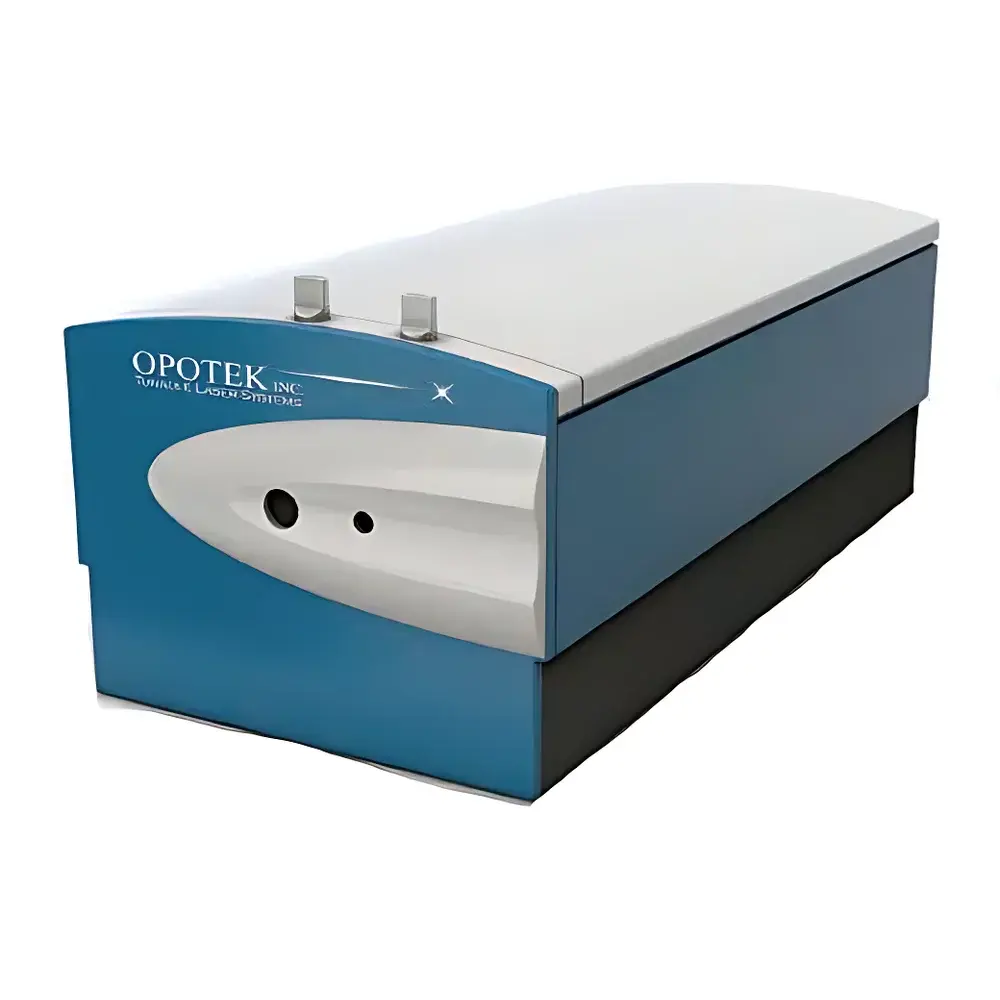
OPOTEK Radiant Series High-Energy Integrated OPO Laser System
| Brand | OPOTEK |
|---|---|
| Origin | USA |
| Manufacturer Type | Authorized Distributor |
| Product Category | Imported |
| Model | Radiant |
| Core Architecture | Solid-State Pump Laser + Monolithically Integrated Optical Parametric Oscillator (OPO) |
| Pump Wavelength Options | 1064 nm, 532 nm, 355 nm |
| Tuning Range (with UV Extension) | 189–410 nm (UV), 410–2600 nm (Visible–IR) |
| Output Configuration | Polarization-Based Signal/Idler Separation via Single Collinear Beam Exit |
| Control Interface | Fully Automated Software-Controlled Wavelength, Pulse Energy, and Repetition Rate Adjustment |
| Primary Applications | Particle Image Velocimetry (PIV), Photoacoustic Imaging, Nonlinear Spectroscopy, Laser Mass Spectrometry, Fluorescence Lifetime Imaging (FLIM), Ultrafast Pump-Probe Studies |
Overview
The OPOTEK Radiant Series is a high-energy, fully integrated optical parametric oscillator (OPO) laser system engineered for demanding scientific and industrial applications requiring broad spectral coverage, pulse-to-pulse stability, and turnkey operability. Unlike modular OPO configurations requiring external alignment and thermal stabilization, the Radiant platform integrates a diode-pumped solid-state (DPSS) pump laser with a monolithic, temperature-stabilized OPO cavity in a single rigid mechanical housing. This co-aligned architecture ensures long-term pointing stability (<10 µrad/h), minimal mode-mismatch losses, and reproducible output across the full tuning range. The system operates on the principle of non-degenerate parametric amplification in periodically poled nonlinear crystals (e.g., KTA or PPLN), enabling simultaneous generation of signal and idler beams from a single pump pulse. Dual-beam separation is achieved via polarization discrimination rather than spatial splitting—ensuring collinear output through a single aperture and eliminating beam walk-off during wavelength scanning.
Key Features
- Monolithic integration of DPSS pump laser and OPO cavity—no external optics or realignment required for routine operation.
- Three selectable fundamental pump wavelengths: 1064 nm (Nd:YAG fundamental), 532 nm (second harmonic), and 355 nm (third harmonic), each optimized for distinct phase-matching conditions in the OPO crystal.
- Extended UV coverage down to 189 nm enabled by optional harmonic generation module using BBO or CLBO crystals—fully software-synchronized with OPO tuning.
- Single-output-port design with polarization-resolved signal/idler delivery—enabling seamless full-range spectral scans (189–2600 nm) without mechanical reconfiguration or beam path interruption.
- Real-time, closed-loop energy monitoring and feedback control per pulse—maintaining ±2% pulse energy stability over 8-hour continuous operation at 10 Hz repetition rate.
- Industrial-grade thermal management system with active water cooling and PID-controlled oven stabilization of nonlinear crystals—critical for maintaining phase-matching bandwidth and conversion efficiency.
Sample Compatibility & Compliance
The Radiant Series is designed for use in controlled laboratory environments compliant with IEC 60825-1:2014 (Laser Product Safety) and ANSI Z136.1-2022 (Safe Use of Lasers). Its Class IV laser classification requires interlocked enclosures and certified laser safety officers (LSOs) for operation. The system supports integration into ISO/IEC 17025-accredited analytical workflows, including those requiring traceable calibration against NIST-traceable reference standards for wavelength (±0.1 nm accuracy) and pulse energy (±1.5% uncertainty). It meets electromagnetic compatibility (EMC) requirements per FCC Part 15 Subpart B and CE Directive 2014/30/EU. For regulated bioanalytical applications (e.g., clinical FLIM or MALDI-TOF MS), the Radiant’s firmware supports audit trail logging and user access controls aligned with FDA 21 CFR Part 11 principles.
Software & Data Management
OPOTEK’s Radiant Control Suite is a Windows-based application offering deterministic command-line API (via TCP/IP or USB-VCOM) and GUI-driven operation. All parameters—including wavelength, pulse energy, repetition rate, crystal temperature setpoint, and harmonic selection—are programmable via intuitive sliders or scriptable Python/LabVIEW drivers. The software logs timestamped metadata (wavelength, energy, temperature, shutter status) for every laser pulse in HDF5 format, enabling direct import into MATLAB, Python (NumPy/Pandas), or commercial spectroscopy platforms (e.g., Ocean Insight, Horiba). Built-in spectral calibration routines auto-correct for grating dispersion drift and detector nonlinearity. Optional remote diagnostics allow secure vendor-assisted troubleshooting without physical access.
Applications
- Particle Image Velocimetry (PIV): High peak power (>10 mJ/pulse at 532 nm) and nanosecond pulse duration enable robust seeding particle illumination in high-speed turbulent flow studies.
- Photoacoustic & Optoacoustic Imaging: Tunable near-IR output (700–1000 nm) matches hemoglobin and lipid absorption bands; 355 nm pumping enables UV-photoacoustics for melanin-selective imaging.
- Nonlinear Spectroscopy: Broad tunability supports resonant Raman, CARS, and SRS measurements across organic dyes, 2D materials, and biological tissues.
- Laser Desorption/Ionization Mass Spectrometry: UV output (193–266 nm) provides efficient soft ionization for intact macromolecule analysis; IR output enables selective vibrational excitation in MALDI matrices.
- Fluorescence Lifetime Imaging Microscopy (FLIM): Sub-10 ns pulse width and jitter <50 ps support time-correlated single-photon counting (TCSPC) with picosecond resolution.
FAQ
What pump sources are internally integrated in the Radiant system?
The Radiant integrates a Q-switched, diode-pumped Nd:YAG laser capable of delivering harmonics at 1064 nm, 532 nm, and 355 nm—all generated within the same laser head.
Can the signal and idler outputs be used simultaneously?
Yes—the polarization-based separation allows concurrent extraction of both beams via external polarizing optics; the standard configuration delivers them sequentially via software-triggered waveplate rotation.
Is wavelength calibration traceable to national standards?
Yes—factory calibration uses a wavemeter referenced to NIST SRM 2034 (Holmium Oxide filter) and is documented in the Certificate of Conformance supplied with each unit.
What cooling infrastructure is required?
A closed-loop chiller with 18–22°C setpoint, ≥2 L/min flow rate, and ≤0.5 bar pressure drop is mandatory; integrated sensors prevent lasing if coolant flow falls below threshold.
Does the system support external triggering and synchronization?
Yes—TTL-compatible sync outputs (pulse pickoff, Q-switch trigger, wavelength encoder) and inputs (external shutter, delay generator) are provided on a 26-pin D-sub connector.





