
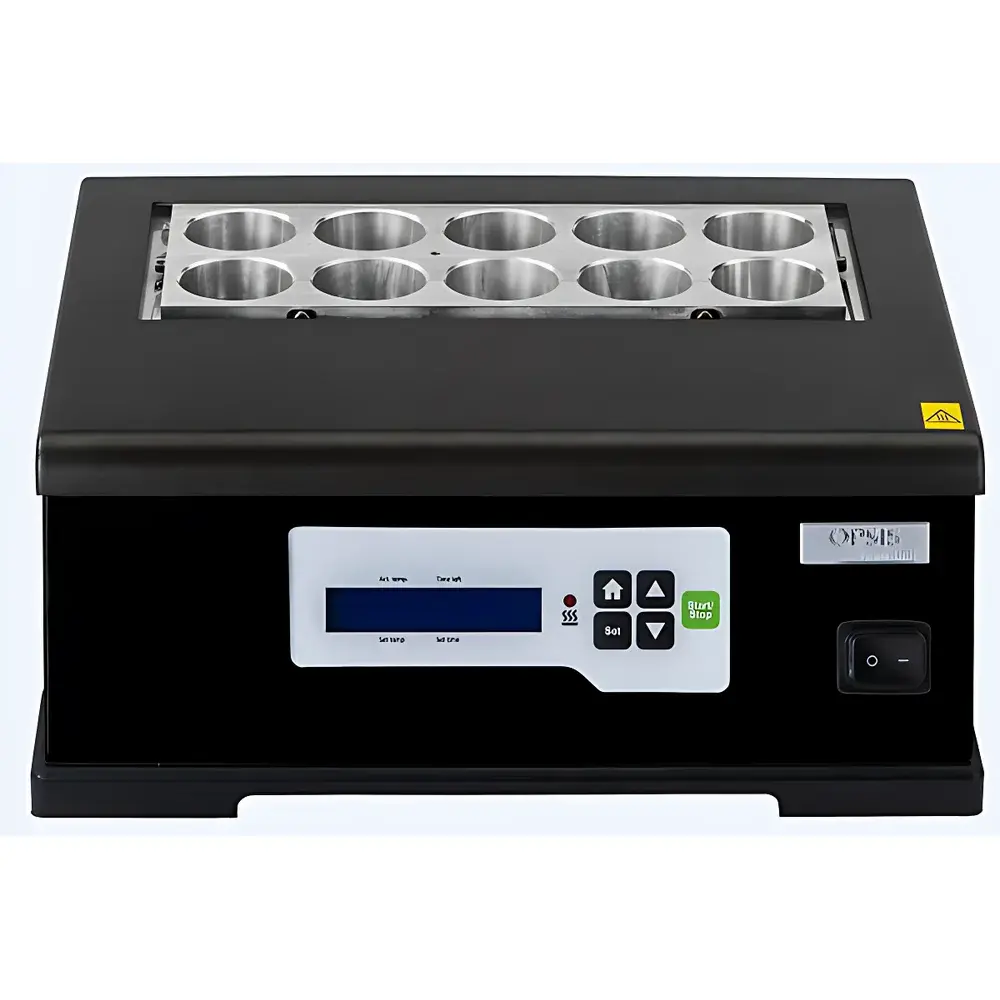
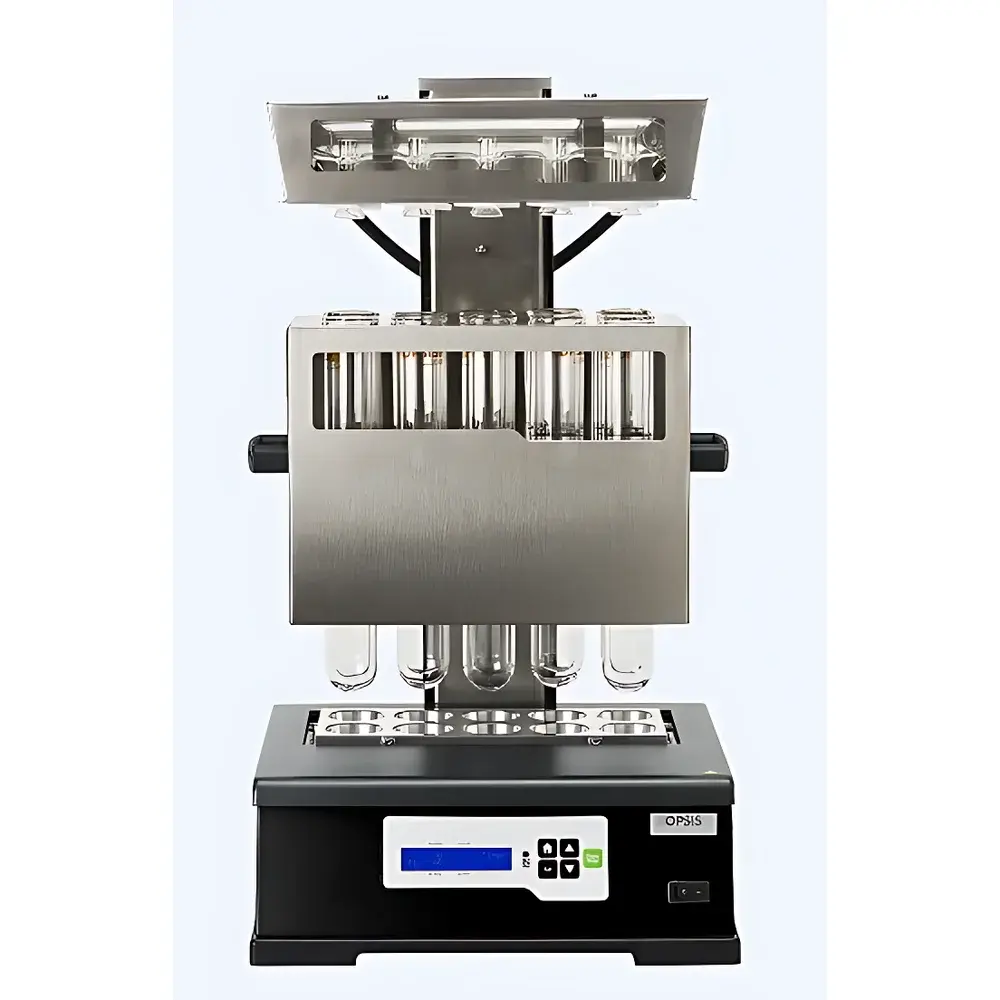
OPSIS DI-320 20-Position Fully Automated Kjeldahl Digestion Furnace
| Brand | OPSS/OPSIS |
|---|---|
| Origin | Sweden |
| Manufacturer Status | Authorized Distributor |
| Origin Category | Imported |
| Model | DI-320 |
| Pricing | Upon Request |
| Digestion Capacity | 20 samples per batch |
| Digestion Time | <60 min |
| Temperature Range | Ambient to 450 °C (digital display) |
| Temperature Control Accuracy | ±0.5 °C |
| Over-Temperature Protection | 500 °C with audible/visual alert |
| Heating Duration Setting | 1–999 min |
| Power Supply | 220 V / 50 Hz, 2200 W |
| Compliance | AOAC, EPA, DIN, ISO |
Overview
The OPSS DI-320 is a 20-position fully automated Kjeldahl digestion furnace engineered for high-throughput, reproducible sample mineralization in compliance with standardized wet-chemical digestion protocols. Designed and manufactured in Sweden, the system implements precise resistive heating within a thermally insulated chamber, coupled with an electromechanically actuated digestion rack lift mechanism. Its operational principle centers on controlled thermal decomposition of organic matrices—typically proteins, soils, feedstuffs, or environmental solids—in concentrated sulfuric acid under catalytic conditions. The furnace supports both classical Kjeldahl nitrogen determination and broader elemental analysis workflows requiring complete acid digestion prior to downstream quantification (e.g., by ICP-OES or AA). With a maximum operating temperature of 450 °C and digital PID-based temperature regulation (±0.5 °C), the DI-320 ensures uniform thermal distribution across all 20 digestion tubes, minimizing inter-sample variability and supporting method transfer between laboratories.
Key Features
- Automated rack elevation and descent: Motor-driven vertical positioning enables hands-free loading/unloading at ergonomic height (approx. 85 cm), reducing operator fatigue and improving workflow consistency.
- Programmable lift sequencing: Integration of lift timing into user-defined digestion methods ensures synchronized mechanical action with heating profiles (e.g., rack lowers after initial charring, rises during reflux phase).
- Real-time process monitoring: Digital interface displays current temperature, setpoint, elapsed time, and remaining digestion duration; alerts trigger on sensor fault, over-temperature, or manual interruption.
- Robust corrosion-resistant construction: Chamber lining, heating elements, and structural components utilize high-grade stainless steel (AISI 316); fluoropolymer-coated fasteners and thick-walled borosilicate glass fume hoods ensure long-term stability in aggressive H2SO4/K2SO4/Se catalyst environments.
- Self-diagnostic firmware: Built-in startup self-test verifies temperature sensor integrity, heater continuity, and motor encoder feedback; faults are logged with diagnostic codes for service traceability.
- Optional fume abatement module: Integrates with certified acid gas scrubbers (e.g., NaOH-based neutralization units) to meet local occupational exposure limits (OELs) and extend furnace service life by minimizing condensate corrosion.
Sample Compatibility & Compliance
The DI-320 accommodates standard 250–400 mL Kjeldahl digestion tubes (e.g., DURAN® or equivalent borosilicate glass), with custom rack configurations available for alternative tube geometries. Its design conforms to internationally recognized validation frameworks: digestion performance aligns with AOAC Official Methods of Analysis (e.g., 984.13, 981.10), EPA Method 3050B (acid digestion of sediments and soils), and ISO 5983-1 (crude protein determination in animal feeding stuffs). The instrument’s temperature accuracy, ramp fidelity, and thermal homogeneity support GLP-compliant documentation when paired with validated software. All electrical and mechanical safety systems comply with IEC 61010-1:2010 for laboratory equipment.
Software & Data Management
While the DI-320 operates via an embedded touchscreen controller with onboard method storage (up to 20 user-defined programs), optional Ethernet or RS-232 connectivity enables integration into centralized LIMS environments. Audit trails—including method parameters, start/stop timestamps, temperature logs, and alarm events—are exportable as CSV files. When used in regulated settings (e.g., food safety labs under FDA 21 CFR Part 11), the system supports electronic signatures and role-based access control through compatible third-party laboratory software platforms. Firmware updates maintain alignment with evolving regulatory expectations for data integrity and instrument qualification.
Applications
- Determination of total nitrogen and crude protein content in cereals, dairy products, meat, and pet food per AOAC and ISO standards.
- Heavy metal extraction from soil, sludge, and plant tissue prior to ICP-MS or AAS analysis (EPA 3050B, ISO 11466).
- Preparation of biological matrices (blood, tissue homogenates) for selenium, copper, or zinc quantification.
- Quality control in fertilizer manufacturing, where ammonium sulfate and urea content require precise Kjeldahl titration.
- Research-scale digestion of novel biomaterials (e.g., algal biomass, bioplastics) under non-standardized acidic conditions.
FAQ
Does the DI-320 support gradient heating profiles?
Yes — users can define up to five sequential temperature ramps with independent dwell times and rate limits (°C/min), enabling optimized charring-reflux-digestion cycles.
Is calibration traceable to national standards?
Temperature sensors are factory-calibrated against NIST-traceable references; field recalibration is supported using certified reference thermometers (e.g., PRTs with ±0.1 °C uncertainty).
Can the lift mechanism be overridden manually during operation?
Yes — emergency manual release allows immediate rack lowering without power interruption, maintaining operator safety during unexpected thermal events.
What maintenance intervals are recommended for routine use?
Visual inspection of seals and fume hood integrity every 100 cycles; annual verification of temperature uniformity across all 20 positions using calibrated multi-point probes.
Is the DI-320 compatible with robotic sample handlers?
Standardized rack dimensions and programmable lift endpoints enable integration with third-party liquid handlers or tube grippers equipped with I/O signaling interfaces (0–10 V or dry contact).



