
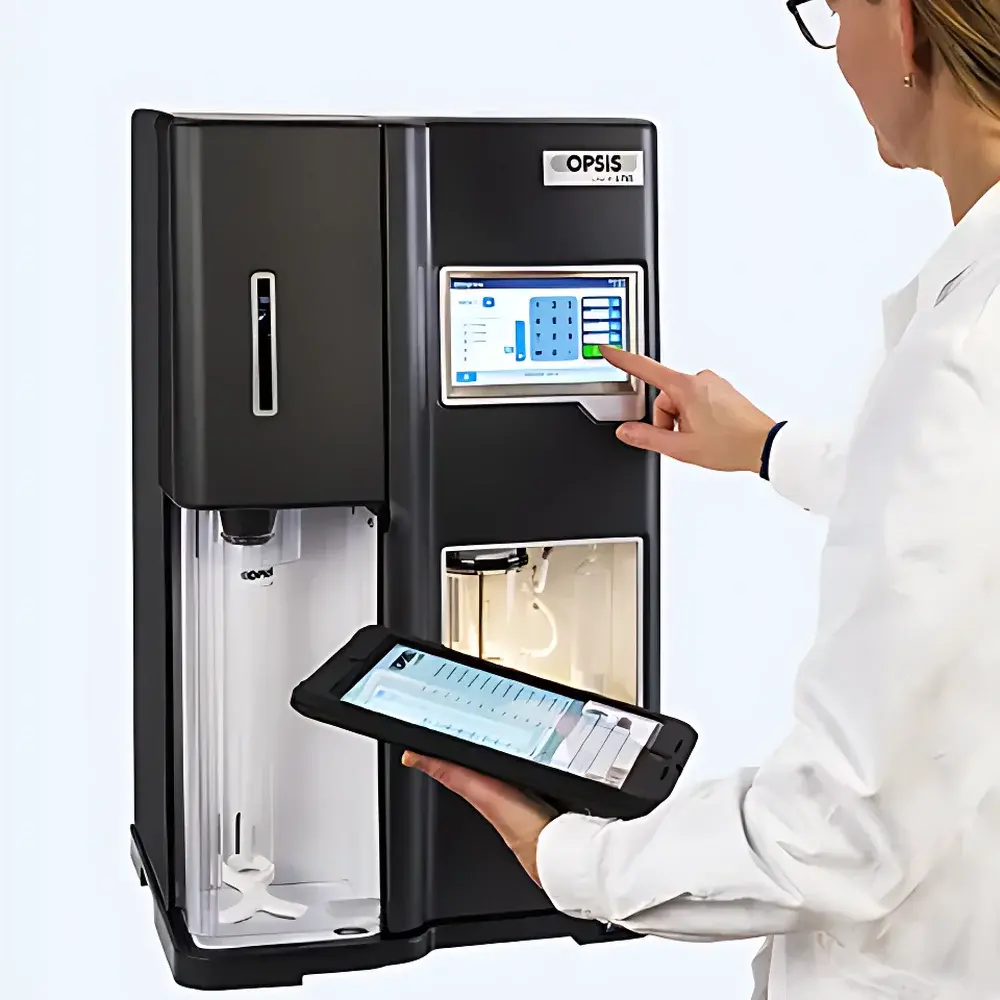
OPSIS KD-200 Semi-Automatic Kjeldahl Nitrogen Determinator
| Brand | OPIS / OPSIS |
|---|---|
| Origin | Sweden |
| Manufacturer Type | Authorized Distributor |
| Origin Category | Imported |
| Model | KD-200 |
| Instrument Type | Kjeldahl Nitrogen Determinator |
| Automation Level | Semi-Automatic |
| Nitrogen Determination Range | 0.05–240 mg N |
| Distillation Time | 2–4 min per sample |
| Repeatability | RSD ≤ ±0.5% |
| Sample Weight Capacity | Solids ≤ 5 g, Liquids ≤ 20 mL |
| Recovery Rate | ≥ 99.5% |
| Power Consumption | 2200 W |
| Dimensions (L×W×H) | 430 mm × 330 mm × 700 mm |
Overview
The OPISIS KD-200 Semi-Automatic Kjeldahl Nitrogen Determinator is an engineered solution for precise, reproducible nitrogen quantification in compliance with internationally recognized wet-chemistry standards. Based on the classical Kjeldahl digestion–distillation–titration principle, the KD-200 performs steam distillation of ammonium ions liberated from acid-digested samples under controlled alkaline conditions. It is designed for laboratories requiring high-throughput, method-flexible distillation without full automation of titration—making it ideal for routine QC/QA labs, feed and food testing facilities, environmental monitoring centers, and academic research groups conducting standardized nitrogen analysis across diverse matrices.
Key Features
- Programmable distillation protocol engine supporting up to 12 user-defined methods—including variable steam intensity (10–100%), programmable delay (0–99 min or continuous), and multi-step reagent addition sequences
- Integrated steam generator, alkali pump, and water pump enabling fully automated dilution, alkalization, distillation, waste discharge, and post-run cleaning—all within a closed, operator-safe system
- Conical joint interface accommodating digestion tubes from 100 mL to 750 mL capacity, ensuring compatibility with existing digestion hardware across multiple digestion furnace models (e.g., OPISIS D-100, D-200 series)
- Robust steel chassis with epoxy-coated surface—validated for resistance to concentrated H2SO4, NaOH, and other aggressive reagents used in Kjeldahl workflows
- Dual-level safety architecture: hardware interlocks (digestion tube presence detection, safety door closure sensor) combined with thermal and pressure monitoring of the steam generator (over-temperature + over-pressure cutoff)
- Color touchscreen HMI with multilingual support (English, Swedish, Danish, Chinese); role-based access control (user, advanced user, service technician) and audit-trail-enabled operation logging
Sample Compatibility & Compliance
The KD-200 supports nitrogen determination across solid and liquid matrices including cereals, animal feed, dairy products, wastewater, soil extracts, sludge, pharmaceutical excipients, and chemical intermediates. Its operational flexibility extends beyond classical Kjeldahl nitrogen (TKN) to non-Kjeldahl applications such as volatile base nitrogen (TVBN), total volatile acidity, formaldehyde, sulfur dioxide, ethanol, phenol, urea, nitrate/nitrite (via Devarda reduction), and cyanide—enabled by low-intensity, extended-duration steam profiles and programmable acid injection (e.g., H3PO4). All standard operating procedures align with AOAC Official Methods ® 981.10, 984.13, 991.20; EPA Method 351.2; ISO 5983-1:2009, ISO 8968-1:2014; and DIN EN ISO 1871. The instrument’s data handling architecture supports GLP/GMP-aligned documentation requirements, including electronic signature readiness and traceable method versioning.
Software & Data Management
- Onboard method storage with timestamped execution logs, including steam pressure, temperature, distillation duration, and reagent volumes per run
- FTP-based file export (CSV, PDF reports) and Wi-Fi connectivity for remote status monitoring and firmware updates
- Compliance-ready data structure: each result file contains instrument ID, operator ID, method ID, sample ID, digest tube barcode (if scanned), raw titrant volume, calculated N content, and RSD per batch—structured for integration into LIMS environments
- Optional upgrade path to KD-210 configuration via external potentiometric titrator interface (RS-232/USB), enabling full 21 CFR Part 11-compliant electronic records when paired with validated titration software
Applications
Primary use cases include protein content estimation in food and feed (via N × 6.25 or matrix-specific conversion factors), regulatory compliance testing for TKN in municipal wastewater (EPA 351.2), quality control of fertilizer nitrogen content, speciation of ammonia vs. organic nitrogen in soil leachates, and forensic analysis of volatile nitrogenous compounds. The KD-200 is especially suited for laboratories performing targeted distillation-only assays—such as SO2 in wine or ethanol in fermentation broths—where full Kjeldahl digestion has been completed off-instrument and only standardized, reproducible distillation is required.
FAQ
Does the KD-200 include an integrated titration system?
No—the KD-200 is a semi-automatic distillation unit. Titration must be performed manually using colorimetric indicators or externally with a compatible potentiometric titrator (e.g., when upgraded to KD-210 configuration).
Can the KD-200 be used for non-Kjeldahl volatile compound analysis?
Yes—its programmable steam intensity and timing allow gentle, prolonged distillation suitable for TVBN, volatile acids, formaldehyde, SO2, and ethanol without degradation or co-distillation artifacts.
What safety certifications does the KD-200 hold?
The instrument complies with IEC 61010-1:2010 for laboratory electrical equipment safety and carries CE marking. All internal fluidic paths are chemically resistant borosilicate glass or PTFE-lined stainless steel.
Is method validation documentation available?
Yes—OPSIS provides IQ/OQ documentation templates aligned with ISO/IEC 17025 and GxP requirements, including performance verification protocols for recovery, precision, linearity, and carryover.
How is cooling water managed during operation?
Cooling water flow is automatically activated only during distillation and deactivated immediately after completion—reducing water consumption by >60% compared to continuously flowing systems.






