
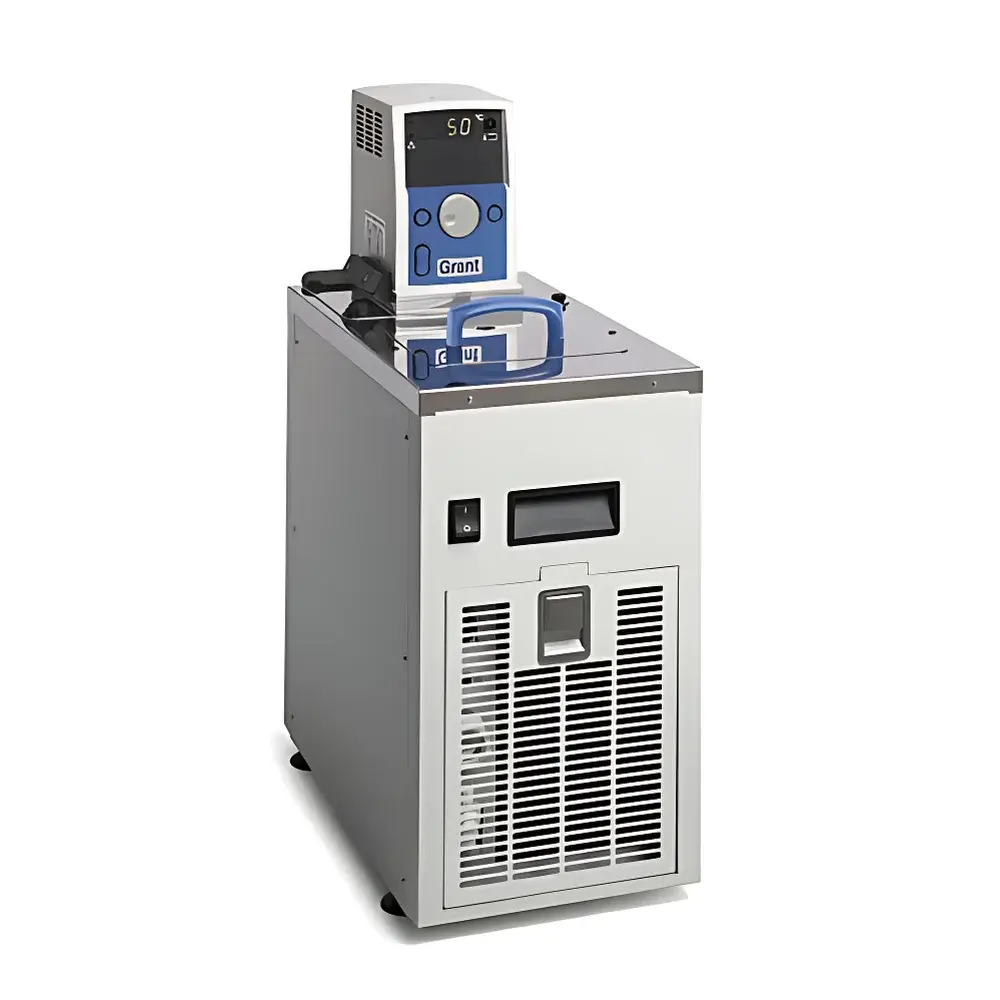
Optima™ R Series Refrigerated Circulating Bath
| Origin | UK |
|---|---|
| Manufacturer Type | Authorized Distributor |
| Import Status | Imported |
| Model | Optima-R Series |
| Pricing | Available Upon Request |
| Temperature Range | −20 to 100 °C |
| Stability | ±0.1 °C |
| Max Flow Rate | 17 L/min |
| Max Pressure | 270 mbar |
| Refrigeration Capacity @ 20 °C | 250–1100 W (model-dependent) |
| Bath Volumes | 5–20 L |
| Drain Port | Standard on GD120-R2 to GD120-R5 |
| Optional Accessories | VTP1/VTP2 Vertical Turbine Pumps |
Overview
The Optima™ R Series Refrigerated Circulating Bath is an engineered thermal management platform designed for precision temperature control in laboratory and analytical applications requiring both active cooling and heating within a single, compact unit. Based on a closed-loop liquid circulation principle, it maintains stable thermal conditions across external equipment—including spectrophotometers, viscometers, calorimeters, and reaction jackets—by delivering conditioned fluid through insulated tubing at precisely regulated temperatures. Its dual-mode operation (refrigeration + heating) enables seamless transitions between sub-zero and elevated setpoints without hardware modification, while the high-stability control architecture ensures ±0.1 °C thermal uniformity under dynamic load conditions. Developed and manufactured in the UK, the system complies with IEC 61010-1 safety standards for laboratory electrical equipment and incorporates fail-safe thermal cutouts, overpressure protection, and dry-run detection to support unattended operation in GLP-compliant environments.
Key Features
- Intuitive front-panel interface with rotary encoder and dual function keys for rapid parameter entry and navigation—no menu nesting required;
- High-contrast, backlit digital display (LED, 4-digit resolution) optimized for readability at distances up to 3 meters;
- Programmable audible/visual alarm system with configurable thresholds for temperature deviation, pump failure, or low fluid level;
- Three user-definable preset temperature points for rapid recall during routine protocols;
- Field-accessible user calibration mode enabling offset adjustment at specific operating points (e.g., 4 °C, 25 °C, 37 °C) to compensate for sensor drift or system-specific thermal lag;
- High-efficiency internal centrifugal pump delivering up to 17 L/min at 270 mbar max pressure, with flow stability maintained across viscosity ranges typical of water-glycol mixtures (up to 50% v/v);
- Modular bath tank design supporting five interchangeable configurations (GD120-R1 to GD120-R5), differing in volume (5–20 L), refrigeration capacity, and integrated drainage functionality;
- Independent refrigeration circuit disable option: allows pure heating operation up to 100 °C without compressor engagement, reducing energy consumption and mechanical wear during warm-only workflows.
Sample Compatibility & Compliance
The Optima™ R Series accommodates standard laboratory fluids including deionized water, 30–50% aqueous glycol solutions, and low-conductivity silicone oils (viscosity ≤ 50 cSt). All wetted components—including pump housing, heat exchanger, and bath chamber—are constructed from corrosion-resistant stainless steel (AISI 316) and EPDM-sealed polymers compatible with ISO 8573-1 Class 3 compressed air environments. Units are CE-marked and conform to EN 61326-1 (EMC) and EN 61000-6-3 (emissions). For regulated quality systems, optional audit-trail-enabled firmware supports 21 CFR Part 11-compliant electronic records when paired with validated data acquisition software. The system meets ASTM E2927-21 requirements for thermal stability verification in calorimetric instrumentation and is routinely deployed in ISO/IEC 17025-accredited testing laboratories for method validation per USP and Ph. Eur. 2.2.42.
Software & Data Management
While the base unit operates autonomously via its embedded controller, optional RS-232/RS-485 and Ethernet interfaces enable integration into centralized lab infrastructure. Communication follows Modbus RTU/TCP protocol for interoperability with SCADA, LIMS, and ELN platforms. Firmware version 2.4+ supports time-stamped event logging (power cycles, alarms, setpoint changes) stored internally for ≥30 days; logs export via USB-C as CSV files compliant with ISO/IEC 17025 clause 7.7.2. Remote monitoring and control are available through the vendor’s web-based LabLink Suite (v3.1), which provides real-time graphing, multi-unit synchronization, and automated report generation aligned with GLP Annex 11 documentation standards.
Applications
- Temperature stabilization of UV-Vis and FTIR spectrophotometer sample compartments during kinetic assays;
- Cooling/heating of jacketed glass reactors in synthetic chemistry workflows (e.g., Grignard additions, polymerization initiation);
- Calibration traceability for thermocouples, RTDs, and infrared thermometers per ISO/IEC 17025 Clause 6.5.2;
- Thermal conditioning of HPLC column ovens and detector cells to minimize retention time drift;
- Support of accelerated stability studies (ICH Q1A) by maintaining controlled storage conditions for reference standards;
- Integration with differential scanning calorimeters (DSC) and thermogravimetric analyzers (TGA) for baseline correction and purge gas pre-conditioning.
FAQ
Can the Optima™ R operate without refrigeration at temperatures above ambient?
Yes—the refrigeration circuit can be disabled via front-panel setting, allowing the unit to function as a high-precision heated circulator up to 100 °C using only the resistive heating element.
What is the maximum allowable viscosity of circulating fluid?
The pump is rated for fluids with kinematic viscosity ≤ 50 cSt at operating temperature; higher viscosities may reduce flow rate and impair thermal response time.
Is external drainage supported on all models?
Drain ports are factory-installed on GD120-R2 through GD120-R5; GD120-R1 requires optional retrofitting.
Are VTP1 and VTP2 pumps compatible with all GD120 variants?
Yes—both vertical turbine pumps connect via standard 12.7 mm (½″) compression fittings and are certified for continuous duty with the full Optima™ R series.
Does the system support NIST-traceable calibration?
User calibration offsets may be applied using NIST-traceable reference thermometers; full factory calibration certificates (with uncertainty budgets per ISO/IEC 17025) are available as a paid service.



