
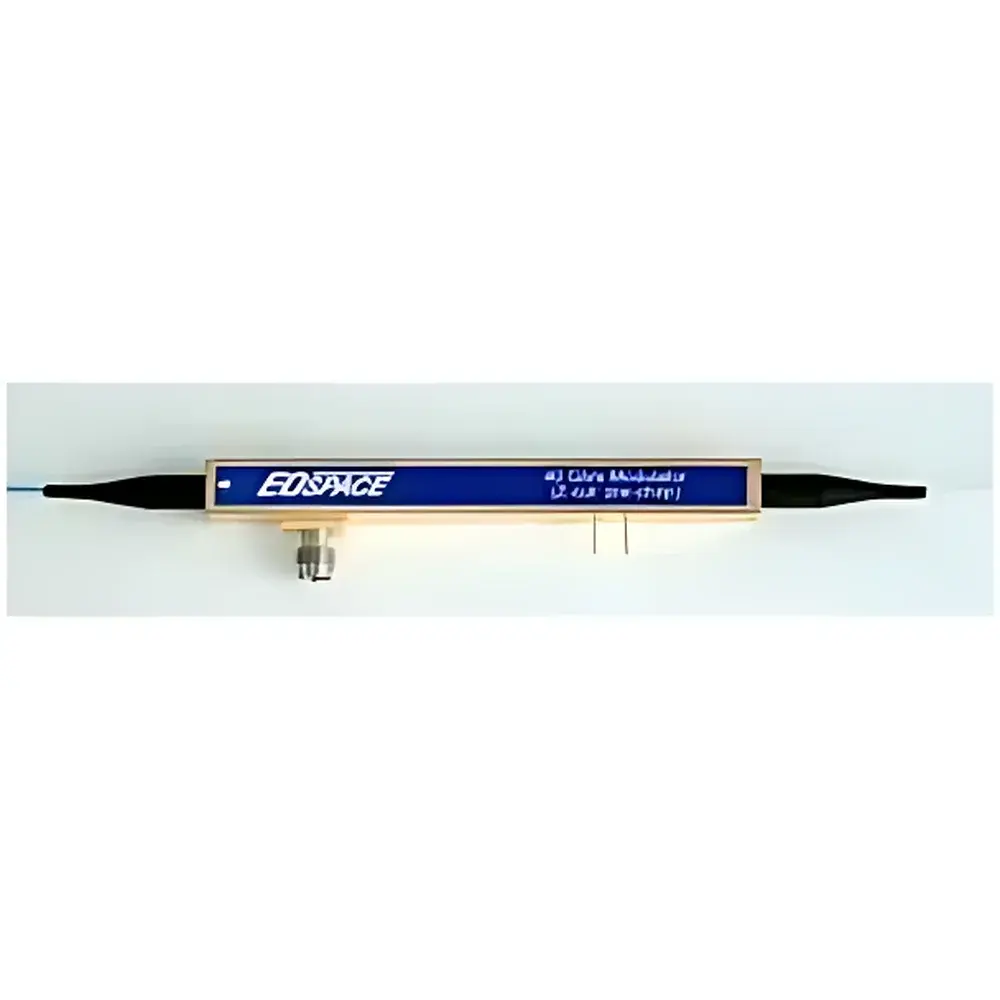
Optiphase Ultra-Low Vπ Electro-Optic Phase Modulator
| Brand | Optiphase |
|---|---|
| Origin | USA |
| Manufacturer Type | Authorized Distributor |
| Product Category | Imported Optical Component |
| Model | Ultra-Low Vπ |
| Component Type | Electro-Optic Modulator |
| Operating Wavelength | 1550 nm (C- and L-band) |
| optional wavelengths | 700, 850, 980, 1064, 1310, 1700, 2000+ nm |
| Insertion Loss | < 4 dB (< 3 dB optical grade) |
| 3-dB Bandwidth | >10 GHz, >20 GHz, or >30 GHz (model-dependent) |
| Vπ (@ 1 GHz) | < 3 V, < 4 V, or < 5 V (model-dependent) |
| Optical Return Loss | > 50 dB |
| RF Connector | Female K (≤20 GHz), Female V (20–40 GHz) |
| Package Dimensions | 88.4 × 8.9 × 8.9 mm³ |
| Optical Interface | FC/UPC (FC/APC and custom interfaces available) |
| S11 | < −10 dB |
| Optional Features | Ultra-low insertion loss, customer-defined ultra-low Vπ, integrated polarizer, integrated variable optical attenuator (VOA), depolarizer |
Overview
The Optiphase Ultra-Low Vπ Electro-Optic Phase Modulator is a high-performance lithium niobate (LiNbO3) waveguide-based device engineered for precision phase control in coherent optical systems, chirp management, quantum optics experiments, interferometric sensing, and advanced photonic signal processing. Leveraging X-cut or Z-cut titanium-indiffused LiNbO3 substrates, the modulator operates on the linear electro-optic (Pockels) effect—inducing a voltage-controlled refractive index change to impart a controllable optical phase shift without altering intensity. Its ultra-low half-wave voltage (Vπ < 3 V at 1 GHz for top-tier variants) enables efficient drive electronics integration, reduced thermal loading, and improved dynamic range in closed-loop stabilization architectures. Designed for C-band (1530–1565 nm) and L-band (1565–1625 nm) operation—with wavelength options extending from 700 nm to 2000+ nm—the device supports both single-mode (SM) and polarization-maintaining (PM) fiber interfacing, ensuring compatibility with polarization-sensitive applications including heterodyne detection and optical frequency comb stabilization.
Key Features
- Ultra-low Vπ: As low as < 3 V @ 1 GHz (optical-grade configuration), minimizing RF driver power requirements and enabling direct interfacing with commercial DACs and arbitrary waveform generators
- Broadband RF response: Selectable 3-dB bandwidths of >10 GHz, >20 GHz, or >30 GHz—validated per IEC 61280-2-9 and Telcordia GR-468-CORE
- Low optical insertion loss: < 4 dB standard; < 3 dB achievable with optimized anti-reflection coatings and mode-field matching (MFD alignment)
- High optical return loss: > 50 dB, meeting ITU-T G.691 and G.694.1 spectral purity requirements for DWDM transmission systems
- Hermetically sealed, bench-top compatible package: 88.4 × 8.9 × 8.9 mm³ aluminum housing with thermal stability < ±0.01 °C/°C ambient drift
- RF interface flexibility: Female K-type connectors for ≤20 GHz operation; female V-type for 20–40 GHz band coverage
- Polarization fidelity: PM input fiber with extinction ratio > 25 dB; SM or PM output options support cascaded modulation schemes
Sample Compatibility & Compliance
The Ultra-Low Vπ Phase Modulator is compatible with standard telecom-grade PM fiber (PANDA or Bow-tie), single-mode fiber (ITU-T G.652.D), and specialty fibers including polarization-preserving photonic crystal fiber (PCF) and fluoride fibers for mid-IR extension. All devices undergo 100% optical and RF characterization per MIL-STD-883H Method 5005.10 (optical throughput) and Method 2032.1 (RF impedance matching). The modulator complies with RoHS Directive 2011/65/EU and REACH Regulation (EC) No. 1907/2006. For regulated environments—including FDA-regulated optical metrology tools and ISO/IEC 17025-accredited calibration labs—the device supports traceable NIST-traceable calibration reports (available upon request) and full GLP-compliant documentation packages.
Software & Data Management
While the phase modulator itself is a passive electro-optic component requiring no embedded firmware, it integrates seamlessly into automated test environments via industry-standard control protocols. Users commonly deploy it within LabVIEW™, Python (PyVISA, NumPy), MATLAB® Instrument Control Toolbox, or Keysight PathWave software suites using GPIB, USB-TMC, or Ethernet (SCPI over TCP/IP) interfaces—when paired with external bias controllers (e.g., Optiphase BIAS-1000 series) or programmable RF sources. Optional integrated monitor photodiodes (available as add-on) enable real-time optical power feedback for closed-loop DC bias stabilization. All calibration data—including Vπ vs. wavelength curves, S-parameters (S11), and temperature-dependent phase shift linearity—are delivered in CSV and HDF5 formats compliant with ASTM E2500-20 (Standard Guide for Specification, Design, and Verification of Computerized Systems in Laboratories).
Applications
- Coherent optical communications: IQ modulator bias point stabilization, carrier suppression, and digital pre-distortion in 400G/800G DP-QPSK and DP-16QAM transceivers
- Quantum photonics: Phase encoding in time-bin and polarization-based qubit generation; Mach-Zehnder interferometer path balancing
- Laser linewidth narrowing: Pound-Drever-Hall (PDH) locking loops for ultra-stable cavity-stabilized lasers (e.g., Ti:Sapphire, fiber lasers)
- Optical sensing: Fiber optic gyroscopes (FOGs), distributed acoustic sensing (DAS), and interferometric strain/temperature monitoring
- Photonic computing: Analog optical matrix multiplication, tunable delay lines, and reconfigurable optical neural network nodes
- Spectroscopy: Frequency comb tooth selection, sideband generation for dual-comb spectroscopy, and electro-optic sampling
FAQ
What is the typical Vπ temperature coefficient for this modulator?
The Vπ exhibits a temperature dependence of approximately +300 ppm/°C across −5 °C to +70 °C, consistent with bulk LiNbO3 electro-optic tensor behavior. Active thermal stabilization (±0.1 °C) is recommended for sub-mrad phase stability over multi-hour operation.
Can this phase modulator be used in reflection configuration?
No—it is a unidirectional, forward-propagating device designed for transmission-mode operation only. Reflection-based phase modulation requires Faraday rotators or resonant cavities not supported by this architecture.
Is DC bias control required for stable phase operation?
Yes. Drift in the lithium niobate waveguide’s DC operating point necessitates active bias control. We recommend pairing with an Optiphase BIAS-1000 series controller or equivalent low-noise, high-impedance (>10 MΩ) bias tee with < 10 nV/√Hz voltage noise floor.
Are custom wavelength versions validated per IEC 61280-2-9?
Yes. All non-standard wavelength variants—including 1064 nm, 1310 nm, and 2000 nm—undergo full RF and optical characterization per IEC 61280-2-9 Annex A (modulation depth verification) and are supplied with wavelength-specific S-parameter files.
Does the device support analog or digital modulation formats?
It supports both. As a linear phase shifter, it is inherently suited for analog phase modulation (e.g., FM, PM), but also serves as the phase arm in digital IQ modulators when combined with complementary intensity modulators and precise RF phasing networks.




