
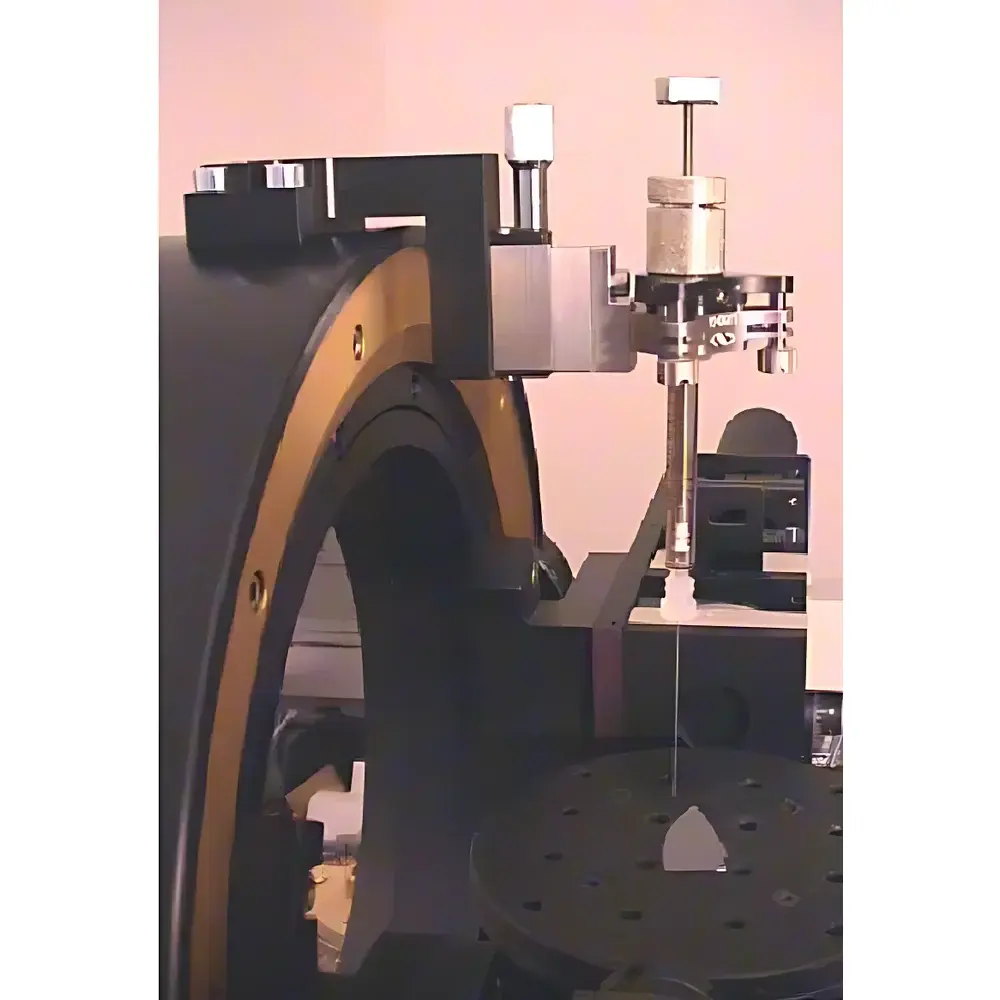
Optrel Multiskop-CA Video Optical Contact Angle Analyzer
| Brand | Optrel |
|---|---|
| Origin | Germany |
| Model | Multiskop-CA |
| Type | Video-based Optical Contact Angle Measurement System |
| Integration | Modular add-on for Multiskop ellipsometry platform |
| Imaging | High-resolution CCD camera with programmable LED backlighting array |
| Sample stage | Motorized XYZ translation stage with thermal coupling capability |
| Analysis engine | Automated contour tracing algorithm based on Young–Laplace equation fitting |
| Compliance | Designed for ISO 19403-2, ASTM D7334, and ISO 21365-compliant surface energy evaluation workflows |
| Software | CAM (Contact Angle Module) with audit-trail-enabled data logging |
Overview
The Optrel Multiskop-CA Video Optical Contact Angle Analyzer is a modular, high-precision optical system engineered for quantitative contact angle measurement and interfacial energy characterization of solid–liquid and solid–gas interfaces. It operates on the fundamental principle that the equilibrium shape of a sessile droplet or captive bubble at a solid surface is governed by the Young–Laplace equation—a physical model describing the pressure difference across a curved liquid–vapor interface as a function of surface tension and local curvature. By capturing high-fidelity side-view images of droplets or bubbles using a calibrated CCD camera and precisely controlled LED illumination, the system extracts the two-dimensional contour profile and fits it to the Young–Laplace solution to determine the static or dynamic contact angle with sub-pixel resolution. As an integrated extension of the Multiskop ellipsometry platform, the Multiskop-CA leverages existing hardware—including the motorized sample stage, image acquisition card, and host computing infrastructure—ensuring mechanical stability, thermal consistency, and synchronization fidelity critical for reproducible interfacial measurements.
Key Features
- Automated contour recognition algorithm eliminating manual baseline or tangent point selection—enabling fully objective, operator-independent analysis.
- Integrated XYZ micro-positioning syringe dispenser with sub-micron repeatability for precise droplet deposition and sequential multi-angle acquisition.
- Dedicated thermostatically coupled sample cell minimizing evaporation artifacts and enabling temperature-controlled wettability studies from 5 °C to 60 °C.
- Uniform, adjustable LED backlight array mounted orthogonally to the imaging axis—optimized for high-contrast silhouette imaging without glare or halo effects.
- Interchangeable high-numerical-aperture objectives supporting magnification ranges from 2× to 10×, facilitating measurement of droplets from 0.5 mm to 8 mm in diameter.
- Native compatibility with Multiskop’s ellipsometric modules—allowing concurrent or sequential acquisition of contact angle and thin-film optical constants on identical sample regions.
Sample Compatibility & Compliance
The Multiskop-CA accommodates rigid and flexible substrates up to 150 mm × 150 mm, including silicon wafers, polymer films, coated metals, porous membranes, and functionalized biomaterials. Its non-contact optical methodology ensures no mechanical perturbation during measurement. The system supports standard test liquids (e.g., water, diiodomethane, ethylene glycol) and custom formulations per ASTM D7334 Annex A1. Data output conforms to ISO 19403-2 (determination of surface free energy via contact angle), ISO 21365 (wettability classification), and supports GLP/GMP documentation requirements through timestamped, user-locked measurement logs with full parameter traceability.
Software & Data Management
The CAM (Contact Angle Module) software runs natively under Windows 10/11 and provides real-time image capture, dynamic video recording, and batch processing of time-resolved contact angle series. All raw images, fitted contours, Young–Laplace residuals, and derived surface energy components are stored in HDF5 format with embedded metadata (exposure time, lens ID, temperature, syringe volume). Audit trails record user actions, parameter modifications, and calibration events in compliance with FDA 21 CFR Part 11 requirements when configured with electronic signatures. Export options include CSV, PDF reports, and direct integration with LIMS via REST API.
Applications
- Quality control of hydrophobic/hydrophilic coatings in medical device manufacturing (e.g., catheter surface functionalization).
- Surface energy mapping of printed electronics substrates to optimize ink adhesion and film uniformity.
- Characterization of plasma-treated polymers for automotive interior components.
- Stability assessment of Pickering emulsions and nanoparticle-laden interfaces in pharmaceutical formulations.
- Correlation of contact angle hysteresis with surface roughness and chemical heterogeneity in MEMS packaging materials.
- Validation of cleaning efficacy on semiconductor wafers post-etch residue removal.
FAQ
Can the Multiskop-CA measure advancing and receding contact angles?
Yes—the system supports automated dynamic mode using programmable syringe dispensing to incrementally add or withdraw liquid volume while capturing sequential frames at user-defined intervals.
Is calibration required before each measurement session?
A single geometric calibration (pixel-to-mm conversion) is performed during initial setup; subsequent sessions inherit this calibration unless optics or magnification is changed.
Does the system support captive bubble measurements on hydrophobic surfaces?
Yes—by inverting the sample orientation and introducing a gas bubble beneath a liquid meniscus, the same imaging and fitting framework applies per ISO 19403-4.
Can third-party liquids be used for surface energy calculation?
Yes—the software allows user-defined liquid property databases, including surface tension, polar/dispersive components, and density, enabling custom Owens–Wendt or van Oss–Chaudhury–Good models.
Is remote operation supported?
Full GUI control and scriptable measurement sequences are available via TCP/IP, enabling integration into automated lab environments and unattended overnight testing protocols.



