
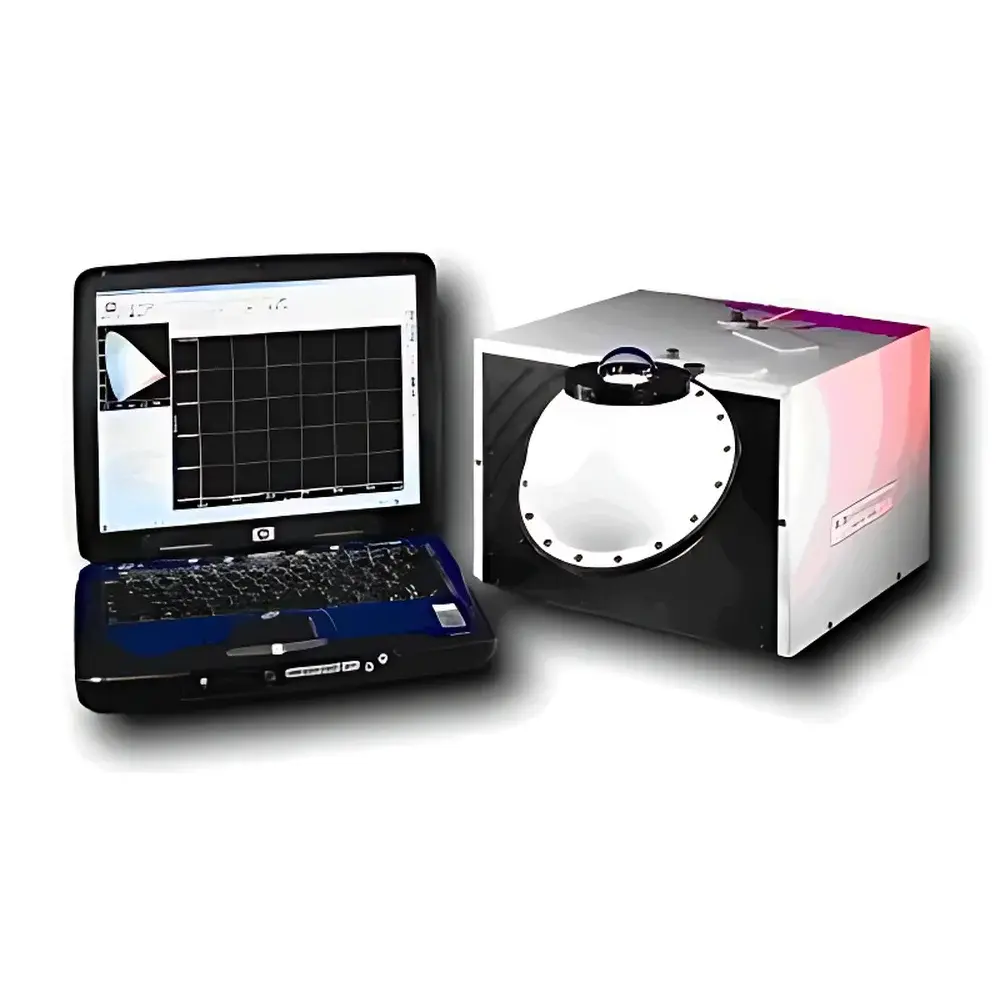
Optronic Laboratories OL 756 Portable UV Spectroradiometric Measurement System
| Brand | Optronic Laboratories |
|---|---|
| Origin | USA |
| Manufacturer Type | Authorized Distributor |
| Origin Category | Imported |
| Model | OL 756 |
| Pricing | Available Upon Request |
| Wavelength Range | 200–800 nm |
| Wavelength Accuracy | ±0.15 nm |
| Wavelength Resolution | 0.025 nm |
| Wavelength Repeatability | ±0.05 nm |
| Optical Half Bandwidth (FWHM) | 0.4–10 nm |
| Stray Light Level | <10⁻⁸ @ 285 nm (typ.) |
| Spectroradiometric Accuracy (k=2) | 1% (UVA–Vis), 3% (UVB–UVC) |
| Measurement Modes | Manual, Normal, Quickscan |
| Max Scan Speed | 200 nm/sec (Quickscan) |
| Noise Equivalent Irradiance | 1.7×10⁻⁷ W/m²·nm @ 300 nm, 1.0×10⁻⁷ W/m²·nm @ 500 nm, 5.6×10⁻⁷ W/m²·nm @ 700 nm |
| Detector | TE-cooled S-20 response photomultiplier tube (PMT) |
| High Voltage Range | 0–1100 V |
| Interface | USB / RS-232 |
| Operating Temperature | 10–40 °C |
| Power | 12 VDC / 3 A max, or 115 VAC / 1.2 A, or 230 VAC / 0.6 A |
| Dimensions | 12.75″ × 11″ × 8.75″ |
| Weight | 25 lbs |
Overview
The Optronic Laboratories OL 756 Portable UV Spectroradiometric Measurement System is a high-fidelity, double-monochromator-based spectroradiometer engineered for traceable, low-uncertainty optical radiation measurement across the ultraviolet and visible spectrum (200–800 nm). Its core architecture implements the dual-grating monochromator design mandated by IEC 62471:2006 for photobiological safety assessment—ensuring compliance with spectral purity requirements critical for accurate hazard classification of lamps, LEDs, displays, and optical radiation sources. The system’s stray light suppression (<10⁻⁸ at 285 nm) eliminates spectral contamination from out-of-band radiation, enabling reliable quantification of biologically weighted irradiance in narrow spectral bands such as actinic UV (200–400 nm), UV-A (315–400 nm), and blue light (300–700 nm) relevant to skin, cornea, and retinal phototoxicity evaluation. Designed for field-deployable metrology, the OL 756 maintains laboratory-grade radiometric accuracy (±1% k=2 for UVA–Vis; ±3% k=2 for UVB–UVC, relative to NIST-traceable standards) without requiring thermal stabilization beyond ambient operating conditions (10–40 °C).
Key Features
- Double monochromator optical path delivering ultra-low stray light performance (<10⁻⁸ @ 285 nm), essential for high-dynamic-range UV measurements and compliance with IEC 62471 Annex B test protocols.
- Thermoelectrically cooled S-20 photocathode photomultiplier tube (PMT) with selectable high-voltage bias (0–1100 V), optimized for signal-to-noise ratio across the full 200–800 nm range.
- High-resolution wavelength scanning capability: 0.025 nm resolution, ±0.15 nm absolute accuracy, and ±0.05 nm repeatability—validated against NIST SRM reference sources.
- Three operational modes: Manual (for discrete wavelength interrogation), Normal (for full-spectrum acquisition with calibrated integration time), and Quickscan (up to 200 nm/sec scan speed for rapid source profiling).
- Modular interface support via USB and RS-232, enabling seamless integration into automated test benches or portable calibration workflows under Windows-based control environments.
- Compact, ruggedized enclosure (12.75″ × 11″ × 8.75″, 25 lbs) with universal power input (12 VDC or 115/230 VAC), facilitating on-site deployment in manufacturing cleanrooms, R&D labs, and regulatory testing facilities.
Sample Compatibility & Compliance
The OL 756 supports direct radiometric measurement of collimated and diffuse optical sources—including UV-C germicidal lamps, UV-A curing systems, LED arrays, OLED panels, and broadband arc lamps—when coupled with appropriate input optics (e.g., cosine-corrected diffusers, fiber-optic probes, or integrating spheres such as the IS-670). It meets the instrumental requirements specified in IEC 62471:2006, CIE S 009/E:2002, and ANSI RP-27.3-22 for photobiological safety testing. Its spectral fidelity and uncertainty budget are aligned with COLIPA (now Cosmetics Europe) recommended instrumentation guidelines for UV/blue light hazard characterization in consumer lighting and cosmetic device applications. The system’s traceability chain conforms to ISO/IEC 17025 requirements when operated within an accredited laboratory framework, and its data output structure supports audit-ready reporting for GLP and GMP-regulated environments.
Software & Data Management
Optronic Laboratories provides proprietary Windows-compatible software for instrument control, spectral acquisition, and photobiological weighting function application (e.g., S(λ) for actinic UV, B(λ) for blue light hazard). The software applies real-time correction for detector responsivity, grating efficiency, and slit function convolution—delivering spectrally resolved irradiance (W/m²·nm) and weighted effective quantities (e.g., Eeff, LB) per IEC 62471 Annex D. All raw and processed spectra are exportable in CSV and XML formats compliant with ASTM E275-22 metadata conventions. Audit trails—including operator ID, timestamp, calibration certificate ID, and instrument configuration parameters—are embedded in each data file. The software architecture supports 21 CFR Part 11-compliant user access controls, electronic signatures, and immutable data archiving when deployed on validated IT infrastructure.
Applications
- Photobiological safety classification of lamps and luminaires per IEC 62471:2006 and EN 62471.
- UV-C disinfection system validation, including radiant exposure (J/m²) and spectral dose rate mapping.
- LED and laser product compliance testing for retinal blue-light hazard (LB) and UV photochemical hazard (EUVA, EB).
- Calibration and verification of UV radiometers, broadband meters, and reference standards.
- Material degradation studies involving UV-induced polymer aging or sunscreen efficacy testing.
- Research in atmospheric science, photomedicine, and optoelectronic device development requiring high-purity UV spectral data.
FAQ
Does the OL 756 require external calibration to maintain traceability?
No—the system includes factory-applied NIST-traceable calibration coefficients stored in non-volatile memory. Users may perform optional in-house verification using certified reference lamps (e.g., FEL, QTH) per ISO/IEC 17025 procedures.
Can the OL 756 measure pulsed UV sources?
Yes, in Manual or Normal mode with adjustable integration time (1 ms to 10 s); synchronization with external trigger signals is supported via TTL input.
Is the OL 756 suitable for outdoor solar UV monitoring?
It is not designed for unfiltered, high-irradiance solar measurements without attenuation; use with calibrated neutral density filters or diffusing optics is required to avoid PMT saturation and ensure linearity.
What accessories are recommended for LED testing?
A 6-inch integrating sphere (IS-670), cosine-corrected input optic, and collimating lens kit are commonly used to ensure uniform spatial sampling and Lambertian response.
How does the OL 756 handle spectral bandwidth corrections in weighted calculations?
The software applies rigorous convolution integrals between measured spectral irradiance and standardized action spectra (e.g., CIE S 009, ICNIRP), accounting for the instrument’s actual FWHM (0.4–10 nm) at each wavelength.
Related Products





