
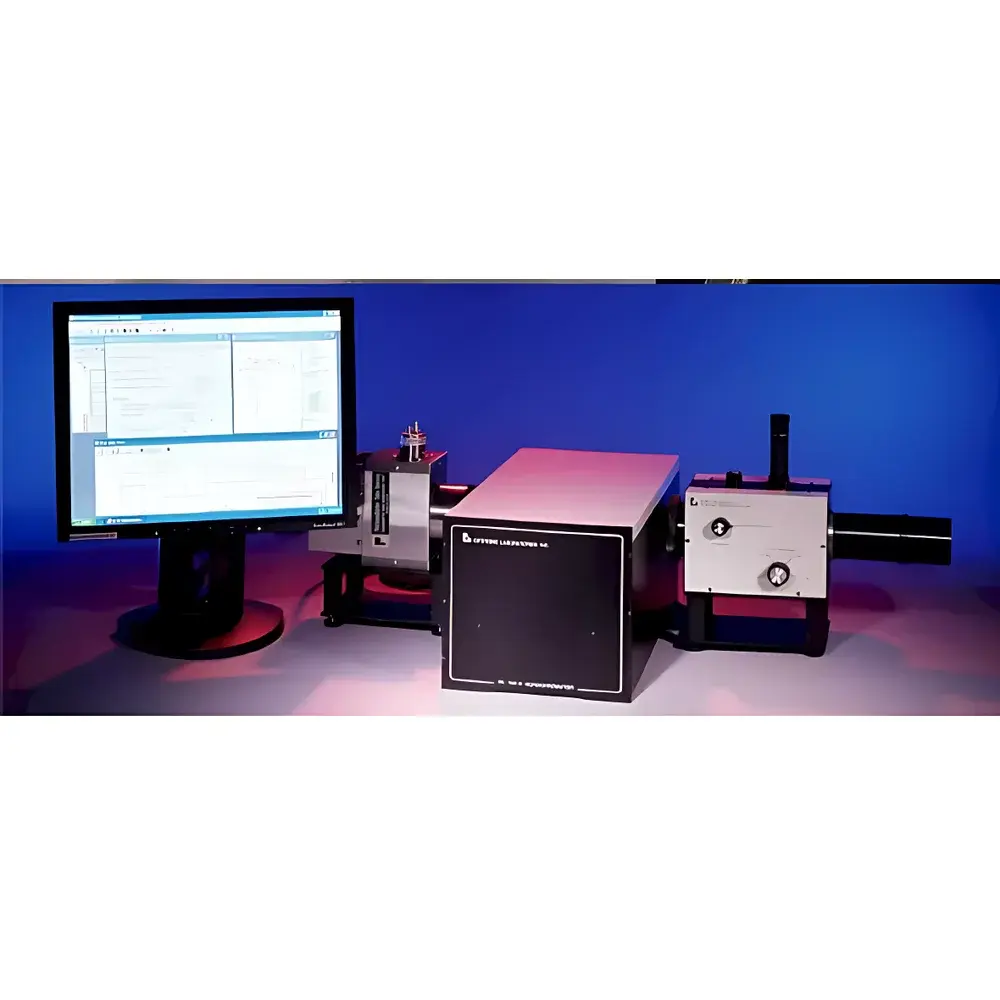
Optronic Laboratories OL750/OL756 Photobiological Safety Testing System
| Brand | Optronic Laboratories |
|---|---|
| Origin | USA |
| Manufacturer Type | Authorized Distributor |
| Product Origin | Imported |
| Model | OL750 / OL756 |
| Price Range | USD 110,000 – 138,000 |
Overview
The Optronic Laboratories OL750/OL756 Photobiological Safety Testing System is a metrology-grade, double-monochromator-based spectral radiometer engineered for full-spectrum photobiological hazard assessment of lamps, LED modules, UV emitters, and general lighting equipment. It operates on the fundamental principle of high-resolution spectral irradiance and radiance measurement across 200 nm to 3000 nm — covering deep ultraviolet (DUV), near-UV, visible, near-infrared (NIR), short-wave infrared (SWIR), and mid-wave infrared (MWIR) bands. The system implements CIE S 009/E:2022, IEC 62471:2006+A1:2015, and IEC/TR 62778 methodologies to quantify biologically weighted radiant exposures in accordance with internationally harmonized action spectra for eight defined hazard categories: (1) Actinic UV hazard (200–400 nm), (2) Near-UV hazard (315–400 nm), (3) Blue-light hazard (300–700 nm), (4) Blue-light hazard for small sources (300–700 nm), (5) Retinal thermal hazard (380–1400 nm), (6) Retinal thermal hazard for weak visual stimuli (780–1400 nm), (7) IR-A/IR-B ocular hazard (780–3000 nm), and (8) Skin thermal hazard (380–3000 nm). Its dual monochromator architecture provides <0.01% stray light rejection at 254 nm — critical for accurate UV-C and UV-B quantification where detector linearity and spectral purity are paramount.
Key Features
- Double monochromator optical design with grating selection optimized for UV throughput and NIR stability
- Automated detector switching system enabling seamless spectral acquisition from 200 nm to 3000 nm without manual intervention or recalibration
- Calibration-traceable to NIST via Optronic Laboratories’ ISO/IEC 17025-accredited calibration laboratory
- Dedicated radiance lens assembly meeting CIE-defined field-of-view requirements (e.g., 11 mrad for retinal hazard evaluation)
- Integrated electrical parameter measurement module (voltage, current, power factor, harmonic distortion) synchronized with spectral acquisition
- Real-time spectral weighting against all eight CIE/IEC hazard functions using embedded firmware algorithms
- Rugged, thermally stabilized optical bench minimizing drift during extended measurement cycles (e.g., 30-min thermal stabilization per IEC 62471 Annex B)
Sample Compatibility & Compliance
The OL750/OL756 supports testing of diverse source geometries — including bare LEDs, COB arrays, integrated luminaires, UV-C germicidal lamps, medical phototherapy devices, and automotive headlamps. It complies with measurement geometry specifications defined in IEC 62471 Annex A (irradiance vs. radiance modes), CIE S 009 Clause 6.3 (angular subtense correction), and EN 60598-1 Annex P (luminaire-specific exposure limits). All spectral data output includes mandatory metadata fields required for GLP/GMP audit trails: instrument ID, calibration certificate number, operator ID, ambient temperature/humidity logs, and traceable timestamping. The system meets FDA 21 CFR Part 11 requirements for electronic records when deployed with validated software configuration and access-controlled user roles.
Software & Data Management
Optronic’s proprietary OL-Spectra v5.2 software provides full compliance workflow automation: automatic hazard classification (Risk Group 0–3), pass/fail reporting per IEC 62471 Table 3, and export of XML-based reports compatible with regulatory submission portals (e.g., EU CE technical documentation repositories). Raw spectral data is stored in HDF5 format with embedded uncertainty budgets per NIST SP 800-140B guidelines. Software supports multi-user environments with role-based permissions (admin, technician, reviewer), electronic signatures, and immutable audit logs tracking every parameter change, calibration event, or report generation. Export formats include PDF/A-2b (archival), CSV (for third-party statistical analysis), and ICS (IESNA-compliant photometric interchange).
Applications
- Pre-market photobiological safety validation for Class I–III medical devices under ISO 15004-2 and IEC 60601-2-57
- LED lighting product certification to ENERGY STAR, DesignLights Consortium (DLC), and EU Ecodesign Regulation (EU) 2019/2020
- UV disinfection device verification per FDA Guidance for Industry: “UV Radiation Devices Intended for Disinfection” (2022)
- Automotive lighting homologation per UNECE R149 and SAE J1383
- Academic and national metrology institute research on action spectrum refinement and new hazard model development
- Third-party test lab accreditation support for ISO/IEC 17025 scope expansion in photobiological safety
FAQ
Does the OL750 meet IEC 62471:2006+A1:2015 measurement uncertainty requirements?
Yes. The system achieves combined standard uncertainty ≤ 5% (k=2) for effective irradiance measurements across all hazard bands when operated within specified environmental conditions (23 ± 2 °C, 50 ± 10% RH) and following the calibration interval schedule defined in the Certificate of Conformance.
Can the OL756 be used for both irradiance and radiance measurements?
Yes. The OL756 variant includes a motorized collimator and calibrated cosine diffuser for irradiance mode, while its optional radiance lens kit (part no. RL-OL756-11mrad) satisfies CIE-defined angular acceptance criteria for retinal hazard evaluation.
Is software validation documentation available for regulated industries?
Optronic Laboratories provides IQ/OQ/PQ protocols, 21 CFR Part 11 compliance statements, and GAMP 5-aligned validation packages upon request — all developed in collaboration with certified validation consultants.
What maintenance is required between NIST-traceable calibrations?
Daily wavelength verification using Hg/Ar spectral lines and quarterly detector linearity checks using neutral density filters are recommended. Full system recalibration is required annually or after any optical component replacement.
How does the dual monochromator suppress stray light in the UV region?
The first monochromator selects a coarse bandpass; the second monochromator further isolates the target wavelength with high-order rejection — achieving <1×10⁻⁴ stray light ratio at 254 nm, essential for accurate actinic UV hazard assessment where signal-to-noise ratios are inherently low.




