
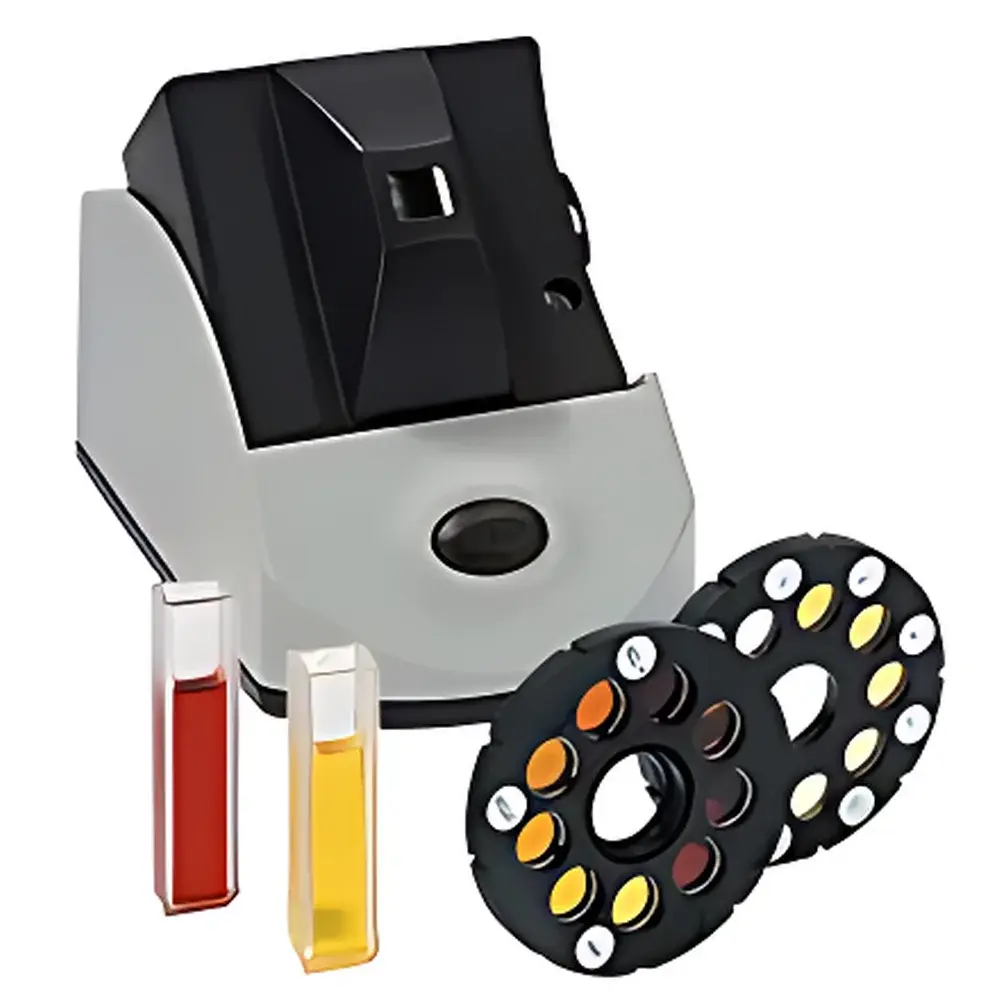
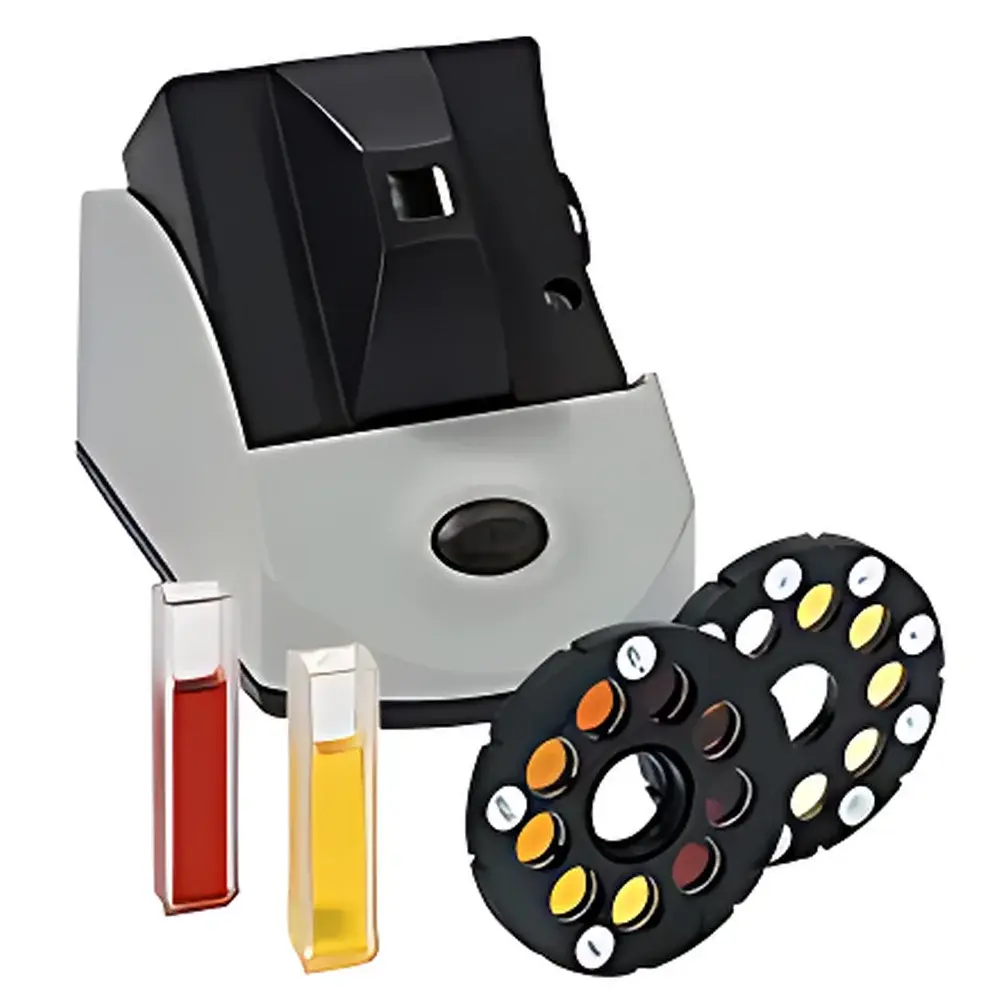
Orbeco-Hellige 705-VA2 Gardner Colorimeter
| Brand | Orbeco-Hellige |
|---|---|
| Origin | USA |
| Model | 705-VA2 |
| Compliance | ASTM D1544, AOCS Td 1a |
| Sample Path Length | 10 mm |
| Light Source | Calibrated Tungsten-Halogen Lamp with Daylight-Mimicking Filter |
| Illumination Standard | Simulated North Sky Daylight (CIE Standard Illuminant C, ~6774 K) |
| Configuration | Portable Visual Comparator System with Dual Standard Color Disks (620C-45 & 620C-46), Two Cuvettes, Illuminator, Carrying Case, and Instruction Manual |
Overview
The Orbeco-Hellige 705-VA2 Gardner Colorimeter is a precision visual comparator engineered for standardized color evaluation of transparent, lightly to moderately colored liquids in accordance with ASTM D1544 and AOCS Td 1a methodologies. It operates on the principle of subjective visual comparison between a test sample and certified Gardner color standards under controlled, spectrally stable illumination. Unlike instrumental colorimeters relying on photodetectors and spectral analysis, the 705-VA2 employs a human observer viewing through a split-field optical comparator—ensuring direct alignment with industry-accepted visual assessment protocols mandated for quality control in coatings, resins, edible oils, and water treatment applications. Its core function is to assign a Gardner scale value (ranging from 1 = pale yellow to 18 = dark brown) based on matched chromaticity under rigorously defined lighting conditions. The instrument’s mechanical architecture is optimized for repeatability across laboratory, production floor, and field environments, with no electronic calibration drift or software dependency.
Key Features
- ASTM D1544– and AOCS Td 1a–compliant dual-disk comparator housing two independently mounted, interference-filtered Gardner standard color disks (620C-45 and 620C-46), each manufactured from optically stable, fade-resistant colored glass;
- Integrated daylight-simulating illuminator featuring a tungsten-halogen lamp paired with a precision-calibrated color-correction filter, delivering consistent CIE Illuminant C spectral power distribution (~6774 K) independent of ambient light conditions;
- 10 mm path-length quartz cuvettes included for standardized sample presentation, ensuring reproducible optical density across measurements;
- Fully portable, self-contained design housed in a durable molded carrying case—enabling immediate deployment in QC labs, manufacturing lines, or remote field sites without external power or setup;
- Optical comparator geometry with fixed 45° viewing angle and parallax-free split-field reticle, minimizing observer bias and facilitating rapid side-by-side hue matching;
- No firmware, batteries, or software required—eliminating validation overhead associated with electronic instruments under GLP/GMP or ISO/IEC 17025 frameworks.
Sample Compatibility & Compliance
The 705-VA2 is validated for use with clear to amber-transparent liquid samples including alkyd resins, linseed oil, rosin esters, nitrocellulose lacquers, unsaturated fatty acids, varnishes, and aqueous solutions used in wastewater effluent monitoring or recreational water quality assessment. Samples must be free of suspended particulates and bubbles; filtration through 0.45 µm membrane filters is recommended prior to analysis. The instrument meets the physical and optical requirements specified in ASTM D1544 Section 6 (Apparatus) and Appendix X1 (Lighting Conditions), as well as AOCS Official Method Td 1a-64. Its traceable color disks are certified against NIST-traceable reference standards and undergo annual verification per manufacturer-recommended maintenance intervals. No regulatory submission requires digital audit trails; however, manual test records—including operator ID, date, sample ID, observed Gardner number, and illuminator status—satisfy FDA 21 CFR Part 11 documentation expectations when maintained in bound logbooks.
Software & Data Management
The 705-VA2 is a purely analog, observer-based measurement system and does not incorporate embedded electronics, firmware, or data logging capabilities. Consequently, it requires no software installation, cybersecurity configuration, or electronic record validation. All results are recorded manually in laboratory notebooks or LIMS-compatible paper forms. This absence of digital components simplifies 21 CFR Part 11 compliance for regulated environments, as no electronic signatures, audit trails, or system validation (IQ/OQ/PQ) are necessary. For laboratories integrating Gardner data into digital workflows, raw observations may be entered directly into validated LIMS or ELN platforms using standardized entry templates aligned with ISO/IEC 17025 clause 7.5.2 (Technical Records).
Applications
- Quality release testing of refined vegetable oils and biodiesel feedstocks per AOCS Td 1a;
- In-process color monitoring of alkyd resin polymerization batches in paint manufacturing;
- Stability assessment of nitrocellulose lacquers during accelerated aging studies;
- Regulatory compliance testing of industrial wastewater discharge per EPA Method 180.1 (colorimetric screening);
- Swimming pool and spa water clarity verification in municipal health inspections;
- Raw material acceptance testing for natural resins and gum rosin derivatives in adhesive formulation.
FAQ
Is the 705-VA2 compliant with current ASTM D1544 editions?
Yes—the optical geometry, disk specifications, and illuminator spectral output meet all requirements of ASTM D1544–23, including Annex A1 on illuminant calibration procedures.
Can I use non-Orbeco color disks with this comparator?
No. Only Orbeco-Hellige-certified disks (e.g., 620C-45/46) maintain traceability to ASTM reference standards; third-party disks lack documented spectral match and thermal stability validation.
What maintenance is required for long-term accuracy?
Annual recalibration of the illuminator’s color temperature (via spectroradiometer) and visual inspection of disk surface integrity per Orbeco Technical Bulletin TB-705-VA2 Rev. D.
Does the unit require electrical certification for use in explosion-proof areas?
The illuminator operates at low-voltage DC (12 V) and is intrinsically safe; however, site-specific hazardous location certification (e.g., ATEX, UL Class I Div 2) must be verified by the end-user’s safety officer.
How is inter-operator variability minimized?
Through mandatory observer training per ASTM D1544 Section 7.2, use of the standardized viewing protocol, and participation in annual color vision testing (Ishihara or Farnsworth-Munsell 100 Hue).




