
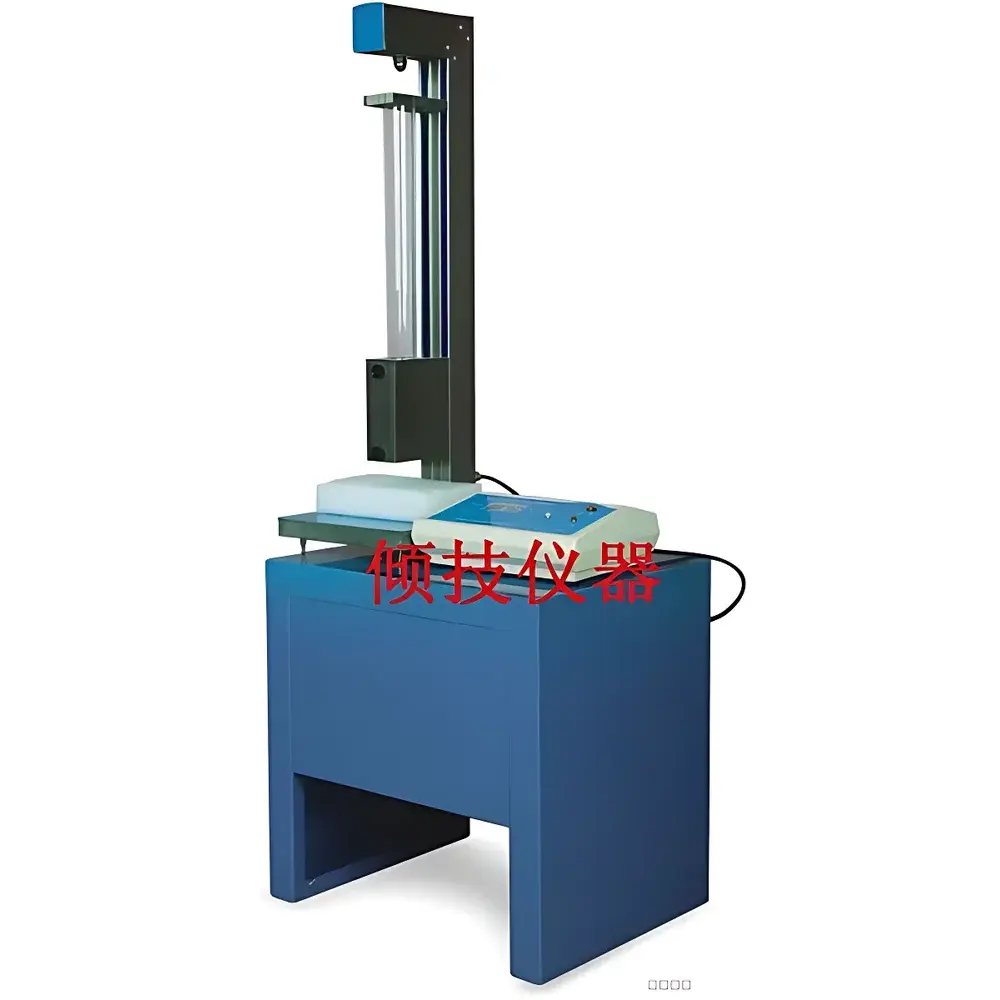
QJHT Foam Resilience Coefficient Tester by Qingji
| Brand | Qingji |
|---|---|
| Origin | Shanghai, China |
| Manufacturer Type | Authorized Distributor |
| Country of Origin | China |
| Model | QJHT |
| Pricing | Available Upon Request |
| Power Supply | 220 V, 50 Hz |
| Time Resolution | 0.0001 s |
| Resilience Coefficient Range | 25–80 % |
| Measurement Accuracy | < ±1 % |
| Sample Dimensions | 100 mm × 100 mm × (50 ± 2) mm |
| Conditioning | 23 ± 2 °C, 45–50 % RH, ≥16 h prior to test |
| Standard Compliance | GB/T 6670–1986 |
Overview
The QJHT Foam Resilience Coefficient Tester is a precision mechanical instrument engineered for the quantitative evaluation of elastic recovery behavior in flexible polymeric materials—primarily soft cellular foams, polyurethane elastomers, viscoelastic sponges, and related cushioning or energy-absorbing composites. It operates on the fundamental principle of free-fall impact dynamics: a standardized steel sphere (typically 16 mm diameter, 16.4 g mass per GB/T 6670–1986) is released from a fixed height (usually 450 mm above the specimen surface) onto a horizontally mounted, conditioned test specimen. High-speed optical sensing or electromagnetic timing captures the time interval between initial contact and peak rebound height. From this temporal measurement—and using kinematic equivalence—the instrument calculates the resilience coefficient (R) as the ratio of rebound height to drop height, expressed as a percentage: R = (hr/hd) × 100%. This metric directly reflects the material’s ability to store and return mechanical energy during transient compression, making it indispensable for quality control in automotive seating, mattress manufacturing, packaging design, and medical cushioning applications.
Key Features
- Optically synchronized dual-sensor timing system with 0.0001-second resolution ensures high reproducibility across repeated measurements under controlled environmental conditions.
- Fixed-height release mechanism with gravity-driven, non-accelerated drop path minimizes kinetic variability and eliminates operator-induced bias.
- Adjustable specimen platform with parallelism verification gauge guarantees consistent load distribution and eliminates edge-effect artifacts.
- Compliance-ready mechanical architecture—designed to support audit trails and procedural documentation required for ISO 9001-certified production environments and internal QC laboratories.
- Modular construction facilitates recalibration and traceable maintenance; all critical components are replaceable without full-system overhaul.
Sample Compatibility & Compliance
The QJHT tester accommodates rigidly defined specimen geometries per GB/T 6670–1986: rectangular prisms measuring 100 mm × 100 mm × (50 ± 2) mm, with opposing faces parallel to within 0.1 mm/m. Specimens must be free of skin layers, surface coatings, or localized density gradients. Prior to testing, samples undergo mandatory conditioning at 23 ± 2 °C and 45–50 % relative humidity for no fewer than 16 hours—a protocol aligned with ASTM D3574 and ISO 2439 methodologies for foam mechanical characterization. While GB/T 6670–1986 remains the primary reference standard, the instrument’s physical configuration and measurement uncertainty (< ±1 %) also permit comparative use in laboratories adhering to ISO 2439:2022 (determination of resilience by ball rebound method) and JIS K 6400-4:2019, subject to local validation protocols.
Software & Data Management
The QJHT system operates in standalone mode with embedded firmware and an integrated LCD interface for real-time display of drop height, rebound height, calculated resilience coefficient, and pass/fail status against user-defined thresholds. Raw timing data is stored internally with timestamp and operator ID (where configured), supporting basic GLP-aligned recordkeeping. For integration into enterprise QA workflows, optional RS-232 or USB-C output enables export of ASCII-formatted test logs—including date/time stamp, sample ID, measured values, and environmental metadata—to LIMS or Excel-based reporting systems. Though not natively 21 CFR Part 11 compliant, the device supports manual audit trail generation through printed calibration certificates, logbook entries, and periodic verification reports—sufficient for non-regulated industrial QC and supplier qualification programs.
Applications
- Quality assurance of molded polyurethane foam blocks used in automotive seat cushions and headrests.
- Batch-to-batch consistency verification for memory foam formulations in bedding and orthopedic support products.
- Development-stage screening of novel elastomeric blends for shock absorption performance.
- Supplier qualification testing per OEM technical specifications requiring resilience coefficient limits (e.g., Ford WSS-M99P1111-A, GMW15624).
- Teaching laboratories conducting fundamental polymer physics experiments on viscoelastic energy dissipation.
FAQ
What environmental conditions must be maintained during testing?
Testing must occur in a climate-controlled room stabilized at 23 ± 2 °C and 45–50 % relative humidity, with specimens conditioned for ≥16 hours prior to measurement.
Is the steel sphere included and calibrated?
Yes—the instrument ships with a certified 16 mm stainless-steel sphere (mass: 16.4 g ± 0.1 g), traceable to national metrology standards; annual recalibration is recommended.
Can the QJHT tester be used for non-foam materials such as rubber or gel pads?
It may yield indicative data for highly elastic solids, but results are not standardized outside foam matrices; GB/T 6670–1986 explicitly restricts application to soft cellular materials.
Does the system support automated data export to Excel or LIMS?
Yes—via optional serial or USB interface; exported files contain timestamped raw timing data, calculated resilience values, and configurable sample identifiers.
What is the warranty coverage and service support structure?
The instrument carries a 12-month limited warranty covering parts and labor; lifetime technical support and spare parts availability are guaranteed through Qingji’s authorized distribution network.



