
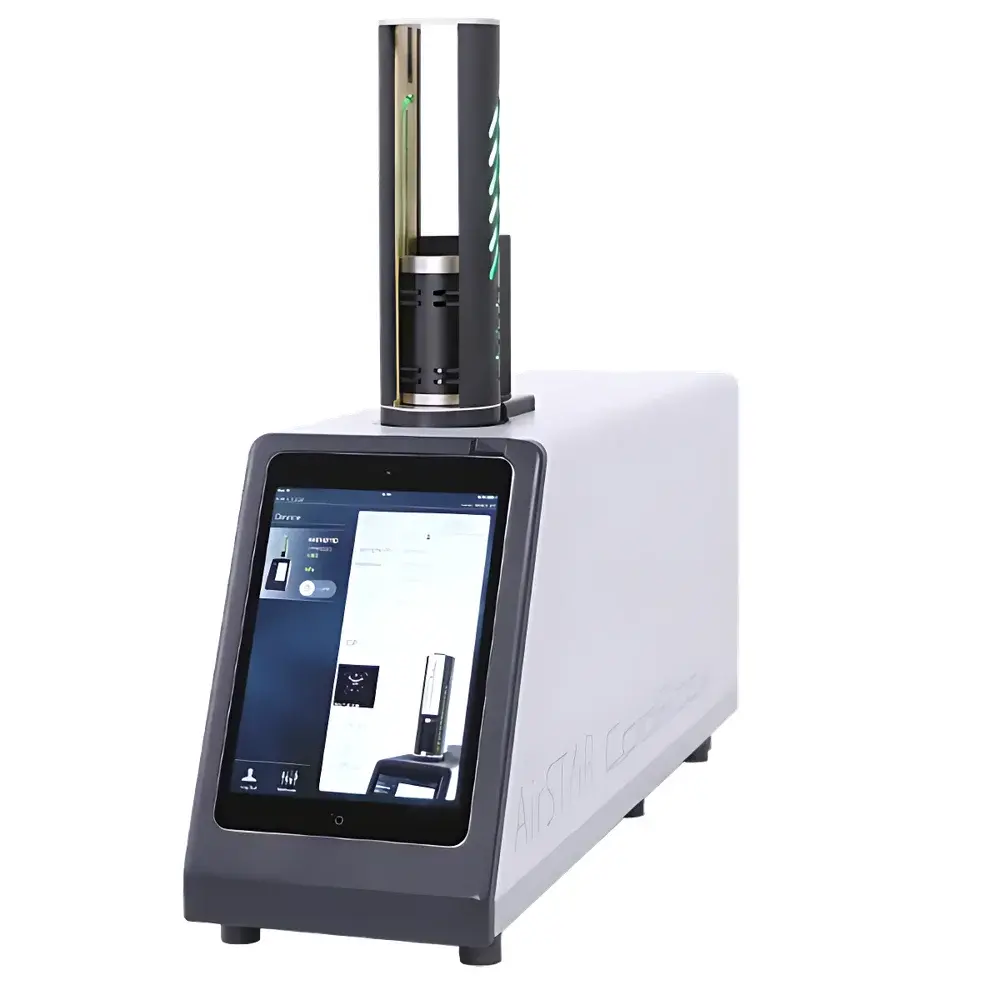
ORBIS BV CPPP Automated Cloud Point and Pour Point Tester
| Brand | ORBIS BV |
|---|---|
| Origin | Netherlands |
| Model | CPPP |
| Temperature Bath Range | +65 °C to −105 °C |
| Cooling Rate | 1–60 °C/h (linear or stepwise) |
| Detection Method | High-resolution digital imaging with real-time video analysis |
| Temperature Sensor | Removable Pt100 probe with embedded calibration data and ID |
| Power Supply to Test Head | Wireless Powercast® technology |
| Motion Control | Microprocessor-driven stepper motor for precise tube lifting and tilting |
| Compliance | ASTM D97, D2500, D5853, D5771, D6892 |
Overview
The ORBIS BV CPPP Automated Cloud Point and Pour Point Tester is a fully integrated, dual-parameter low-temperature characterization system engineered for precise, reproducible determination of cloud point (CP) and pour point (PP) in petroleum products—including diesel fuels, lubricating oils, jet fuels, and crude fractions. It operates on the principle of optical endpoint detection combined with controlled thermal ramping and mechanical sample manipulation. Cloud point is identified by the onset of wax crystal formation, observed as light-scattering discontinuity via high-resolution digital imaging; pour point is determined by detecting the cessation of flow under standardized tilt conditions following incremental cooling. The instrument implements thermodynamic equilibrium protocols aligned with internationally harmonized test methods, ensuring traceability to reference standards and compatibility with regulatory reporting frameworks used in refinery QC, fuel certification, and product specification compliance.
Key Features
- Dual-parameter capability: A single test head simultaneously acquires both cloud point and pour point data within one thermal cycle—eliminating sequential testing, reducing operator intervention, and improving inter-test consistency.
- Optical detection architecture: Equipped with a high-resolution industrial camera and adaptive illumination, enabling pixel-level analysis of turbidity onset and solid-phase agglomeration without reliance on subjective visual assessment.
- Wireless power delivery: Powercast® technology supplies stable, contactless power to the cryogenic test head, removing cable constraints and minimizing thermal bridging or mechanical stress during low-temperature operation.
- Modular temperature sensing: Interchangeable Pt100 probes feature embedded EEPROM storage for factory calibration coefficients, serial identification, and sensor-specific correction tables—supporting audit-ready traceability per ISO/IEC 17025 requirements.
- Precision motion control: Microcomputer-regulated stepper motors execute repeatable tube elevation, tilt angle adjustment (±0.1° resolution), and dwell timing—critical for ASTM D97-compliant flow evaluation at sub-ambient temperatures.
- Flexible thermal programming: Users define custom cooling profiles—including linear ramps or multi-segment stepwise decrements—with rate resolution down to 0.1 °C/h and endpoint hold durations configurable in 30-second increments.
Sample Compatibility & Compliance
The CPPP accommodates standard ASTM/ISO sample volumes (typically 30–45 mL) in borosilicate glass test tubes conforming to D97/D2500 dimensional specifications. It supports transparent, semi-transparent, and mildly pigmented hydrocarbon liquids, including biodiesel blends (B5–B20), synthetic lubricants, and distillate fuels with varying paraffin content. All operational logic, result calculation algorithms, and reporting templates are preconfigured to satisfy method-specific acceptance criteria across ASTM, EN, ISO, JIS, and GB/T standards. The system’s firmware architecture includes built-in method validation checks—for example, automatic verification of cooling rate adherence, minimum hold times at critical transition zones, and image-based confirmation of phase separation prior to pour point declaration. Full compliance documentation—including method equivalence matrices and uncertainty budget summaries—is provided for GLP/GMP environments subject to FDA 21 CFR Part 11 or EU Annex 11 review.
Software & Data Management
AirSTAR CPPP software provides a validated, role-based interface compliant with ALCOA+ data integrity principles. It supports electronic signatures, full audit trails (including user actions, parameter changes, and result overrides), and time-stamped raw image sequences stored alongside metadata (temperature history, motor position logs, ambient conditions). Data export options include CSV, PDF reports with embedded thumbnails, and direct integration into LIMS via ASTM E1384-compliant XML schema. Customizable report templates allow inclusion of company logos, QA reviewer fields, and instrument calibration status banners. All calibration events, maintenance logs, and software version histories are retained locally with optional encrypted cloud backup. The software also enables remote monitoring via secure HTTPS connection—permitting real-time observation of active tests without compromising network security policies.
Applications
This instrument serves critical functions across upstream, midstream, and downstream petroleum operations. In refineries, it validates cold flow properties of finished diesel to meet regional winter-grade specifications (e.g., EN 590 Class F). In lubricant manufacturing, it verifies base oil blending consistency and additive package efficacy under simulated service conditions. For biofuel producers, it assesses cloud point depression performance of cold-flow improvers in FAME and HVO blends. Independent testing laboratories use the CPPP for third-party certification against API RP 1172 or ASTM D975 compliance programs. Research applications include kinetic wax crystallization studies, low-temperature rheology correlation modeling, and development of predictive CP/PP algorithms using machine learning trained on instrument-generated image datasets.
FAQ
Does the CPPP require external refrigeration or liquid nitrogen?
No—the system integrates a closed-cycle cascade refrigeration unit capable of reaching −105 °C without consumables or external cryogens.
Can the instrument be validated for 21 CFR Part 11 compliance?
Yes—AirSTAR CPPP software includes electronic signature workflows, audit trail generation, and secure user access controls meeting FDA requirements for regulated environments.
How is temperature uniformity verified across the bath?
The system performs automated thermal mapping during startup using three independent Pt100 sensors positioned at top, middle, and bottom zones; deviation limits are enforced per ASTM E74 and ISO 17025.
Is method revalidation required when switching between cloud point and pour point testing?
No—dual-parameter operation uses identical hardware, thermal profile logic, and detection algorithms; only test-specific pass/fail criteria differ per standard.
What maintenance intervals are recommended for long-term reliability?
Compressor oil and filter replacement every 12 months; optical lens cleaning and camera focus verification every 6 months; annual full calibration with NIST-traceable reference fluids.




