
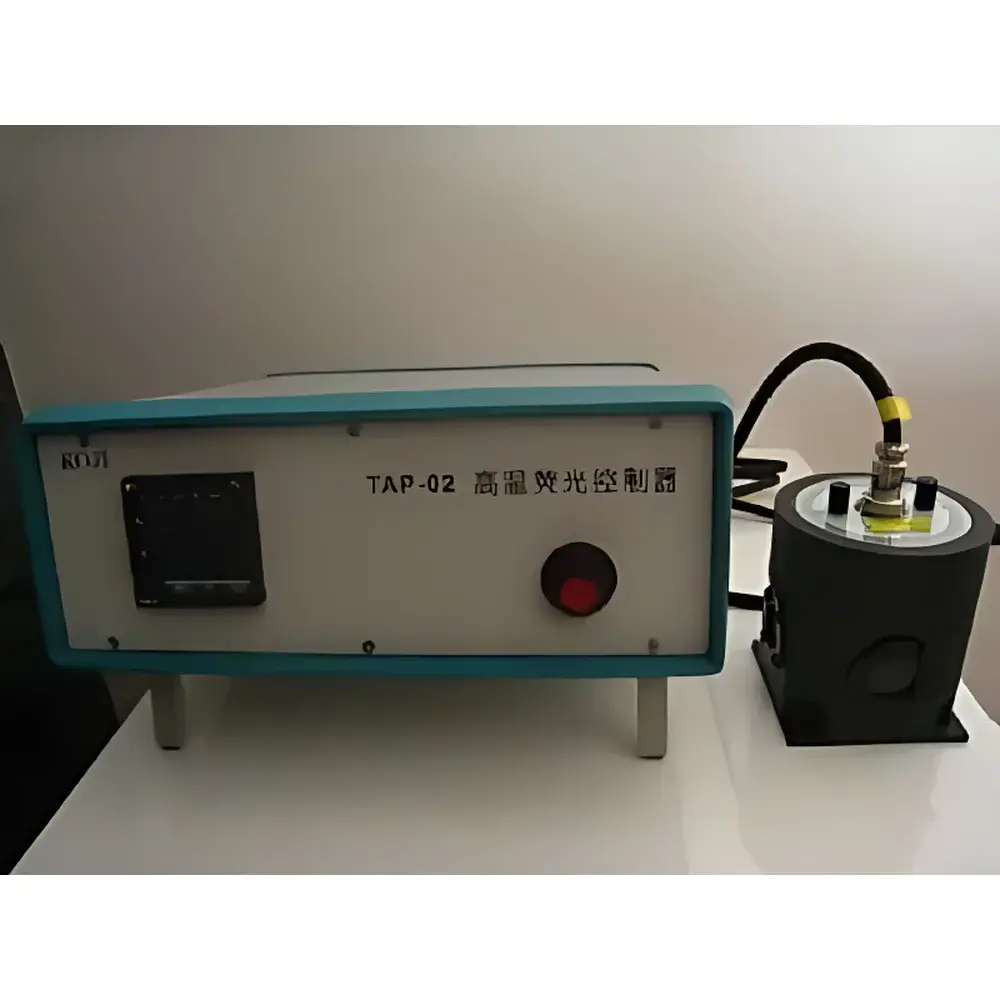
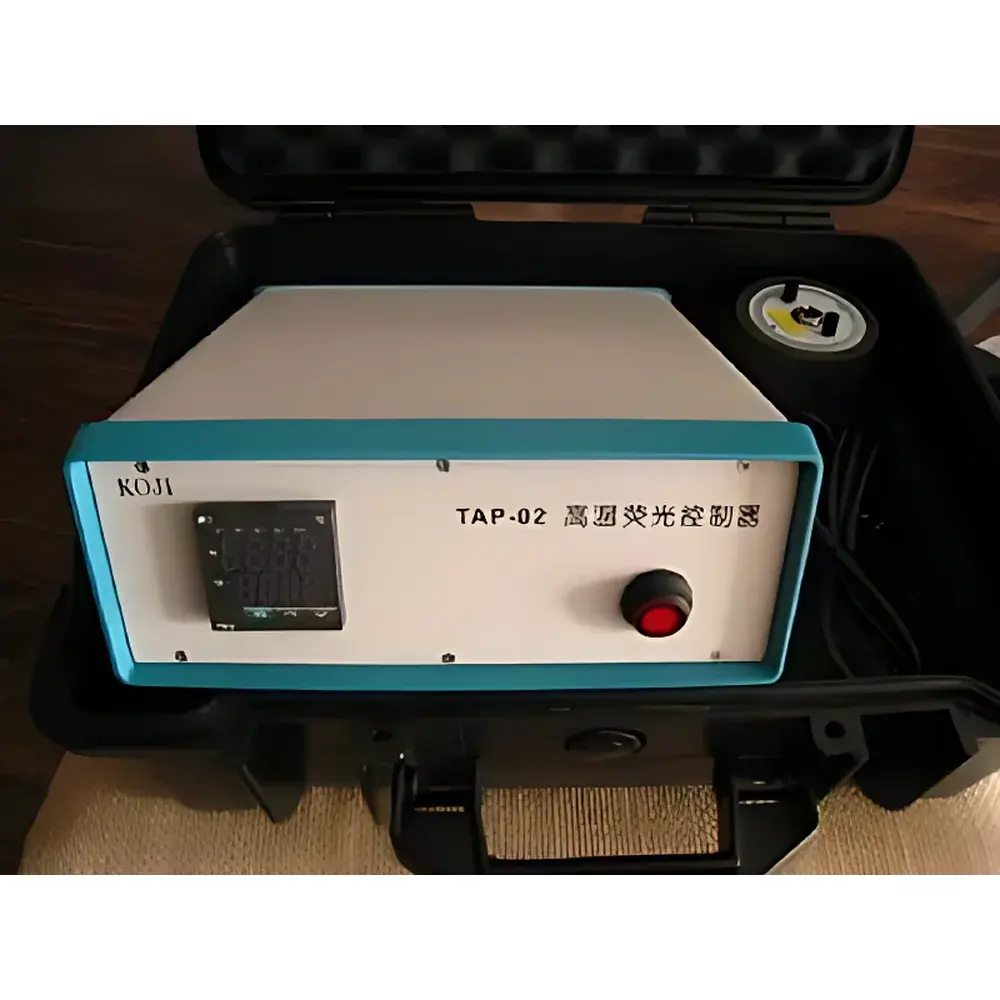
Orient KOJI TAP-02 High-Temperature (Thermal Quenching) Fluorescence Analyzer, 300°C
| Brand | Orient KOJI |
|---|---|
| Origin | Tianjin, China |
| Model | TAP-02 |
| Instrument Type | Steady-State and Time-Resolved Fluorescence Spectrometer |
| Temperature Range | Ambient to 300°C (573 K) |
| Temperature Control Accuracy | ±0.1°C |
| Temperature Stability | ±0.2°C (40–300°C) |
| Programmable Segments | 8-step ramp/soak |
| Heating Rate | >20°C/min |
| Cooling Design | Active rapid cooling |
| Operating Environment | Ambient pressure with controllable gas flow (N₂, O₂, Ar, etc.) |
| Power Supply | AC 220 V, 5 A, 500 W |
| Compatibility | Modular integration with Hitachi F-4500/F-7000/F-4600/F-2700 |
Overview
The Orient KOJI TAP-02 High-Temperature Fluorescence Analyzer is a precision-engineered thermal quenching measurement module designed for in situ, temperature-dependent photoluminescence characterization of solid-state luminescent materials. It operates on the principle of steady-state and time-resolved fluorescence spectroscopy under controlled thermal conditions, enabling quantitative analysis of thermal activation energy, non-radiative decay pathways, and luminescence stability across a broad operational range (ambient to 300°C / 573 K). Unlike conventional hot-stage accessories, the TAP-02 integrates tightly with commercial fluorometers via standardized optical and electrical interfaces—preserving native instrument performance while adding calibrated thermal control. Its design supports real-time monitoring of emission intensity, peak wavelength shift, lifetime decay kinetics, and quantum yield variation as a function of temperature—critical parameters for developing phosphors, OLED emitters, persistent luminescent materials, and thermally stable scintillators.
Key Features
- Modular architecture compatible with major benchtop fluorometers including Hitachi (F-4500, F-7000, F-4600, F-2700), HORIBA (FluoroMax-4, FluoroLog-3), and Edinburgh Instruments (FLS920, FS5, FLS980, FLS1000); custom interface kits available upon request
- Eight-segment programmable temperature profile control, supporting complex ramp-hold-cool sequences with sub-degree resolution
- High-fidelity thermal regulation: ±0.1°C setpoint accuracy and ±0.2°C stability over the full 40–300°C operating window
- Fast thermal response: heating rates exceeding 20°C/min, coupled with active forced-air cooling for rapid cooldown between measurements
- Atmosphere-compatible sample chamber: maintains continuous gas flow (N₂, O₂, Ar, synthetic air) at ambient pressure to prevent oxidation or decomposition during high-temperature testing
- Low thermal mass ceramic heater and integrated Pt100 sensor ensure minimal thermal lag and high spatial uniformity across the sample stage
- Compact footprint and plug-and-play cabling (control + power) enable seamless installation without optical realignment or spectrometer recalibration
Sample Compatibility & Compliance
The TAP-02 accommodates standard solid samples—including powders (mounted in quartz crucibles), thin films (on fused silica or sapphire substrates), and bulk ceramics—within a 12 mm diameter measurement zone. Sample mounting is fully reversible and does not require permanent bonding or vacuum sealing. The system complies with general laboratory safety standards for Class I electrical equipment (IEC 61010-1) and is engineered to operate within the mechanical and thermal envelope specifications of host fluorometers. While not certified for GLP/GMP environments out-of-the-box, its deterministic temperature logging (via RS232/USB output), audit-ready parameter recording, and reproducible thermal profiles support data integrity requirements aligned with ISO/IEC 17025 and ASTM E1421–22 (Standard Practice for Determining Thermal Quenching Behavior of Luminescent Materials).
Software & Data Management
Temperature control is managed through a dedicated embedded microcontroller with local LCD interface and remote command capability via ASCII-based serial protocol (TTL/RS232). Real-time temperature data streams synchronously with spectral acquisition software (e.g., FL Solutions, Duetta, or Fluoracle) using TTL trigger signals or software API hooks. All thermal parameters—including actual vs. setpoint traces, ramp rate logs, and dwell durations—are timestamped and exportable as CSV for post-acquisition correlation with spectral datasets. For regulated environments, optional firmware upgrades support 21 CFR Part 11-compliant electronic signatures and audit trails when integrated with validated third-party LIMS or ELN platforms.
Applications
- Quantitative thermal quenching analysis of LED phosphors (e.g., YAG:Ce³⁺, β-SiAlON:Eu²⁺) and narrow-band red emitters (K₂SiF₆:Mn⁴⁺)
- In situ monitoring of phase-transition-induced luminescence changes in perovskite nanocrystals and layered halides
- High-temperature degradation kinetics of organic electroluminescent materials under inert or reactive atmospheres
- Thermally stimulated luminescence (TSL) pre-characterization prior to dosimetry studies
- Correlation of lattice expansion (via XRD) and non-radiative relaxation (via lifetime mapping) in multiferroic oxides
- Development of high-stability afterglow materials for anti-counterfeiting and emergency signage applications
FAQ
Is the TAP-02 compatible with time-resolved fluorescence measurements?
Yes—the thermal stage introduces negligible temporal jitter (<10 ns) and does not attenuate pulsed excitation sources; it has been validated with TCSPC and gated detection systems on FLS1000 and FluoroLog-3 platforms.
Can the system maintain atmosphere control during rapid heating cycles?
Yes—gas flow remains uninterrupted throughout the entire thermal program; recommended flow rates are 50–200 mL/min depending on chamber purge efficiency and reactivity requirements.
Does the TAP-02 require optical recalibration of the host fluorometer after installation?
No—its optical path is collinear with the native excitation/emission beam; alignment-sensitive components (e.g., monochromator slits, PMT positioning) remain unchanged.
What is the maximum recommended sample thickness for optimal thermal uniformity?
For powders and films, ≤1 mm thickness ensures <±0.5°C intra-sample gradient at 300°C; thicker ceramics may require empirical calibration of surface-to-core offset.
Is firmware update support provided for long-term instrument maintenance?
Yes—Orient KOJI offers free firmware patches and documentation updates for registered users, including compatibility enhancements for newly released spectrometer models.
Related Products




