
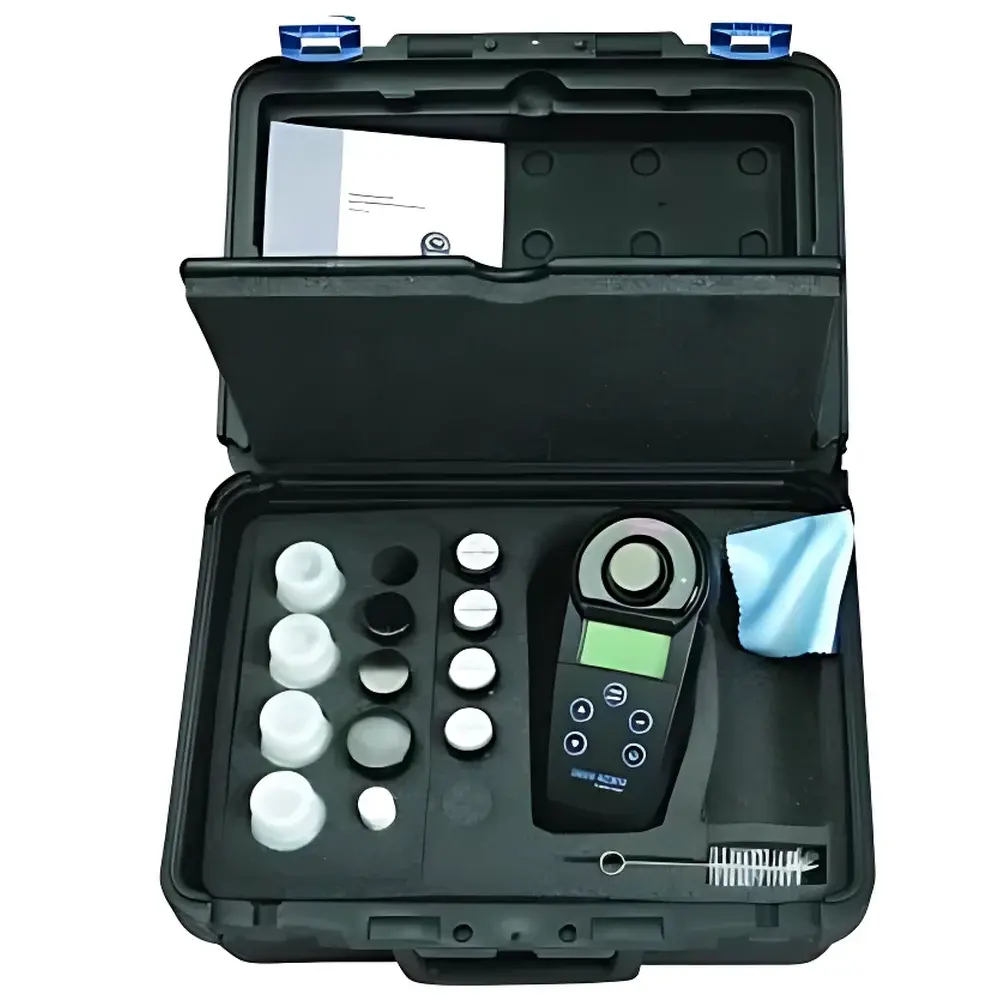
Orion AQ3010 Portable Turbidimeter
| Origin | USA |
|---|---|
| Manufacturer Type | Authorized Distributor |
| Origin Category | Imported |
| Model | AQ3010 |
| Product Type | Portable |
| Measurement Range | 0.01–19.99 NTU, 20.0–99.9 NTU, 100–1000 NTU |
| Resolution | 0.01 NTU (0.01–19.99), 0.1 NTU (20.0–99.9), 1 NTU (100–1000) |
| Operating Temperature | 0–50 °C (RH 0–90% at 30 °C) |
| Accuracy | ±2% of reading (0–500 NTU) |
| Light Source | Infrared LED compliant with ISO 7027 |
| Power Supply | 4×AAA alkaline batteries (≥3000 measurements) or 4×AAA lithium batteries (≥12,000 measurements) |
| IP Rating | IP67 |
| Auto-ranging | Yes (0–1000 NTU) |
| Calibration Standards | EPA-compliant polymer standards at 0.2, 20, 100, and 800 NTU |
| Sample Cell | 25 mm diameter vials |
| Auto-power-off | After 20 minutes idle |
| Battery Self-test | With diagnostic fault codes |
Overview
The Orion AQ3010 Portable Turbidimeter is an ISO 7027-compliant optical instrument engineered for precise, field-deployable turbidity measurement across diverse liquid matrices—including colored samples such as wine, fruit juices, wastewater effluents, and potable water. It employs a fixed-wavelength infrared LED (850 nm) to minimize interference from sample coloration and absorbance, enabling reliable 90° side-scatter detection in accordance with the nephelometric principle defined in ISO 7027 and US EPA Method 180.1. Unlike visible-light turbidimeters, the AQ3010’s IR source eliminates spectral bias introduced by chromophores, ensuring high reproducibility in applications where sample hue would otherwise compromise accuracy. Its rugged, fully sealed IP67-rated housing permits uninterrupted operation in humid laboratories, industrial process environments, and uncontrolled outdoor conditions—from municipal water sampling sites to winery quality control stations.
Key Features
- Infrared LED light source (850 nm) compliant with ISO 7027 and EPA Method 180.1 for color-insensitive turbidity quantification
- True auto-ranging capability across three dynamic ranges (0.01–19.99 NTU, 20.0–99.9 NTU, 100–1000 NTU) with seamless range switching and no manual gain adjustment
- High-resolution display with context-sensitive resolution: 0.01 NTU (low range), 0.1 NTU (mid range), and 1 NTU (high range)
- IP67 ingress protection—dust-tight and submersible up to 1 m for 30 minutes—validated per IEC 60529
- Integrated battery self-diagnostic system with alphanumeric fault codes for predictive maintenance and traceable power management
- No rubber light-shield cap required during measurement due to optimized optical path geometry and ambient light rejection algorithm
- Fast calibration using pre-formulated, ready-to-use EPA polymer standards (0.2, 20, 100, and 800 NTU) eliminating dilution errors and standard preparation variability
Sample Compatibility & Compliance
The AQ3010 is validated for use with standard 25 mm round glass or quartz vials (included in kit AQ3010). Its optical design accommodates both low-turbidity clear liquids (e.g., filtered drinking water, pharmaceutical rinse solutions) and highly scattering suspensions (e.g., activated sludge, untreated surface water). The instrument meets critical regulatory requirements for environmental monitoring: it supports GLP-compliant data integrity through non-volatile memory storage of calibration history, operator ID fields (via optional software integration), and time-stamped measurement logs. While the device itself does not embed 21 CFR Part 11 electronic signature controls, its output data files (CSV/Excel-compatible) are structured for import into LIMS or ELN systems that enforce audit-trail and user-access protocols. All calibrations adhere to EPA-approved polymer standards traceable to NIST SRM 2102, satisfying reporting obligations under 40 CFR Part 136 and ISO/IEC 17025 accredited testing workflows.
Software & Data Management
Data export is performed via USB interface (cable included) to standard PC platforms running Windows 10/11. The AQ3010 generates timestamped CSV files containing measured NTU value, date/time stamp, calibration status flag, range used, and battery voltage at time of measurement. No proprietary software installation is required—files open natively in Excel or import directly into laboratory information management systems (LIMS). For regulated environments, users may configure external validation scripts to verify file integrity (SHA-256 hash) and enforce metadata tagging (e.g., analyst ID, location code, sample ID) prior to ingestion. Firmware updates are delivered as signed binary packages with version-controlled release notes, supporting long-term method consistency across instrument fleets.
Applications
- Drinking water quality verification per WHO Guidelines and US EPA Total Coliform Rule compliance monitoring
- Wastewater treatment plant effluent reporting under NPDES permits
- Process control in beverage manufacturing (wine clarification, juice pasteurization validation, beer filtration endpoint determination)
- Pharmaceutical water system monitoring (PW, WFI) per USP and EU Annex 1 requirements
- Environmental field surveys including lake stratification studies, stormwater runoff characterization, and sediment transport modeling
- Educational laboratory instruction in environmental science and analytical chemistry curricula
FAQ
Does the AQ3010 require recalibration after each sample change?
No. The instrument maintains optical stability between measurements; recalibration is only required per established QA/QC schedules (e.g., daily before analysis, after temperature shifts >10 °C, or following physical shock).
Can the AQ3010 measure samples with high absorbance, such as dark grape juice?
Yes. The 850 nm infrared source minimizes absorption-related signal attenuation, enabling accurate turbidity quantification in colored liquids where visible-light instruments exhibit significant negative bias.
Is the AQ3010 suitable for GMP-regulated pharmaceutical water testing?
It meets technical performance criteria for PW/WFI turbidity screening per USP , though full GMP compliance requires integration with a validated data management system supporting audit trails, electronic signatures, and change control—functions implemented externally per site-specific validation protocols.
What is the expected service life of the infrared LED source?
The LED is rated for ≥50,000 hours of operational life under typical intermittent-use conditions, exceeding the instrument’s mechanical service lifetime and eliminating routine source replacement.
How does the AQ3010 handle condensation on the sample cell window during high-humidity field use?
The optical chamber includes passive desiccant integration and thermal mass design to suppress dew formation; additionally, the IP67 seal prevents moisture ingress during temporary immersion or rain exposure.




