
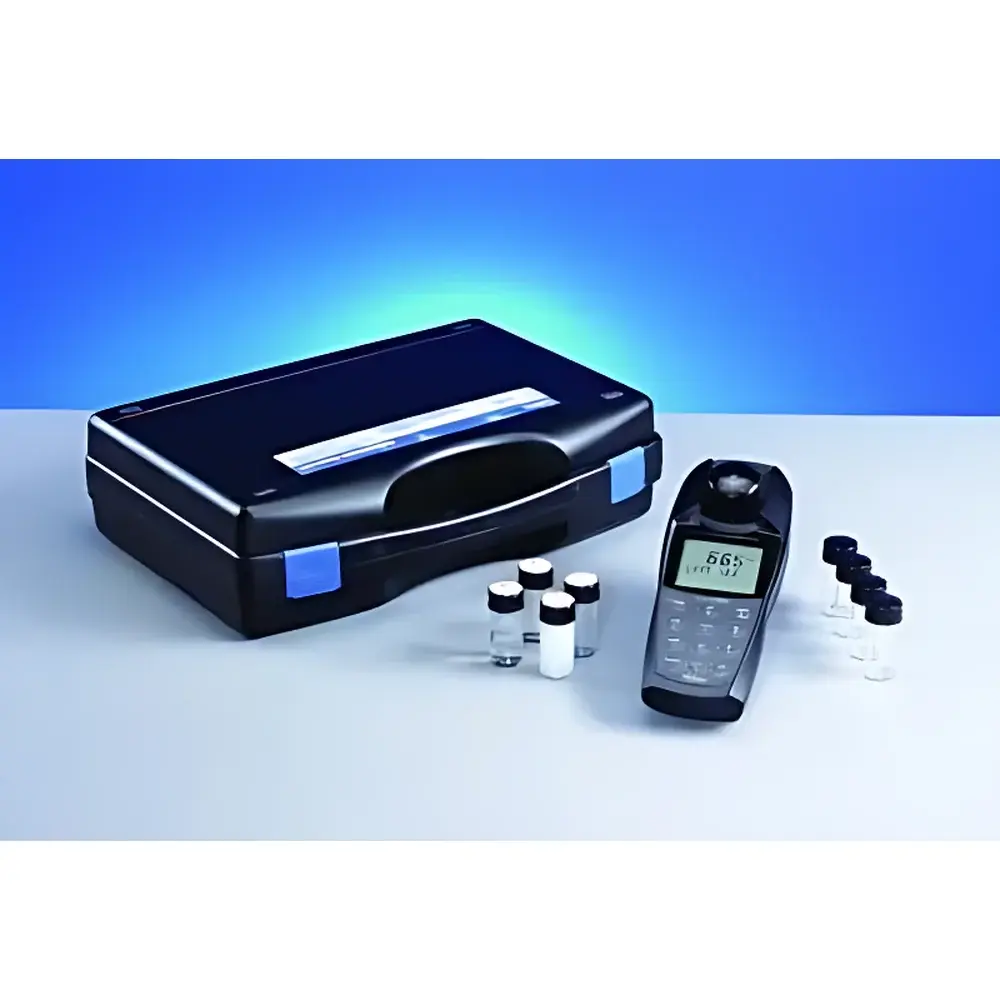
Orion AQ4500 Precision Turbidimeter
| Origin | USA |
|---|---|
| Manufacturer Type | Authorized Distributor |
| Origin Category | Imported |
| Model | AQ4500 |
| Price | Upon Request |
| Instrument Type | Portable |
| Measurement Ranges | EPA 180.1: 0–4000 NTU |
| GLI Method 2 | 0–40 NTU |
| ISO 7027 | 0–150 FNU |
| EBC | 0–24.5 EBC |
| ISO ABSB | 40–4000 FAU |
| IR-Ratio Mode | 0–4000 NTU |
| ASBC | 0–236 ASBC |
| Resolution | 0.001 NTU / 0.01 NTU / 0.1 NTU (auto-ranging) |
| Operating Temperature | −40.0 to +60.0 °C (non-condensing) |
| Accuracy | ±1% of reading |
| Light Source | Dual-wavelength LED (white + infrared) |
| Battery Life | 2500 h (alkaline) / 100,000 h (lithium) |
| Data Storage | 100 measurements |
| Interface | RS232 with 25-pin to 9-pin adapter |
| Calibration Standards | 0, 1, 10, 100, and 1000 NTU |
| Sample Cell | 24 mm diameter cuvette |
| Display | Custom LCD with dual-function touch keys |
| Environmental Compliance | Meets EPA 180.1, ISO 7027, ASBC Beer Methods, EBC Brewing Standards, and ISO 7027 (ABSB) |
Overview
The Orion AQ4500 Precision Turbidimeter is an advanced portable optical instrument engineered for high-fidelity turbidity measurement across diverse regulatory and industrial contexts. It employs a dual-optical-path, dual-detector design based on nephelometric detection at 90°, compliant with the fundamental principles of ISO 7027 and EPA Method 180.1. Unlike conventional tungsten-lamp-based systems, the AQ4500 utilizes a stabilized dual-wavelength LED source—emitting both white and infrared light—to eliminate color interference and enable robust compensation for chromatic absorbance in colored samples. This architecture ensures traceable, reproducible results without lamp drift or warm-up delay (tstart ≈ 1 s), while delivering >100,000 hours of stable illumination life. Its ruggedized IP67-rated enclosure supports field deployment in extreme ambient conditions—from arctic monitoring stations to tropical wastewater outfalls—without compromising optical integrity or calibration stability.
Key Features
- Dual-beam ratio-metric detection: Simultaneous measurement of scattered and reference light intensities eliminates source intensity fluctuation errors and enhances long-term repeatability.
- Multi-standard compliance engine: Native support for EPA 180.1 (NTU), ISO 7027 (FNU), ASBC (ASBC units), EBC (EBC units), ISO ABSB (FAU), and IR-ratio modes—all selectable via intuitive menu navigation.
- Color-compensated turbidity algorithm: Infrared channel subtraction corrects for spectral absorption in yellow-brown aqueous matrices (e.g., humic-rich surface waters, beer, cider), enabling accurate low-range quantification down to 0.001 NTU.
- Auto-ranging resolution: Dynamically selects optimal resolution (0.001 / 0.01 / 0.1 NTU) based on signal magnitude—critical for maintaining precision across four-decade dynamic range (0–4000 NTU).
- GLI Method 2–validated low-turbidity mode: Optimized optics and signal processing deliver sub-0.01 NTU resolution in the 0–40 NTU range, meeting stringent requirements for drinking water clarity verification and membrane filtration monitoring.
- Field-hardened interface: 12-key capacitive touch panel with tactile feedback; custom LCD with high-contrast backlighting; RS232 serial port with included 25-pin to 9-pin adapter for direct connection to LIMS or data loggers.
Sample Compatibility & Compliance
The AQ4500 accepts standard 24 mm diameter glass or quartz cuvettes (AC2T24 supplied), ensuring compatibility with legacy sample handling workflows and certified reference materials. Its optical path geometry and detector alignment are validated per ASTM D6508 and ISO 7027 Annex B for geometric consistency. The instrument satisfies regulatory data integrity requirements under FDA 21 CFR Part 11 when paired with Orion’s optional audit-trail-enabled software (not bundled). Calibration protocols align with USP , APHA Standard Methods 2130 B, and GLP-compliant laboratory practices. For brewing applications, it is the only portable turbidimeter certified by both the American Society of Brewing Chemists (ASBC) and the European Brewery Convention (EBC) for routine haze analysis in wort, beer, and filtered beverages.
Software & Data Management
While the AQ4500 operates autonomously with onboard storage of up to 100 measurements—including date/time stamp, measurement mode, and calibration ID—its RS232 interface enables seamless integration into centralized QA/QC infrastructure. Exported data conforms to ASCII-delimited format compatible with Microsoft Excel, LabArchives, and Thermo Fisher Scientific’s QIAGEN CLC Workbench. Optional firmware updates (via USB-to-serial dongle) maintain alignment with evolving ISO/IEC 17025 documentation requirements. All stored records retain full traceability to NIST-traceable calibration standards (AC45STAQ series), supporting internal audits and external accreditation assessments (e.g., ISO/IEC 17025:2017 Clause 7.7).
Applications
- Drinking water treatment: Real-time monitoring of coagulation efficiency, filter performance, and distribution system integrity per EPA Safe Drinking Water Act guidelines.
- Wastewater discharge compliance: Quantitative verification of effluent turbidity against NPDES permit limits (e.g., ≤5 NTU for tertiary discharge).
- Beverage quality control: ASBC/EBC-compliant haze measurement in raw wort, finished beer, wine, and fruit juices—supporting shelf-life prediction and colloidal stability assessment.
- Environmental field studies: In-situ profiling of suspended solids in rivers, lakes, and estuaries using GLI Method 2–optimized averaging algorithms that mitigate transient particle settling effects.
- Pharmaceutical manufacturing: USP -aligned clarity testing of parenteral solutions and sterile filtrates where visual inspection is insufficient.
FAQ
Does the AQ4500 require annual recalibration?
Calibration frequency follows risk-based laboratory policy per ISO/IEC 17025; however, due to its LED source stability and dual-beam architecture, annual verification against NIST-traceable standards (e.g., AC45STAQ set) is typically sufficient for GLP environments.
Can the AQ4500 measure turbidity in highly colored samples like dark beer or tea extracts?
Yes—the IR-ratio mode leverages infrared scattering to suppress absorbance artifacts, enabling accurate turbidity reporting even in samples with strong visible-light absorption (A430 > 2.0).
Is the IP67 rating valid during battery replacement?
The sealed battery compartment maintains IP67 integrity only when the o-ring–equipped cover is fully torqued; users must inspect gasket condition prior to reassembly per maintenance manual Section 4.2.
What validation documentation is provided with the instrument?
Each unit ships with a Factory Certificate of Conformance, NIST-traceable calibration report (using StablCal® standards), and ISO 7027/180.1 compliance statement signed by Thermo Fisher Quality Assurance.
How does the “Average” function improve reliability for natural water samples?
The 10-cycle averaging algorithm compensates for heterogeneous particle distribution in flowing or agitated samples—reducing coefficient of variation (CV) by up to 65% compared to single-point readings in riverine or reservoir applications.



