
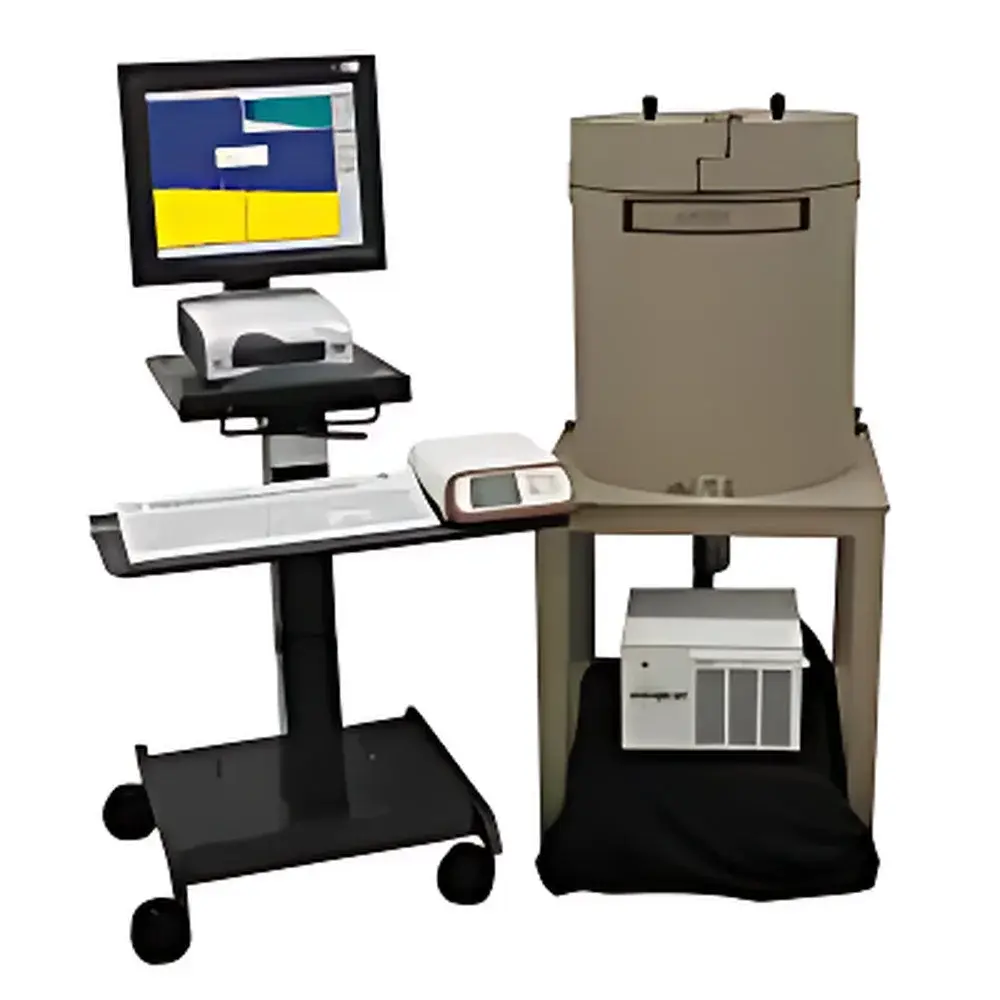
ORTEC GEM-C65 High-Purity Germanium (HPGe) Gamma-Ray Spectrometry System
| Brand | ORTEC |
|---|---|
| Origin | USA |
| Model | GEM-C65 |
| Cryocooler Type | SunPower Stirling Engine (200,000-hour MTBF) |
| Liquid Nitrogen Dewar Capacity | 28 L |
| Continuous Operation Without Refill | >2 years (with uninterrupted power) |
| Dewar Height (excl. detector) | 66.5 cm |
| Dewar Diameter (excl. detector) | 44.1 cm |
| Power Consumption | 125 W (typical), 300 W (max at startup) |
| Operating Temperature | 0–40 °C |
| Relative Humidity | 20–90% RH (non-condensing) |
| Acoustic Noise | <60 dB at 1 m |
| Maintenance Interval | Air filter cleaning/replacement every 2 months |
| Alarm Function | Visual & audible alert issued 48 h prior to LN₂ depletion |
| Display Interface | Integrated alphanumeric LCD showing cryostat status and real-time LN₂ level |
| Compliance | Designed for ISO/IEC 17025-compliant laboratories |
Overview
The ORTEC GEM-C65 High-Purity Germanium (HPGe) Gamma-Ray Spectrometry System is a fully integrated, laboratory-grade nuclear spectroscopy platform engineered for high-resolution gamma-ray detection and quantitative radionuclide analysis. Utilizing an ultra-low-background, p-type coaxial HPGe crystal cooled to cryogenic temperatures via a closed-cycle Stirling cryocooler, the system eliminates dependency on routine liquid nitrogen refills while maintaining spectral resolution comparable to traditional LN₂-cooled detectors. The GEM-C65 employs pulse-shape analysis and digital signal processing to deliver energy resolution ≤1.8 keV FWHM at 1332 keV (⁶⁰Co), enabling precise identification and quantification of gamma-emitting isotopes across environmental, regulatory, and research applications. Its modular architecture integrates detector, cryostat, preamplifier, high-voltage supply, and digital multichannel analyzer into a single compact unit—reducing setup complexity and minimizing electronic noise coupling.
Key Features
- Self-contained 28 L liquid nitrogen dewar with integrated SunPower Stirling cryocooler rated for 200,000 hours MTBF—enabling continuous operation exceeding two years without manual LN₂ replenishment under stable power conditions.
- Real-time alphanumeric LCD display providing immediate visibility of cryostat operational state (e.g., “LN₂ Circulating”, “Standby”, “Alarm Active”) and numeric readout of remaining LN₂ volume as percentage or liters.
- Predictive maintenance logic triggers visual and audible alerts 48 hours before LN₂ depletion threshold is reached—supporting uninterrupted data acquisition in time-critical monitoring campaigns.
- Acoustically optimized mechanical design limits operational noise to <60 dB at 1 meter—suitable for shared laboratory environments without dedicated acoustic enclosures.
- Low-power architecture: 125 W typical draw during steady-state operation; peak draw of 300 W only during initial cooldown sequence—compatible with standard 120 V / 60 Hz or 230 V / 50 Hz laboratory circuits.
- Robust environmental tolerance: certified for reliable operation across 0–40 °C ambient temperature and 20–90% relative humidity (non-condensing), meeting ASTM D618 and IEC 60068-2-30 standards for climatic testing.
Sample Compatibility & Compliance
The GEM-C65 accepts standard geometry samples—including Marinelli beakers (up to 1 L), petri dishes, filter papers, soil cores, and air particulate filters—via its removable endcap and low-background aluminum shielding assembly. Detector efficiency calibration is traceable to NIST SRM 4350B and performed using certified reference materials compliant with ISO/IEC 17025:2017. The system’s shielding configuration meets ANSI N42.14-2019 requirements for background suppression in low-level environmental assays. All firmware and control software are validated per FDA 21 CFR Part 11 for electronic records and signatures, supporting full audit trails, user access controls, and electronic signature capture required for EPA Method 901.1, ASTM D3648, and IAEA Technical Reports Series No. 417 compliance.
Software & Data Management
Controlled via ORTEC’s GammaVision® v9.01 software suite, the GEM-C65 supports automated spectrum acquisition, peak search, nuclide identification (using IAEA NuDat 3.0 library), and activity calculation with uncertainty propagation per ISO 11929. Data files adhere to the ANSI N42.42-2022 standard for radiation spectroscopy—ensuring interoperability with third-party analysis tools and LIMS integration. Audit logs record all parameter changes, calibration events, and user actions with timestamps and operator IDs. Raw spectra and processed results are stored in encrypted SQLite databases with optional network backup to NAS or cloud repositories configured per institutional IT security policies.
Applications
- Environmental radioactivity monitoring: quantification of ¹³⁷Cs, ⁴⁰K, ²²⁶Ra, ²³⁸U, and transuranics in soil, sediment, water, and biota per EPA 901.1 and ISO 18589.
- Nuclear facility effluent and decommissioning waste characterization—supporting ALARA assessments and clearance-level verification.
- Food and agricultural product screening for post-accident contamination (e.g., Fukushima-derived isotopes) in accordance with Codex Alimentarius Guideline CXG 51-2003.
- Research-grade nuclear structure studies requiring high-statistics, low-background gamma spectra with sub-keV resolution stability over multi-week acquisitions.
- Emergency response deployment: rapid field-to-lab transition enabled by transport-stable cryogenic performance and battery-backed alarm memory.
FAQ
Does the GEM-C65 require periodic liquid nitrogen refills?
No—the integrated Stirling cryocooler maintains detector temperature continuously; the 28 L dewar serves as thermal buffer and redundancy, extending unattended operation beyond two years.
Can GammaVision software be validated for 21 CFR Part 11 compliance?
Yes—GammaVision v9.01 includes configurable audit trail settings, electronic signature workflows, and role-based access controls documented in ORTEC’s IQ/OQ/PQ validation package.
What is the recommended calibration frequency for environmental compliance reporting?
Annual energy and efficiency calibration using traceable reference sources is standard; however, daily background checks and weekly check-source verification are required per ISO/IEC 17025 Clause 7.7 for accredited labs.
Is the system suitable for mobile or temporary lab installations?
Yes—its 66.5 cm height, 44.1 cm diameter footprint, and 125 W power profile allow deployment in ISO container labs or vehicle-mounted setups with appropriate vibration isolation and HVAC conditioning.
How is detector resolution verified after long-term operation?
Resolution drift is monitored automatically via built-in ¹³³Ba and ⁶⁰Co check sources; deviations >±0.1 keV from baseline FWHM trigger recalibration prompts in GammaVision’s QC dashboard.







