
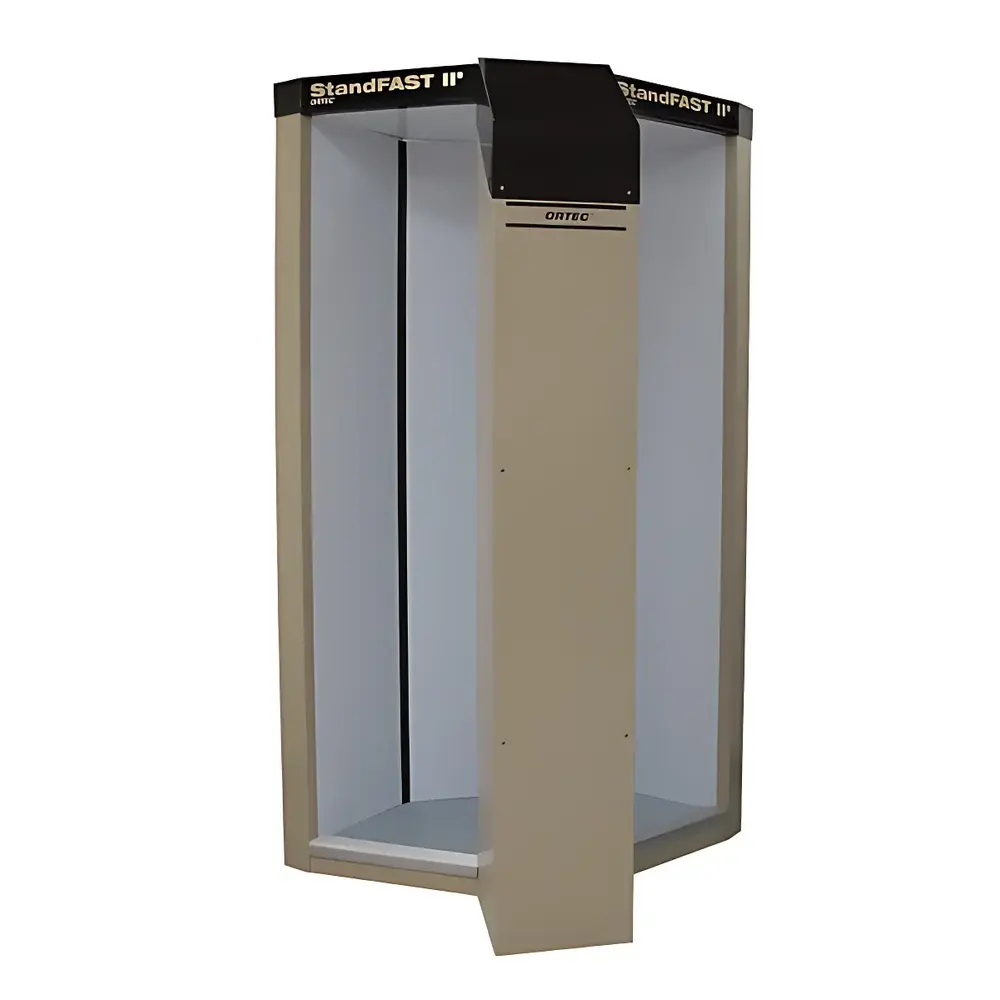
ORTEC StandFAST II Hybrid Whole Body Counter
| Brand | ORTEC |
|---|---|
| Origin | USA |
| Model | StandFAST II |
| Detector Configuration | Dual-detector (2 × 4"×4"×16" NaI(Tl) + IDM-200 HPGe) |
| Energy Range | 100 keV – 2 MeV |
| NaI Energy Resolution | <8% FWHM at 661 keV |
| Shielding Mass | 3855 kg |
| Max Component Weight | 1043 kg |
| Height | 221 cm |
| Minimum Distance Between Shielding and Electronics Rack | ≥30 m |
| Shielding Materials | Ultra-low-background steel (Co-60-free), oxygen-free copper, low-background plastics |
| Surface Finish | Epoxy-coated, replaceable plastic liner |
| Software Modes | Supervisor / Operator (password-protected) |
| Data Storage | Industrial-standard SQL database with audit-trail-capable schema |
| Compliance Support | Designed for GLP/GMP environments |
Overview
The ORTEC StandFAST II Hybrid Whole Body Counter is an engineered solution for in vivo radionuclide quantification in occupational health, nuclear medicine, emergency response, and environmental monitoring programs. Based on the principle of gamma-ray spectrometry, it performs non-invasive, direct measurement of internally deposited radioactive isotopes—including 137Cs, 40K, 60Co, 131I, and transuranic nuclides—by detecting characteristic gamma emissions from the human body. Its hybrid detector architecture integrates high-efficiency scintillation detection with high-resolution semiconductor spectroscopy to deliver both rapid screening capability and precise nuclide identification. Validated using MCNP-based Monte Carlo modeling, the hexagonal shield geometry optimizes background suppression while enabling flexible siting in laboratory corners or open-floor clinical spaces—without requiring structural reinforcement.
Key Features
- Hybrid dual-detector configuration: Two large-volume 4″×4″×16″ NaI(Tl) detectors provide high counting efficiency for rapid gross activity assessment, while the integrated IDM-200 HPGe detector (85 mm diameter × 30 mm thickness) delivers superior energy resolution for unambiguous nuclide identification and quantitative analysis.
- DigiBASE-E digital MCA integration: Each NaI detector couples directly to a DigiBASE-E module, incorporating PMT base, preamplifier, HV supply, and digitizer in a single unit—eliminating analog cabling artifacts and ensuring stable spectral acquisition with real-time digital stabilization.
- Ultra-low-background shielding: Constructed from Co-60–free ultra-low-background steel, oxygen-free copper, and radiopure polymers; epoxy-coated exterior and modular plastic liner facilitate decontamination and long-term maintenance compliance.
- Modular field-installation design: Maximum component weight limited to 1043 kg; optimized for standard freight logistics and on-site assembly without crane dependency.
- Concurrent measurement architecture: Enables overlapping operation—data acquisition for subject #2 begins immediately after subject #1’s scan completes, while subject #3 is prepared—maximizing throughput in high-volume surveillance programs.
Sample Compatibility & Compliance
The StandFAST II accommodates standing adult subjects (height range: 150–200 cm; weight limit: 136 kg) with minimal positioning assistance. Its open-front geometry eliminates claustrophobia concerns and supports mobility-impaired individuals via optional adjustable foot platforms. The system meets IEC 61526 and ANSI N42.22 requirements for whole-body counting performance. Shielding validation includes measured background rates ≤0.15 counts/s in the 100–2000 keV window. Design documentation supports regulatory audits under GLP (21 CFR Part 58), GMP (21 CFR Part 211), and ISO/IEC 17025 frameworks. Database architecture incorporates timestamped operator logs, electronic signatures, and immutable audit trails—enabling full traceability per FDA 21 CFR Part 11 Annex 11 expectations.
Software & Data Management
Acquisition and analysis are managed through ORTEC’s proprietary Whole Body Counter software, featuring dual-access roles: password-protected Supervisor mode (for calibration, QA/QC, and database administration) and Operator mode (for routine subject scanning). The EASY-CALIBRATION utility automates energy and efficiency calibration using reference sources traceable to NIST standards. All spectra and metadata—including subject demographics, scan parameters, and QA flags—are stored in a relational SQL database compliant with ODBC/JDBC protocols. Export functions support CSV, XML, and DICOM-SR formats for integration with enterprise LIMS, radiation safety information systems (RSIS), or national dose registries. Automated report generation templates comply with IAEA RS-G-1.2 and EURATOM BSS Directive reporting structures.
Applications
- Occupational monitoring of nuclear power plant staff, fuel fabrication workers, and decommissioning personnel.
- Post-incident internal contamination assessment following radiological dispersal device (RDD) or nuclear facility events.
- Medical isotope therapy follow-up (e.g., 131I ablation, 177Lu-PSMA) to quantify residual activity and calculate effective dose.
- Environmental epidemiology studies assessing chronic low-dose exposure in populations near uranium mining or legacy sites.
- Research applications in biokinetic modeling, dosimetry validation, and inter-laboratory comparison exercises coordinated by IAEA or WHO.
FAQ
What is the minimum detectable activity (MDA) for 137Cs under typical 5-minute counting conditions?
MDA is geometry- and background-dependent; typical values range from 150–250 Bq for a 70-kg adult, assuming standard calibration and validated shielding performance.
Can the system be upgraded to support seated or supine configurations?
No—the StandFAST II is specifically engineered for standing geometry. ORTEC offers the GC-3000 series for seated/lithotomy configurations.
Is remote diagnostics and software update support available?
Yes—ORTEC provides secure, encrypted remote access for firmware updates, spectral library revisions, and troubleshooting under signed service agreements.
Does the system include factory certification for background performance?
Yes—each unit ships with a certified background spectrum report, MCNP validation summary, and NIST-traceable efficiency calibration certificate.
How is detector stability maintained during extended operational periods?
DigiBASE-E implements continuous digital gain stabilization; IDM-200 HPGe operates with closed-cycle cryocooling and real-time temperature compensation algorithms.







