
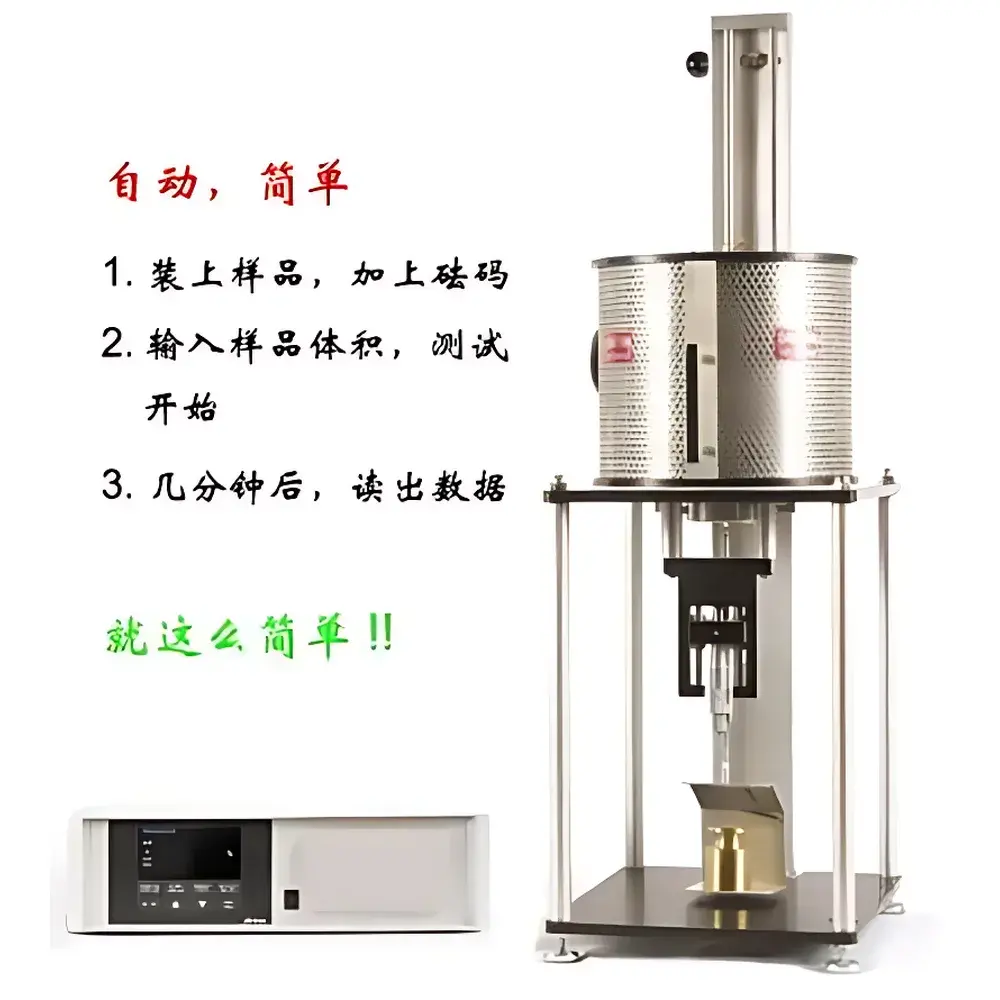
Orton BBV 1000 Series High-Temperature Beam Bending Viscometer
| Brand | Orton |
|---|---|
| Origin | USA |
| Manufacturer Type | Authorized Distributor |
| Instrument Type | High-Temperature Viscometer |
| Model | BBV 1000 Series |
| Temperature Range | Up to 1000°C / 1200°C / 1600°C (configurable) |
| Control Method | PID-controlled programmable heating |
| Standards Compliance | ASTM C-598 (Annealing & Strain Point), ASTM C-1350M (Viscosity vs. Temperature) |
| Viscosity Range | 10⁹–10¹⁴ P (Poise) |
| Sample Span | Standard 50 mm (customizable) |
| Sample Cross-Section | 2.5–5.0 mm diameter rod |
| Measurement Principle | Beam bending deflection under constant load at elevated temperature |
| Detection | LVDT-based real-time deformation monitoring |
| Accuracy | ±1 °C for annealing/strain point determination on geometrically regular glass rods |
| Software | Orton proprietary control, acquisition, and analysis suite with automated reporting |
Overview
The Orton BBV 1000 Series High-Temperature Beam Bending Viscometer is an engineered solution for the precise thermal-mechanical characterization of inorganic glasses and high-viscosity amorphous materials. Based on the fundamental principle of beam bending under constant flexural load, the instrument measures time-dependent deformation of a vertically suspended cylindrical glass specimen as temperature increases under controlled ramping conditions. This method directly correlates mechanical relaxation behavior with viscosity through established rheological models—specifically the Maxwell relation between strain rate, applied stress, and shear viscosity. Unlike rotational or capillary viscometers, the BBV 1000 operates in the solid-to-viscous transition regime (10⁹–10¹⁴ P), making it uniquely suited for determining critical thermal transition points—annealing point (AP), strain point (SP), and viscosity-temperature profiles—as defined in ASTM C-598 and ASTM C-1350M. Its design eliminates manual observation and subjective endpoint interpretation, replacing them with closed-loop PID temperature control, linear variable differential transformer (LVDT)-based displacement sensing, and algorithmic derivation of transition temperatures or viscosity values.
Key Features
- PID-controlled programmable furnace with three maximum temperature configurations: 1000°C, 1200°C, or 1600°C—selected at time of order to match material softening ranges.
- LVDT displacement transducer with sub-micron resolution, continuously tracking beam deflection at sampling intervals configurable down to 1 second.
- Modular sample holder accommodating standard 50 mm span rods; optional spans available for specialized geometries or low-deformation materials.
- Load application via calibrated dead-weight system (standard masses traceable to NIST standards), ensuring reproducible flexural stress independent of operator intervention.
- Automated endpoint detection: software identifies AP and SP per ASTM C-598 criteria (e.g., 10¹³.5 P and 10¹⁴.5 P equivalent deformation rates) without user threshold input.
- Viscosity calculation engine compliant with ASTM C-1350M Annex A1, converting measured strain rate, geometry, and load into absolute viscosity (in Poise) across the full operational range.
Sample Compatibility & Compliance
The BBV 1000 accepts cylindrical glass rods with diameters from 2.5 mm to 5.0 mm and lengths sufficient to achieve required span-to-diameter ratios (typically ≥10:1). It supports borosilicate, soda-lime, aluminosilicate, phosphate, and chalcogenide glasses, as well as ceramic precursors and certain high-Tg polymers exhibiting measurable bending creep above 500°C. All measurements adhere strictly to ASTM C-598 (Standard Test Method for Annealing Point and Strain Point of Glass) and ASTM C-1350M (Standard Test Method for Viscosity–Temperature Relationship of Glass by Beam Bending). The system architecture meets GLP documentation requirements: audit trails record all parameter changes, calibration events, and raw data timestamps; raw LVDT voltage traces and thermocouple readings are stored unprocessed for retrospective validation. While not FDA 21 CFR Part 11–certified out-of-the-box, the software supports electronic signature configuration and secure user access levels when deployed in regulated QC environments.
Software & Data Management
Orton’s proprietary BBV Control Suite provides integrated instrument orchestration and post-processing. During operation, the interface displays real-time plots of temperature vs. time, displacement vs. time, and derived strain rate. Predefined test templates enforce compliance with ASTM C-598 or C-1350M protocols—including ramp rate limits (e.g., ≤5°C/min for AP/SP), dwell periods, and load application timing. Post-run analysis generates ISO/IEC 17025–compatible reports listing AP/SP temperatures, viscosity–temperature tables (log η vs. T), confidence intervals for replicate runs, and statistical summaries across multi-sample batches. Export options include CSV (for LIMS integration), PDF (with embedded metadata), and XML (for automated QA workflows). All raw binary data files are timestamped, checksum-verified, and retain original sensor resolution—enabling third-party reprocessing if required for regulatory review.
Applications
- Determination of annealing and strain points for optical fiber preform qualification and flat-panel display glass manufacturing.
- Development of low-expansion glass compositions for telescope mirrors and semiconductor lithography masks.
- Viscosity modeling for glass melting and forming simulations (e.g., finite element analysis inputs).
- Thermal history studies of phase-separated glasses and devitrification kinetics.
- Quality control of recycled glass cullet batches where compositional drift affects thermal transitions.
- Research on novel bioactive glasses and glass-ceramic scaffolds for biomedical applications.
FAQ
What distinguishes the BBV 1000 from rotational high-temperature rheometers?
Rotational systems require molten-state flow and are generally limited to viscosities below ~10⁸ P. The BBV 1000 operates in the quasi-solid regime using bending creep—making it appropriate for transition-point determination where rotational methods fail due to insufficient torque or sample slippage.
Can the BBV 1000 measure viscosity outside the 10⁹–10¹⁴ P range?
No. Below 10⁹ P, deformation becomes too rapid for stable LVDT tracking; above 10¹⁴ P, creep rates fall below detectable thresholds within practical test durations. For lower viscosities, capillary or falling-ball methods per ASTM C965 are recommended.
Is sample preparation standardized?
Yes. ASTM C-598 specifies rod geometry tolerances (±0.05 mm diameter, straightness <0.1 mm/m), end-face perpendicularity (<0.5°), and annealing history. Orton provides detailed SOPs and metrology guidelines for in-house sample machining and verification.
How is temperature calibrated and verified?
Each furnace is supplied with dual NIST-traceable Type S thermocouples (one for control, one for verification). Annual recalibration includes fixed-point checks at Ag (961.78°C) and Cu (1084.62°C) using reference cells, documented per ISO/IEC 17025.



