
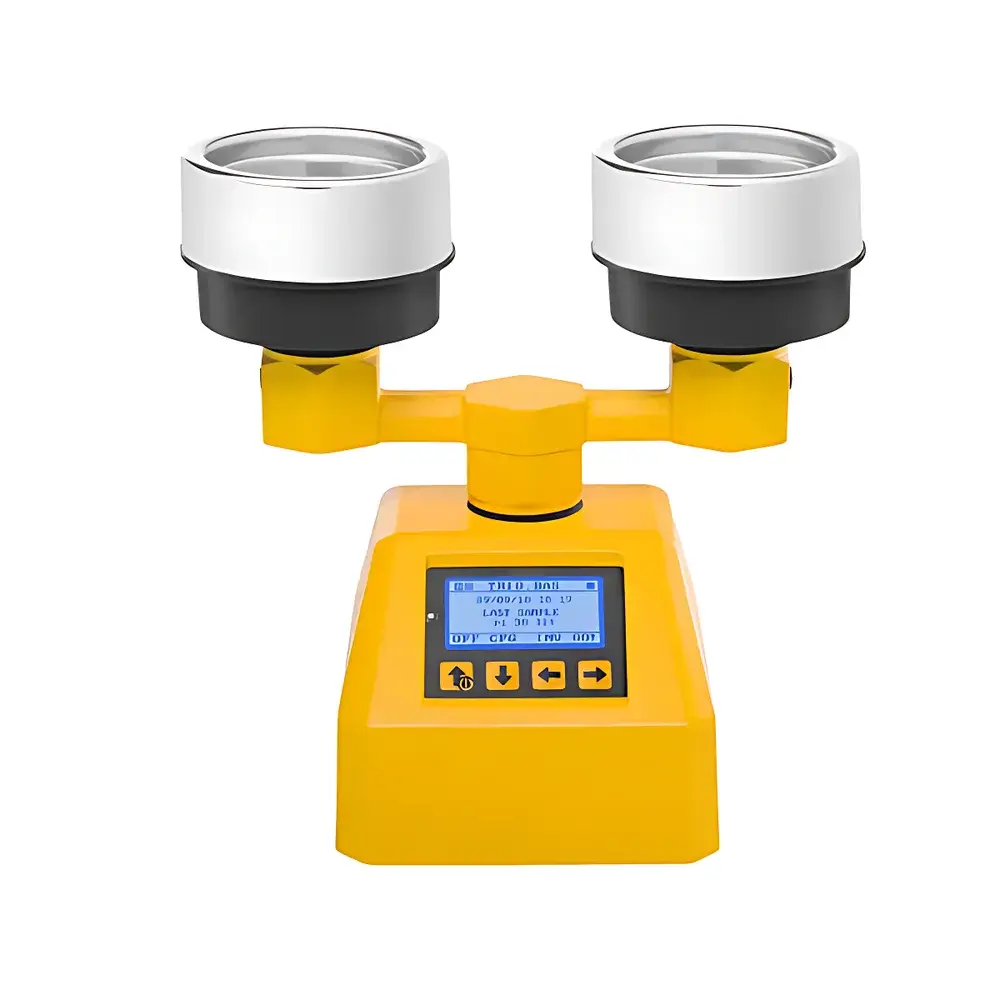
ORUM TRIO.BAS DUO Air Microbial Sampler
| Origin | Italy |
|---|---|
| Manufacturer Type | Authorized Distributor |
| Origin Category | Imported |
| Model | TRIO.BAS DUO |
| Price Range | USD 6,800 – 13,600 (FOB) |
| Sampling Principle | Isokinetic Impaction via Precision Laser-Drilled Stainless Steel Nozzle Array |
| Flow Rate | 200 L/min (selectable 100/200 L/min) |
| Flow Accuracy | ±2.5% of reading |
| Sampling Duration | 0–10 min (programmable in segments) |
| Operating Temperature | −10 °C to +40 °C |
| Operating Relative Humidity | 0–80 % RH |
| Sample Dish Compatibility | 60 mm and 90 mm Petri Dishes |
| Display | Backlit LCD (32 × 64 mm) |
| Control Interface | 4 Membrane Waterproof Keys |
| Wireless Connectivity | Integrated Bluetooth 5.0 |
| Power Supply | Rechargeable Ni-MH Battery (12 V, 4500 mAh) |
| Charging Input | AC 100–240 V, 50/60 Hz |
| USB Charging Port | 5 V, 500 mA |
| Weight | 1.9 kg (main unit only) |
| Dimensions | 260 × 280 × 140 mm |
| Certifications | CE (EN 61010-1:2010, EN 61326-1:2006, EN 62321:2009), ATEX II 2G Ex eb IIB T4 Gb (EN 60079-0:2012, IEC 60079-15:2010) |
| Data Integrity Compliance | FDA 21 CFR Part 11–ready audit trail & electronic signature support |
Overview
The ORUM TRIO.BAS DUO Air Microbial Sampler is an ISO 14698-1–compliant, high-flow isokinetic impactor engineered for quantitative monitoring of viable airborne microorganisms in critical environments—including cleanrooms (ISO Class 5–8), aseptic manufacturing suites, hospital isolation rooms, and pharmaceutical R&D laboratories. It operates on the principle of inertial impaction: air is drawn at precisely controlled velocity through a laser-drilled stainless steel nozzle array (60 or 90 mm format), directing viable particles onto nutrient agar surfaces with minimal desiccation or shear-induced viability loss. Unlike filtration or centrifugal methods, impaction preserves colony-forming unit (CFU) integrity for subsequent identification and enumeration under standardized incubation protocols (e.g., ISO 14698-2, EU GMP Annex 1). The dual-chamber architecture enables simultaneous sampling onto two independent agar plates—allowing parallel detection of total aerobic microorganisms and selective yeast/mold populations without cross-contamination or instrument downtime.
Key Features
- Dual-Channel Independent Sampling: Two physically isolated impactor heads operate synchronously or independently, supporting concurrent collection for total CFU and differential fungal enumeration per USP & EP microbiological testing guidelines.
- Laser-Engineered Nozzle Plate: ORUM’s proprietary nanosecond-pulsed laser drilling eliminates burrs and internal edge irregularities on stainless steel impactor surfaces—reducing fiber adhesion, minimizing carryover, and ensuring reproducible deposition efficiency across >10,000 sampling cycles.
- Rotary-Lock Impactor Head: Tool-free bayonet-style coupling replaces threaded interfaces, eliminating thread galling and flow-path misalignment—maintaining certified ±2.5% volumetric accuracy over extended operational life.
- Segmented Time Programming: Enables up to 10 discrete time intervals within a single 10-minute cycle (e.g., 2 × 3 min + 1 × 4 min), facilitating temporal profiling of microbial load shifts during process interventions or HVAC transitions.
- ATEX-Certified Hazardous Area Operation: Available in explosion-proof configuration (II 2G Ex eb IIB T4 Gb) for continuous sampling in Zone 1/2 classified areas handling flammable vapors (Group IIA/IIB/IIC), including solvent-based coating lines and API synthesis facilities.
- FDA 21 CFR Part 11–Ready Architecture: Built-in audit trail logs operator ID, timestamp, sampling parameters, battery status, and calibration events; supports role-based access control and digital signature verification for GLP/GMP-regulated workflows.
Sample Compatibility & Compliance
The TRIO.BAS DUO accepts standard 60 mm and 90 mm Petri dishes filled with TSA, SDA, or other pharmacopeial media (USP , EP 2.6.12). Its airflow dynamics conform to ISO 14698-1 Annex B requirements for uniform particle deposition across the agar surface. Device-level compliance includes CE marking per EN 61010-1 (safety), EN 61326-1 (EMC), and EN 62321 (RoHS); ATEX certification ensures safe deployment in explosive atmospheres per IEC 60079 series. All firmware and data management modules undergo periodic validation per ASTM E2500 and ISO/IEC 17025 documentation standards.
Software & Data Management
Bluetooth 5.0 connectivity enables bidirectional communication with ORUM’s validated desktop application (Windows/macOS) and mobile companion app (iOS/Android). Users configure sampling sequences, review real-time flow stability graphs, export CSV/Excel reports with embedded metadata, and generate PDF-certified records compliant with ALCOA+ principles. Data encryption (AES-256), automatic backup to network drives, and configurable retention policies ensure alignment with FDA 21 CFR Part 11 Subpart B requirements for electronic records and signatures.
Applications
- Aseptic processing line environmental monitoring (EU GMP Annex 1, FDA Guidance for Industry)
- Pharmaceutical cleanroom qualification and routine surveillance (ISO 14644-2, ISO 14698-1)
- Hospital infection control programs (CDC/HICPAC standards)
- Medical device sterilization validation (ISO 11137)
- Biotechnology upstream/downstream facility risk assessment
- Food & beverage production hygiene verification (ISO 22000, HACCP)
FAQ
Does the TRIO.BAS DUO require annual recalibration?
Yes. Annual traceable calibration against NIST-traceable flow meters is recommended per ISO/IEC 17025 and internal quality system requirements. ORUM provides certified calibration services with full uncertainty budgets.
Can the device store sampling history locally when offline?
Yes. Internal non-volatile memory retains ≥500 complete sampling records—including timestamps, flow logs, and operator IDs—even during power loss.
Is the nano-antimicrobial housing surface validated against ISO 22196?
Yes. The silver-ion doped polymer casing demonstrates ≥99.9% reduction of Staphylococcus aureus and Escherichia coli after 24 h per ISO 22196:2011 test protocol.
What maintenance is required between sampling sessions?
Nozzle plates require ethanol wipe-down and visual inspection prior to each use; full cleaning per SOP ORUM-CLEAN-03 is advised after every 50 cycles or exposure to high-particulate environments.
Does Bluetooth operation affect sampling accuracy?
No. RF emissions are shielded per EN 61326-1 Class B limits; wireless communication operates only during idle or post-sampling phases—never during active air draw.







