
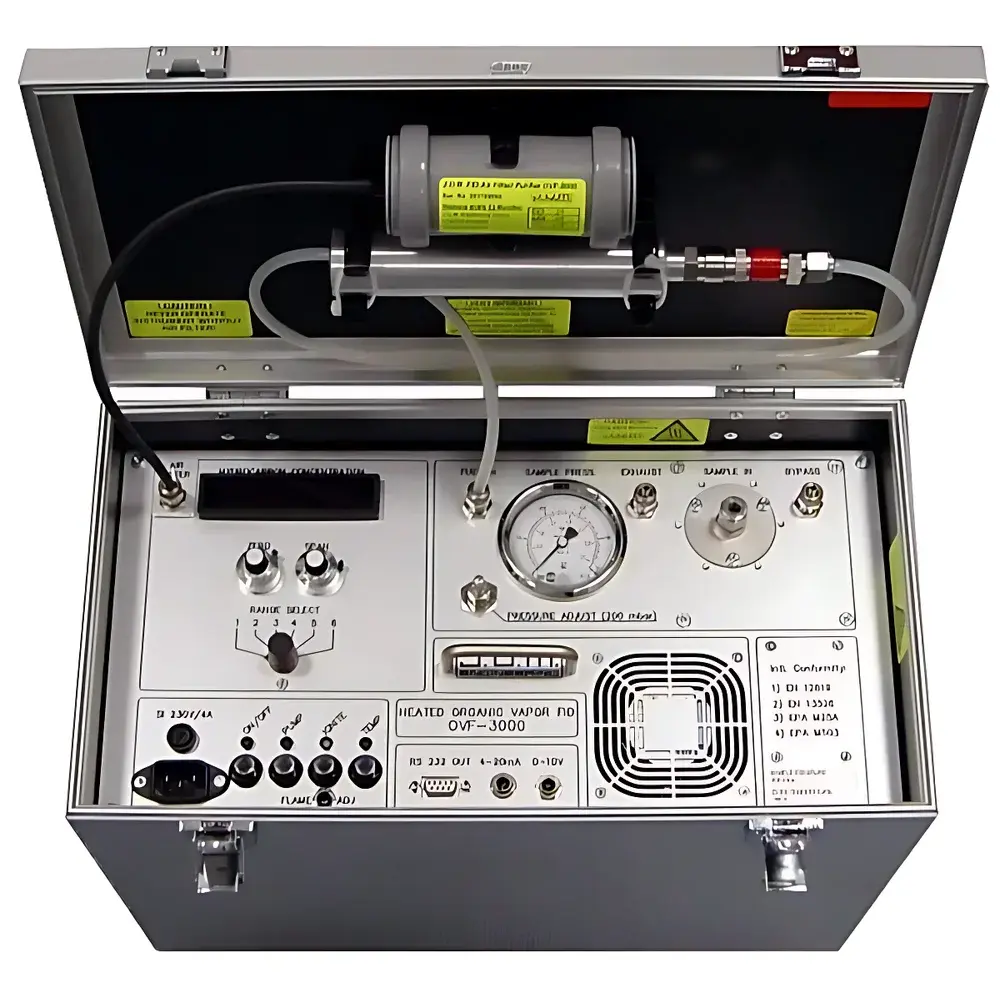
J.U.M. OVF3000-1 Portable VOC Analyzer with FID Detector
| Brand | J.U.M. |
|---|---|
| Origin | Germany |
| Model | OVF3000-1 |
| Detection Principle | Flame Ionization Detection (FID) |
| Instrument Type | Portable Real-Time Analyzer |
| Typical Configuration | Total Volatile Organic Compounds (TVOC) Analyzer |
| Measurement Range | 0–1000 ppm |
| Resolution | 0.1 ppm |
| Accuracy | ±5% of reading |
| Response Time | <60 s |
| Detector Sensitivity | 1 ppm full-scale for CH₄ |
| Heating Chamber Temperature | 190 °C |
| Built-in Air Supply | Yes |
| Operating Time per Hydrogen Cartridge | >40 h |
Overview
The J.U.M. OVF3000-1 is a field-deployable, flame ionization detector (FID)-based portable analyzer engineered for quantitative real-time measurement of total volatile organic compounds (TVOC) in ambient air, stack gas, and process streams. Unlike photoionization detectors (PID) or metal oxide sensors, the FID principle provides near-universal response to hydrocarbons and most organic vapors—with linear, stoichiometric sensitivity proportional to carbon mass flow. This makes the OVF3000-1 particularly suited for regulatory-compliant emission monitoring where compound-independent quantification is required. Its robust thermal design features a precisely controlled 190 °C combustion chamber, ensuring complete oxidation of complex organics—including aromatic, chlorinated, and oxygenated species—without catalytic interference or memory effects. The instrument operates independently of external gas supplies, integrating an internal compressed air system and low-pressure metal hydride hydrogen storage, enabling uninterrupted operation for over 40 hours on a single cartridge.
Key Features
- FID detection with proven linearity across six programmable range spans (0–10 ppm to 0–100,000 ppm), configurable via firmware for application-specific calibration protocols
- True portability: integrated battery power, ruggedized IP65-rated enclosure, and ergonomic carry handle optimized for field use in industrial plants, waste treatment facilities, and environmental inspection sites
- Thermally stabilized detection system with active temperature control and automatic zero/span verification routines to maintain long-term baseline stability
- Real-time data logging at 1-second intervals with onboard memory supporting ≥10,000 measurement records; timestamped and traceable to internal RTC
- Low-maintenance architecture: no consumable filters or optical components; FID jet and collector electrode accessible for routine cleaning without tooling
- Compliance-ready firmware supporting audit trails, user access levels (operator/administrator), and optional 21 CFR Part 11–compliant electronic signatures when paired with certified software
Sample Compatibility & Compliance
The OVF3000-1 is validated for direct sampling of non-condensing gas matrices including ambient air, flue gas (up to 200 °C with optional heated probe), compressed air, nitrogen, and synthetic gas mixtures. It excludes halogenated compounds with high electronegativity (e.g., CFCs, SF₆) that yield sub-stoichiometric FID response, and is not intended for hydrogen sulfide or ammonia-rich streams due to potential catalyst poisoning in the combustion zone. Regulatory alignment includes full conformance with German TA Luft requirements under 2nd, 13th, and 17th BImSchV ordinances; European standards EN 12619 (continuous monitoring of emissions) and EN 13526 (performance testing of FID analyzers); and U.S. EPA Methods 25A (total gaseous organic concentration) and Method 503 (calibration and verification procedures). All factory calibrations are traceable to NIST-certified methane standards.
Software & Data Management
Data acquisition and instrument configuration are managed via J.U.M.’s proprietary OVF Control Suite (v4.2+), compatible with Windows 10/11 and deployable on tablet or laptop platforms. The software supports automated calibration sequence execution, multi-point span validation, drift correction algorithms, and export of CSV/Excel-compatible reports with embedded metadata (operator ID, location tag, calibration certificate number). Raw time-series data includes analog output scaling, temperature-compensated FID current values, and diagnostic flags (e.g., flame-out detection, low H₂ pressure warning). For enterprise integration, optional Modbus TCP and OPC UA interfaces enable seamless connection to SCADA systems and centralized LIMS environments—supporting GLP/GMP-aligned data integrity workflows including electronic audit trails and change history logs.
Applications
- Continuous emission monitoring (CEM) of combustion sources—including boilers, incinerators, and thermal oxidizers—in accordance with national permitting conditions
- Process optimization and catalyst performance evaluation during catalytic converter testing and engine development programs
- Leak detection and repair (LDAR) surveys in petrochemical, pharmaceutical, and fine chemical manufacturing facilities
- Indoor air quality (IAQ) assessment in cleanrooms, laboratories, and occupied buildings following ISO 16000-22 and WHO TVOC guidelines
- Verification of carbon adsorption bed breakthrough during solvent recovery operations and activated carbon regeneration cycles
- Trace hydrocarbon monitoring in ultra-high-purity (UHP) gases used in semiconductor fabrication, where detection limits down to 1 ppm CH₄-equivalent are critical for process yield assurance
FAQ
Does the OVF3000-1 require external hydrogen or air supply?
No. It incorporates a self-contained low-pressure metal hydride hydrogen cartridge and an integrated diaphragm air compressor, eliminating dependency on external gas cylinders or shop air lines.
Can it measure individual VOCs, or only total hydrocarbons?
The OVF3000-1 is a non-separating FID-based total VOC analyzer. It reports sum-concentration as methane-equivalent (ppm C₁) and does not provide speciated identification without coupling to a GC module.
Is the instrument suitable for use in explosive atmospheres?
It is rated for Zone 2 / Class I Div 2 hazardous locations when operated with approved intrinsically safe accessories; full ATEX/IECEx certification documentation is available upon request.
How often must the FID be calibrated?
Initial calibration is performed at the factory using NIST-traceable standards. Field recalibration is recommended every 30 days for compliance-critical applications or after exposure to high-concentration samples exceeding 80% of full scale.
What maintenance is required beyond calibration?
Routine maintenance includes quarterly inspection of the FID jet and collector electrode, annual replacement of the desiccant in the internal air dryer, and periodic verification of hydrogen cartridge seal integrity—no optical alignment or sensor replacement is needed within the first five years of operation.
Related Products







