
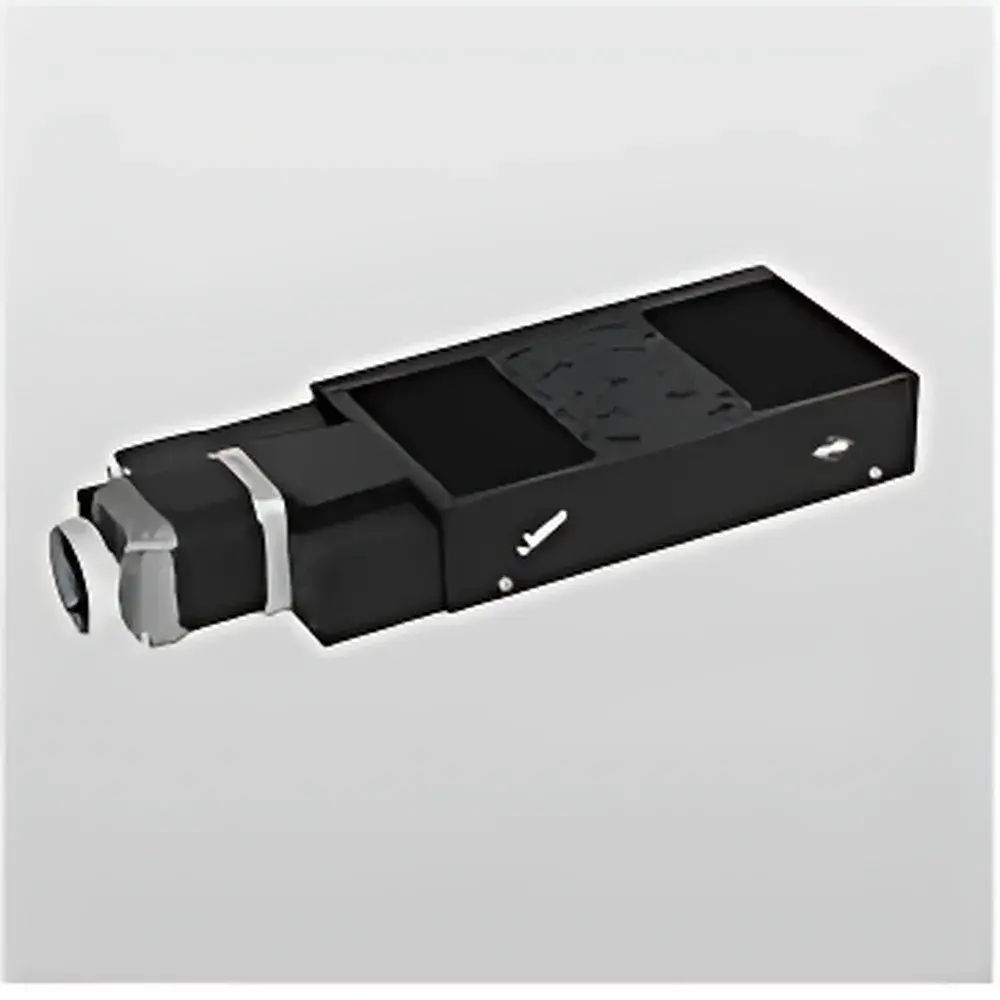
OWIS LIMES80 High-Precision Motorized Linear Translation Stage
| Brand | OWIS |
|---|---|
| Origin | Germany |
| Model | LIMES80 |
| Product Type | Motorized Translation Stage |
| Drive Options | Stepper Motor / DC Servo Motor |
| Travel Options | 50 / 70 / 105 / 135 / 210 mm |
| Max. Speed | 25 mm/s |
| Max. Load Capacity | 150 N |
| Max. Driving Force | 60 N |
| Lead Screw Pitch | 1 mm |
| Bidirectional Repeatability | < 2 µm |
| Positioning Error | < 16 µm per 100 mm |
| Tip/Tilt Errors | < 100 µrad (yaw), < 150 µrad (pitch) |
| Vertical & Horizontal Abbe Errors | < 4 µm |
| Motor Supply Voltage (Max.) | 40 V (stepper), 24 V (servo) |
| Holding Voltage | 3.2 V |
| Max. Motor Current | 1.8 A (stepper), 3.3 A (servo) |
| Steps per Revolution | 200 (stepper), 2000 (servo) |
| Optional Encoders | Incremental optical grating scale (±3 µm/m accuracy, 0.1 µm resolution) |
| Optional Brake | Electromagnetic holding brake |
Overview
The OWIS LIMES80 is a high-precision motorized linear translation stage engineered for demanding optical alignment, interferometric setup, and micro-positioning applications in research laboratories and precision manufacturing environments. Based on a robust monolithic aluminum base with hardened anodized black electroplating, the stage integrates a preloaded spherical-roller lead screw mechanism and recirculating ball-bearing guideways to eliminate backlash while sustaining high axial rigidity and load capacity up to 150 N. Its kinematic design minimizes parasitic motion—ensuring sub-microradian angular deviations (<100 µrad yaw, <150 µrad pitch) and Abbe errors below ±4 µm across full travel. The LIMES80 operates under ISO 9001-certified manufacturing protocols in Germany and conforms to CE marking requirements for electromagnetic compatibility (EMC Directive 2014/30/EU) and low-voltage safety (LVD Directive 2014/35/EU). It is routinely deployed in setups requiring traceable, repeatable displacement—including ultra-stable laser cavity alignment, fiber coupling platforms, and metrology-grade calibration benches.
Key Features
- Monolithic high-strength aluminum construction with black hard-anodized surface finish for enhanced wear resistance and thermal stability
- Preloaded spherical-roller lead screw (1 mm pitch) enabling zero-backlash operation and extended service life under continuous duty cycles
- Bidirectional repeatability better than ±2 µm—validated per ISO 230-2 Annex B under no-load, 20 °C ambient conditions
- Five standard travel lengths: 50 mm, 70 mm, 105 mm, 135 mm, and 210 mm—each optimized for mechanical resonance suppression and stiffness-to-mass ratio
- Integrated Hall-effect, mechanical, and inductive limit switches for reliable end-of-travel detection and system-level interlock integration
- Optional electromagnetic brake for power-loss safety compliance in GMP and GLP environments
- Optional incremental optical grating scale feedback (±3 µm/m linearity error, 0.1 µm interpolation resolution) supporting closed-loop control architectures
Sample Compatibility & Compliance
The LIMES80 is compatible with standard optical table mounting patterns (M6 threaded holes on 25 mm grid) and accepts custom top plates for integration with kinematic mirror mounts, fiber positioners, or vacuum-compatible adapters (upon request). All materials comply with RoHS 2011/65/EU restrictions on hazardous substances. Electrical interfaces meet IEC 61000-6-2 (immunity) and IEC 61000-6-4 (emission) standards. When equipped with encoder feedback and appropriate controller firmware, the stage supports audit trails and electronic signatures required under FDA 21 CFR Part 11 for regulated pharmaceutical and medical device R&D workflows.
Software & Data Management
OWIS provides native drivers for Windows-based motion control via USB or RS-485 (Modbus RTU protocol), fully compatible with MATLAB, LabVIEW, Python (PySerial, PyVISA), and common PLC environments. Third-party integration is supported through ASCII command sets compliant with SCPI-like syntax. Encoder-equipped variants log position data at up to 1 kHz sampling rate; timestamped trajectory files are exportable in CSV or HDF5 format for post-processing in Origin, Igor Pro, or Python-based analysis pipelines. Firmware updates are delivered via secure HTTPS download and include version-controlled changelogs aligned with ISO/IEC 17025 documentation practices.
Applications
- Precision alignment of laser cavities, beam splitters, and waveplates in quantum optics experiments
- Fiber-optic component positioning for coupling efficiency optimization and polarization-dependent loss (PDL) characterization
- Stage scanning in confocal microscopy, white-light interferometry, and optical coherence tomography (OCT) systems
- Calibration reference motion for coordinate measuring machines (CMMs) and laser trackers per ISO 10360
- Automated sample translation in spectroscopic mapping and photoluminescence lifetime imaging (PLIM)
- Integration into multi-axis goniometers for synchrotron beamline instrumentation
FAQ
What is the difference between stepper and DC servo motor versions?
The stepper variant uses open-loop control with 200 steps/rev and is ideal for cost-sensitive, moderate-dynamic applications. The servo version offers 2000 counts/rev, higher torque density, and inherent stall detection—suited for high-acceleration, closed-loop positioning tasks.
Can the LIMES80 operate in vacuum environments?
Standard units are rated for ambient air use only. Vacuum-compatible configurations (with dry-lubricated bearings and outgassing-tested adhesives) are available as custom builds—contact OWIS engineering for ISO 14644 Class 5 cleanroom or UHV (<10⁻⁷ mbar) specifications.
Is encoder feedback necessary for achieving <2 µm repeatability?
No. The specified bidirectional repeatability is achieved with open-loop stepper or servo control. The encoder enhances absolute positioning accuracy and enables dynamic error compensation but does not improve intrinsic repeatability.
How is thermal drift mitigated over extended travel ranges?
The aluminum structure features a low coefficient of thermal expansion (23.1 × 10⁻⁶/K), and the lead screw’s preload compensates for thermal growth-induced backlash. For sub-micron stability over >1 hour, active temperature stabilization of the baseplate is recommended.
Does OWIS provide calibration certificates traceable to national standards?
Yes—NIST-traceable calibration reports (including bidirectional repeatability, positioning error, and straightness measurements) are available upon request and conform to ISO/IEC 17025:2017 accreditation requirements.




