
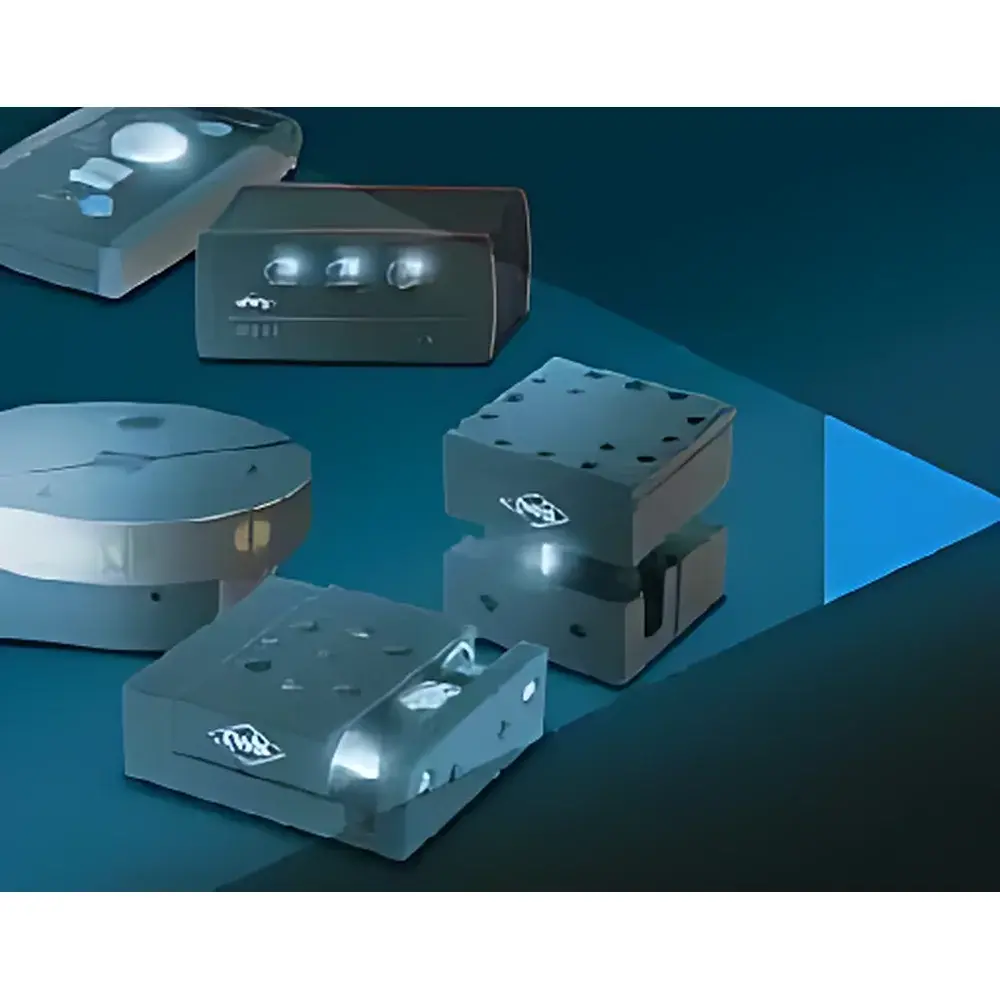
OWIS NDT24-30 Piezo-Inertial Nanopositioning Rotation Stage
| Brand | OWIS |
|---|---|
| Origin | Germany |
| Type | Motorized Translation Stage |
| Model | NDT24-30 (and variants: NDT24-30-MSI, NAGO P24-8, NAGO T24-8, NHV24-6, NHV24-6-MSI, NLV24-7, NLV24-7-MSI, PT30-5, PT30-5-MSI) |
| Travel Range | Up to ±3.3° (angular), 6 mm (vertical), 7 mm (linear), continuous rotation (rotational) |
| Minimum Step Size | 20–40 µrad (angular), 50–300 nm (linear/vertical) |
| Maximum Step Size | 6–100 µrad (angular), 700–2000 nm (linear/vertical) |
| Load Capacity | 2–30 N |
| Bidirectional Repeatability | ≤0.1 µrad / ≤400 nm |
| Tilt Moment (Mx/My/Mz) | ≤0.1 N·m |
| Max. Angular Velocity | 100–300 mrad/s |
| Max. Linear Velocity | 0.3–2 mm/s |
| Construction Material | High-strength anodized aluminum (black, low-reflectivity finish) |
| Control Unit | NHS06 Manual Controller |
| Mounting Accessory | NMP50 Mounting Plate |
Overview
The OWIS NDT24-30 series represents a family of precision nanopositioning stages engineered for sub-microradian angular control and nanometer-level linear displacement in optical and photonics laboratories. These stages employ piezo-inertial drive technology — a friction-based, stick-slip actuation principle that delivers high-resolution motion without mechanical backlash or hysteresis typical of conventional stepper or servo systems. Unlike electromagnetic or voice-coil actuators, the piezo-inertial mechanism enables open-loop operation with exceptional repeatability, making it especially suitable for applications requiring deterministic, vibration-free positioning in compact footprints. Each stage is designed for integration into multi-axis kinematic platforms, supporting modular assembly of XY, XYZ, or XYZθ configurations. The NDT24-30 variant provides continuous 360° rotational capability with step resolution down to 40 µrad and bidirectional repeatability better than 0.1 µrad — critical for beam steering, interferometric alignment, and adaptive optics calibration.
Key Features
- High power density in minimal volume: All models maintain mechanical rigidity while occupying under 24 mm × 24 mm footprint — ideal for space-constrained optical breadboards and vacuum chambers.
- Nanometer- and microradian-scale resolution: Linear stages achieve minimum steps as low as 50 nm; angular stages resolve down to 2 µrad, enabling precise wavefront correction and cavity length tuning.
- Vibration-free stopping behavior: The inertial drive eliminates overshoot, ringing, or settling delay — essential for time-critical measurements such as pump-probe spectroscopy or single-photon detection alignment.
- Black anodized aluminum construction: Provides EMI shielding, thermal stability (CTE ≈ 23.6 × 10⁻⁶ K⁻¹), and low optical reflectivity to minimize stray light in sensitive interferometric setups.
- Ceramic guide option: Extends service life under continuous operation by reducing wear in high-cycle positioning tasks (e.g., automated wafer inspection).
- Vacuum-compatible variants (e.g., NDT24-30-MSI, NHV24-6-MSI): Rated for operation at pressures ≤10⁻⁶ mbar, with non-outgassing materials and lubrication-free guidance.
Sample Compatibility & Compliance
These stages are compatible with standard optical mounting interfaces (M4, M6 tapped holes) and integrate seamlessly with OWIS’s NMP50 mounting plate for stable base attachment. All units conform to ISO 9001 manufacturing protocols and meet RoHS Directive 2011/65/EU material restrictions. For regulated environments, the NHS06 controller supports analog voltage input (±10 V) and digital TTL triggering — enabling synchronization with data acquisition systems compliant with IEEE 1588 (PTP) timing standards. While not intrinsically certified for FDA 21 CFR Part 11, audit trails and configuration logs can be implemented externally via third-party LabArchives or LabVIEW-based SCADA frameworks adhering to GLP/GMP documentation requirements.
Software & Data Management
The NHS06 manual control unit provides intuitive knob-and-button interface with real-time position feedback via LED display. For automated workflows, OWIS supplies DLL libraries and LabVIEW VIs compatible with Windows 10/11 (64-bit), supporting integration into Python (PyVISA), MATLAB, or C# environments. Position data logging is performed at up to 1 kHz sampling rate, with timestamped CSV export. Firmware updates preserve backward compatibility across all NDT/NLV/NHV/NAGO series units. No cloud connectivity or proprietary cloud platform is embedded — ensuring full data sovereignty and compliance with institutional IT security policies.
Applications
- Laser cavity mirror alignment and mode-matching optimization in ultrafast oscillator design
- Active stabilization of Michelson and Mach-Zehnder interferometers
- Automated focus scanning in confocal microscopy and optical coherence tomography (OCT)
- Beam pointing correction in free-space quantum communication terminals
- Calibration of photonic integrated circuit (PIC) test fixtures requiring <100 nm positional fidelity
- In-situ strain mapping in synchrotron X-ray diffraction setups using angular dithering protocols
FAQ
What drive principle do OWIS nanopositioning stages use?
They utilize piezo-inertial (stick-slip) actuation — a solid-state, friction-driven method that avoids magnetic interference and eliminates the need for closed-loop sensors in most laboratory applications.
Are vacuum-rated versions fully bakeable?
Vacuum-compatible models (e.g., -MSI suffix) are rated for UHV conditions (≤10⁻⁶ mbar) but are not designed for thermal baking above 80 °C due to adhesive and polymer component limitations.
Can multiple axes be synchronized without external master clock?
Yes — the NHS06 controller supports multi-channel triggering via shared TTL start signals, enabling hardware-synchronized motion across up to four axes with sub-millisecond jitter.
Is ceramic guidance available for all stage types?
Ceramic guides are optional for NLV, NHV, and NDT series; they are not offered for NAGO angular stages due to kinematic constraints in goniometric design.
What is the maximum payload for dynamic vs. static loading?
Load ratings listed (2–30 N) assume static equilibrium; for dynamic acceleration profiles exceeding 0.5 g, derating by 30% is recommended to maintain repeatability specifications.





