
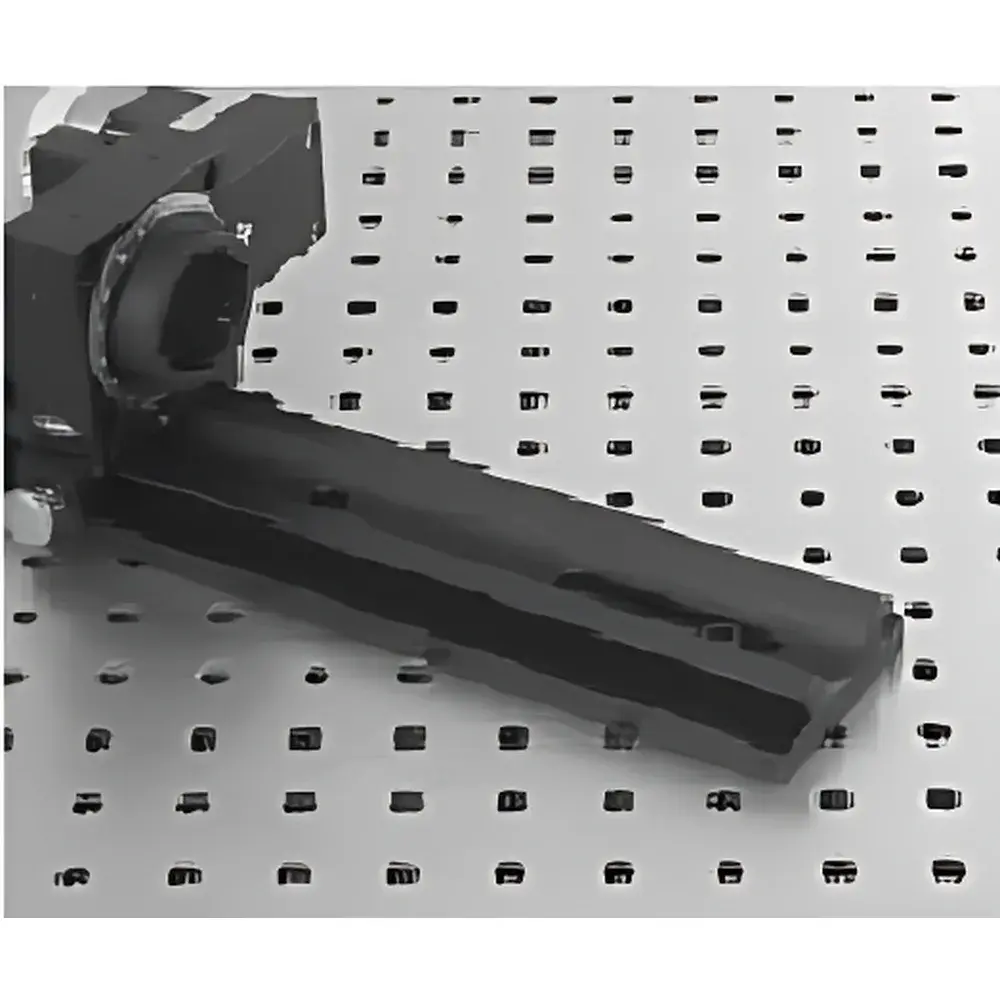
OWIS SYS40 / SYS65 / SYS90 Beam Steering System
| Brand | OWIS |
|---|---|
| Origin | Germany |
| Model Series | SYS40, SYS65, SYS90 |
| Rail Heights | 40 mm, 65 mm, 105 mm |
| Rail Lengths | 40–2000 mm (custom lengths available) |
| Slide Widths | 10–110 mm |
| 4-Side Profile Heights | 40 mm, 65 mm |
| 4-Side Profile Lengths | 180–1500 mm |
| Material | High-stability aluminum alloy, black anodized |
| Mounting Compatibility | M6 threaded grids (25 mm / 50 mm pitch), slotted-hole adaptability for non-metric optical tables |
| Surface Options | Standard black anodizing |
| Optional Accessories | Integrated tape scales (metric or imperial) |
Overview
The OWIS SYS40, SYS65, and SYS90 Beam Steering Systems are modular, precision-engineered optical mounting platforms designed for stable, repeatable alignment of lasers, mirrors, lenses, beam splitters, and other optomechanical components in research, metrology, and industrial laser applications. These systems operate on a rigid mechanical principle—based on precisely machined aluminum alloy rails and dovetail-guided slides—that ensures long-term dimensional stability under thermal fluctuation, mechanical load, and repeated reconfiguration. Unlike generic lab furniture or passive workbenches, the SYS series is an active optical infrastructure: each rail establishes a defined optical axis height (40 mm, 65 mm, or 105 mm above the mounting surface), enabling rapid, traceable, and height-consistent assembly of multi-axis optical trains without recalibration. The system’s core architecture follows ISO/IEC 17025-aligned design principles for measurement reproducibility—critical when building interferometers, cavity ring-down setups, or alignment-sensitive quantum optics experiments.
Key Features
- Three standardized optical axis heights (40 mm, 65 mm, 105 mm) across SYS40, SYS65, and SYS90 families—ensuring vertical scalability and inter-system compatibility.
- High-stability aluminum alloy (EN AW-6082 T6 or equivalent) with tight tolerance machining (±5 µm flatness over 1 m) and hard-wearing black anodized surface (≥25 µm thickness, ASTM B580 Type II).
- Dual-mounting rail variants: S-series rails with counterbored M6 holes (25 mm / 50 mm pitch) for standard optical tables; S-LL-series rails with continuous longitudinal slots for universal compatibility—including imperial-threaded tables, vacuum chambers, and custom frames.
- RT-series slides feature dual-point tilting clamping mechanisms that apply uniform lateral force without inducing rail deformation—preserving guide geometry and positional repeatability (≤ ±1.5 µm runout after 100 cycles).
- 4-side profile systems (S-65-4, S-40-4) provide torsional rigidity up to 3.2 × 10⁶ N·mm²/rad, enabling cantilevered 3D structures (e.g., vertical beam lifts, multi-level periscopes) while maintaining full dovetail interchangeability with S-rail components.
- All components support optional integrated metric or imperial tape scales (±0.1 mm accuracy, adhesive-backed or mechanically anchored) for rapid visual referencing without external metrology tools.
Sample Compatibility & Compliance
The SYS platform is compatible with industry-standard optomechanics including Thorlabs, Newport, and Standa mounts (via adapter plates), as well as OWIS’ own kinematic mirror mounts, translation stages, and rotation stages. It meets mechanical interface requirements of ISO 10110-7 (optical component mounting), DIN 31636 (threaded hole patterns for optical tables), and SEMI F22-0204 (vibration-isolated cleanroom integration). While not a regulated medical or analytical device, its construction materials and surface treatments comply with RoHS 2011/65/EU and REACH Annex XVII. For GLP/GMP environments requiring audit trails, OWIS provides material certification (EN 10204 3.1) and dimensional inspection reports upon request.
Software & Data Management
The SYS Beam Steering System is a purely mechanical, hardware-based platform with no embedded electronics or firmware. Consequently, it requires no drivers, configuration software, or cybersecurity protocols. Its design supports seamless integration into digital lab workflows via CAD interoperability: native STEP and IGES models are available for SolidWorks, Fusion 360, and NX, enabling precise virtual prototyping and tolerance stack-up analysis prior to physical assembly. OWIS also supplies annotated dimensioned drawings (PDF + DXF) compliant with ASME Y14.5–2018 GD&T standards—facilitating QA documentation, ISO 9001 internal audits, and third-party calibration validation.
Applications
- Laser cavity alignment and mode matching in ultrafast Ti:sapphire and fiber laser systems.
- Construction of Michelson, Mach–Zehnder, and Sagnac interferometers requiring sub-microradian angular stability.
- Optical path routing in Raman spectroscopy, LIDAR receiver benches, and OCT sample arms.
- Modular testbeds for photonic integrated circuit (PIC) packaging and free-space coupling verification.
- Education labs requiring robust, reconfigurable platforms for teaching wave optics, polarization control, and beam propagation theory.
- Vacuum-compatible configurations (using non-outgassing anodization and stainless steel fasteners) for UHV laser cooling and atomic physics experiments.
FAQ
Can SYS65 components be mounted directly onto a Newport RS4000 optical table?
Yes—the S65 rails with counterbored M6 holes match the 25 mm pitch grid of RS4000 tables. For optimal flatness retention, use four-point leveling and torque screws to 1.2 N·m.
Is thermal drift compensated in the SYS system design?
No active compensation is used; however, the EN AW-6082 alloy exhibits low thermal expansion (23.1 × 10⁻⁶ K⁻¹) and high thermal conductivity (180 W/m·K), minimizing gradient-induced misalignment during ambient fluctuations.
Are custom rail lengths or non-standard surface finishes available?
Yes—OWIS offers cut-to-length rails (min. 40 mm, max. 2000 mm) and alternative finishes including clear anodizing, electropolishing, or passivated stainless steel cladding upon technical review.
Do SYS slides maintain position under vibration?
When tightened to specified torque (1.0–1.5 N·m for knurled screws; 1.2–1.8 N·m for socket head cap screws), RT-series slides withstand random vibration profiles per MIL-STD-810G Method 514.6, Category 24 (5–500 Hz, 0.04 g²/Hz PSD).
Can I combine SYS40 and SYS65 components in one setup?
Mechanically, yes—dovetail interfaces are identical across SYS40 and SYS65. However, optical axis height mismatch (40 mm vs. 65 mm) must be accounted for in optical design; adapter risers are available from OWIS.
Related Products



