
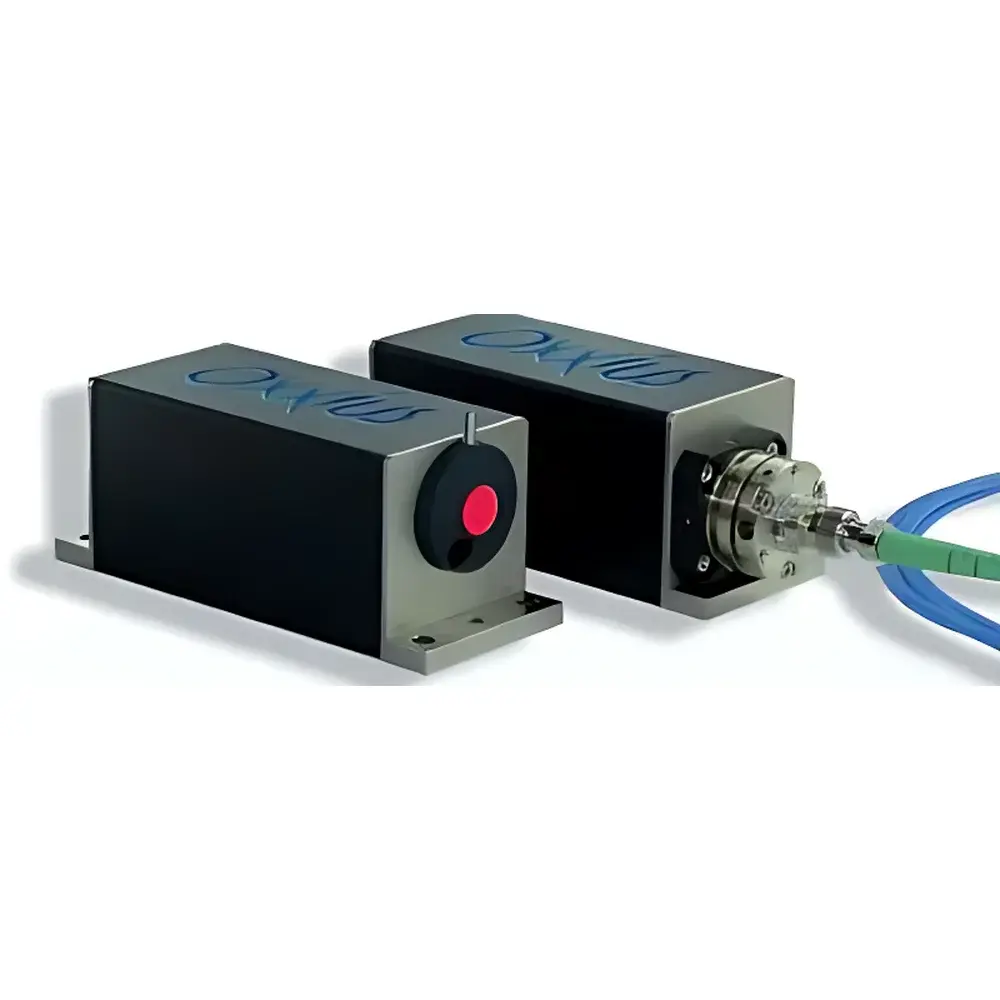
Oxxius LBX-785 Single Longitudinal Mode Laser
| Origin | France |
|---|---|
| Manufacturer Type | Authorized Distributor |
| Origin Category | Imported |
| Model | LBX-785 |
| Wavelength | 785 nm ±1 nm |
| Spectral Linewidth | <100 MHz |
| Coherence Length | >1 m |
| Output Power | 100 mW |
| Beam Diameter | 0.5 mm (1/e², at 50 mm from aperture) |
| Beam Divergence | 2.5 mrad (1/e², full angle, far field) |
| Beam Quality | TEM₀₀, M² < 1.8 |
| Power Stability | ±1% p-p (over 8 h, ±3 °C) |
| Optical Noise | <0.5% RMS (10 Hz–2 MHz) |
| Polarization Ratio | >100:1 (vertical, ±3°) |
| Pointing Stability | <5 µrad/°C |
Overview
The Oxxius LBX-785 is a continuous-wave (CW), single longitudinal mode (SLM) diode-pumped solid-state (DPSS) laser engineered for high-spectral-purity applications requiring exceptional coherence, amplitude stability, and beam fidelity. Operating at a nominal wavelength of 785 nm ±1 nm, it leverages intracavity frequency-selective elements and thermally stabilized resonator design to achieve a narrow spectral linewidth of <100 MHz—corresponding to a coherence length exceeding 1 meter. This performance envelope makes the LBX-785 particularly suited for interferometric techniques, coherent Raman spectroscopy (e.g., SRS, CARS), holographic data storage, and high-resolution fluorescence excitation where phase stability and minimal temporal jitter are critical. Unlike multimode or free-running diode lasers, the LBX-785 delivers diffraction-limited TEM₀₀ output with M² < 1.8, enabling efficient coupling into single-mode fibers and high-numerical-aperture microscope objectives without significant spatial mode degradation.
Key Features
- Single longitudinal mode operation with 1 m coherence length
- Stable CW output at 100 mW with ±1% peak-to-peak power stability over 8 hours (±3 °C ambient variation)
- Low-intensity noise: <0.5% RMS (10 Hz–2 MHz bandwidth), essential for photon-counting and lock-in detection
- TEM₀₀ Gaussian beam profile with 0.5 mm 1/e² diameter at 50 mm from aperture and 2.5 mrad full-angle divergence
- High polarization extinction ratio (>100:1), vertically oriented with angular tolerance of ±3°
- Thermally compensated mechanical design ensuring pointing stability <5 µrad/°C
- Integrated digital control interface (USB 2.0 & RS-232) supporting remote modulation, power ramping, and status monitoring
- Compliant with IEC 60825-1:2014 Class 3B laser safety requirements; includes interlock connector and key switch
Sample Compatibility & Compliance
The LBX-785 is routinely deployed in regulated analytical environments, including ISO/IEC 17025-accredited laboratories performing Raman-based material identification and pharmaceutical polymorph screening. Its stable 785 nm output avoids strong fluorescence interference common with shorter-wavelength excitation, while maintaining sufficient photon energy for efficient resonance enhancement in many organic and biological samples. The laser meets EN 61326-1:2013 for electromagnetic compatibility (EMC) and conforms to RoHS 2015/863/EU directives. For GxP-compliant workflows, optional firmware supports audit-trail logging of operational parameters (power setpoint, temperature, runtime) in accordance with FDA 21 CFR Part 11 requirements when integrated with validated host software.
Software & Data Management
Oxxius provides the LBX Control Suite—a platform-independent application (Windows/macOS/Linux) enabling real-time monitoring of laser diode current, TEC temperature, photodiode feedback signal, and interlock status. Users may configure analog/digital modulation profiles (TTL, PWM, or 0–5 V input), define custom power ramps with programmable slew rates, and export timestamped telemetry logs in CSV format. The SDK (C/C++, Python, LabVIEW) supports integration into automated platforms such as LIMS or custom-built spectrometer control systems. All firmware updates are digitally signed and delivered via secure HTTPS channels to maintain system integrity during lifecycle maintenance.
Applications
- Raman spectroscopy: Primary excitation source for benchtop and portable Raman systems, especially where low fluorescence background and high signal-to-noise ratio are required for trace-level detection
- Confocal and super-resolution microscopy: Enables STED and RESOLFT modalities requiring diffraction-limited focusability and long coherence for stimulated emission depletion beam shaping
- Holography & interferometry: Used in dynamic holographic interferometers for non-contact strain mapping and vibration analysis due to sub-microradian pointing stability
- Photoluminescence (PL) and time-resolved spectroscopy: Provides narrowband excitation for quantum dot characterization and defect-state analysis in semiconductors
- Bioanalytical instrumentation: Integrated into flow cytometers and microplate readers for multiplexed fluorescence assays leveraging 785 nm-compatible dyes (e.g., IRDye 800CW)
- Fiber-optic sensor interrogation: Serves as a coherent source for distributed Brillouin or Rayleigh scattering-based sensing systems
FAQ
Is the LBX-785 compatible with standard single-mode fiber coupling optics?
Yes—the TEM₀₀ beam profile, 0.5 mm 1/e² diameter, and low M² enable >90% coupling efficiency into SMF-28 or similar 5.6 µm core fibers using off-the-shelf aspheric collimators and focusing lenses.
Does the laser support analog modulation for lock-in amplification setups?
Yes—it accepts 0–5 V analog input for direct intensity modulation up to 100 kHz (small-signal, -3 dB point), with linearity deviation <±2% across the full range.
What thermal management is required for continuous operation?
The unit incorporates an integrated thermoelectric cooler (TEC) and heatsink; no external chiller is needed. Ambient air cooling suffices provided airflow ≥1 m/s is maintained at the rear exhaust vent.
Can the LBX-785 be integrated into OEM instruments?
Yes—Oxxius offers OEM versions with customized mechanical housing, simplified electrical interfaces (e.g., 24 V DC only), and extended temperature range options (-10 to +50 °C operating envelope).
Is factory recalibration available, and what is the recommended interval?
Calibration services—including wavelength verification via wavemeter traceability to NIST standards and power calibration against NIST-traceable thermopile sensors—are available annually or after 2,000 operating hours, whichever occurs first.




