
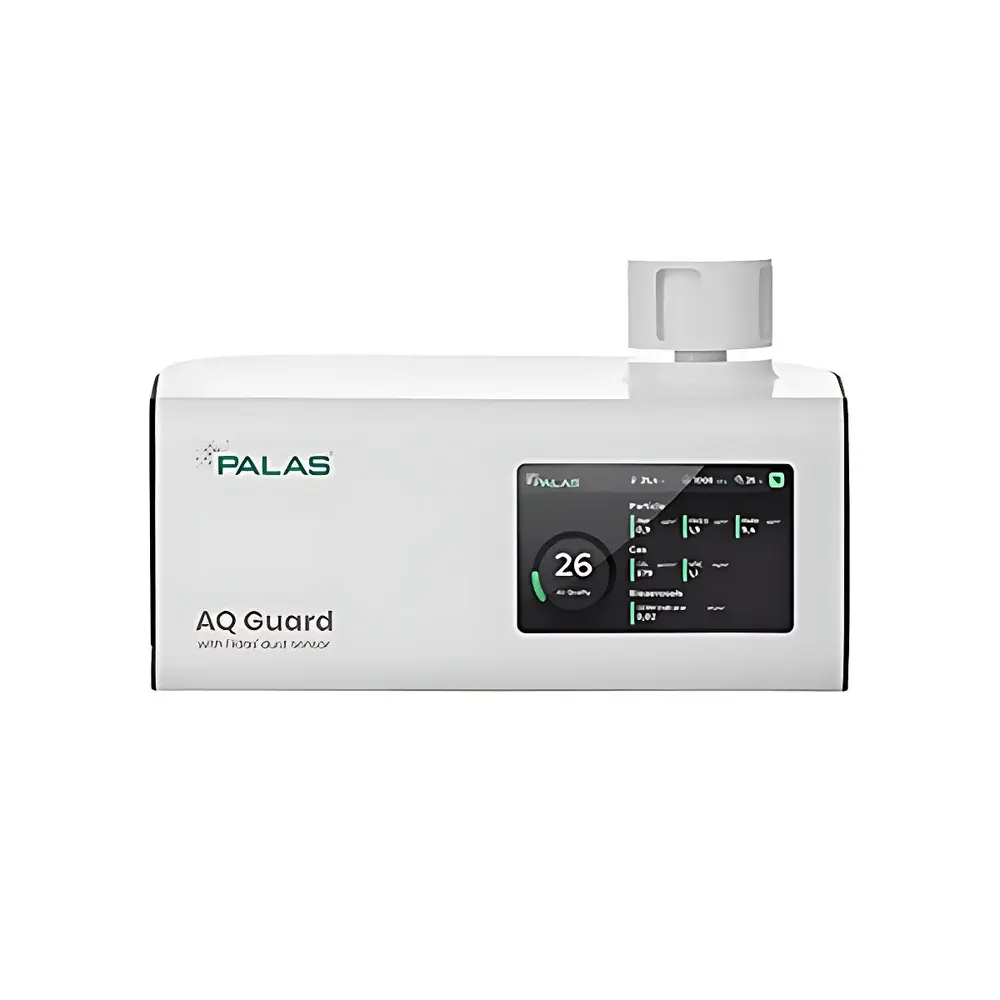
Palas AQ Guard Portable Compact Indoor Air Quality Monitor
| Brand | Palas |
|---|---|
| Origin | Germany |
| Model | AQ Guard |
| Instrument Type | Portable |
| Measurement Principle | Single-Particle Optical Light Scattering with Advanced Mass Conversion Algorithm |
| Particle Size Range | 175 nm – 20 µm |
| Certified Technology Base | EN 16450-compliant Fidas®200 platform |
| CO₂ & TVOC Detection | Integrated electrochemical and PID sensors |
| Environmental Rating | Ambient (AQ Guard “Ambient” variant features heated aerosol inlet for reference-grade accuracy) |
| Compliance Context | Designed to support ISO 16000-8, ISO 29463, and EU Directive 2008/50/EC monitoring requirements |
Overview
The Palas AQ Guard is a portable, compact indoor air quality (IAQ) monitor engineered for continuous, real-time assessment of airborne particulate matter and gaseous pollutants in occupied and semi-enclosed environments. Unlike conventional optical particle counters relying solely on amplitude-based sizing, the AQ Guard employs a proprietary single-particle optical light scattering detection principle—enhanced by a time-resolved signal analysis algorithm that incorporates pulse width and waveform morphology. This approach enables robust mass concentration estimation (PM1, PM2.5, PM10) across a broad dynamic size range from 175 nm to 20 µm, without reliance on fixed density assumptions or calibration transfer functions. Its core sensor architecture is derived from the EN 16450-certified Fidas®200 system, ensuring metrological traceability and performance consistency aligned with European ambient air monitoring standards. The AQ Guard “Ambient” configuration includes a temperature-controlled, heated aerosol inlet to suppress hygroscopic growth artifacts—thereby achieving measurement fidelity comparable to type-approved stationary reference analyzers.
Key Features
- Real-time, simultaneous quantification of PM1, PM2.5, and PM10 mass concentrations using physics-based optical scattering and validated mass conversion algorithms
- Integrated dual-sensor gas module: non-dispersive infrared (NDIR) for CO2 and photoionization detection (PID) for total volatile organic compounds (TVOC)
- Compact, battery-operated design (up to 8 h continuous operation) with IP54-rated enclosure for field-deployable use in variable environmental conditions
- Heated aerosol inlet (standard on AQ Guard “Ambient”) minimizes humidity-induced particle swelling, improving comparability with regulatory reference methods
- Onboard calculation of Palas-developed Air Quality Index (AQI) and Infection Risk Index (IRI), both grounded in peer-reviewed exposure-response models for respiratory health endpoints
- Internal data logging (≥30 days at 1-min resolution) with timestamped metadata including temperature, relative humidity, and barometric pressure
Sample Compatibility & Compliance
The AQ Guard is validated for sampling undiluted ambient and indoor air streams without pre-filtration or dilution stages. It maintains measurement integrity across typical indoor RH ranges (20–80 %) when operated in “Ambient” mode. The instrument’s optical detection system meets the functional requirements of ISO 29463-3 (high-efficiency filter testing) for particle counting sensitivity and size resolution. While not itself a type-approved reference analyzer under EU Regulation (EU) 2016/429, its underlying Fidas®200-derived technology has undergone independent verification per EN 16450:2017 for continuous particulate monitoring applications. Data outputs comply with ISO 16000-8 (indoor air—part 8: determination of aldehydes and ketones) and support GLP-aligned documentation workflows through audit-trail-capable software export.
Software & Data Management
Data acquisition and visualization are managed via Palas’ proprietary AQ Guard Control Software (v3.2+), compatible with Windows 10/11. The software provides synchronized multi-parameter time-series plots, customizable alert thresholds (e.g., PM2.5 > 25 µg/m³), and automated report generation compliant with ISO/IEC 17025 documentation frameworks. Raw scatter pulse data—including amplitude, duration, and asymmetry metrics—is exportable in CSV and HDF5 formats for third-party algorithmic reprocessing. Firmware updates include cryptographic signature validation, and all configuration changes are logged with user ID, timestamp, and parameter delta—supporting FDA 21 CFR Part 11 readiness when deployed in regulated facilities.
Applications
- Occupied building IAQ auditing: schools, hospitals, elderly care facilities, and office complexes where ventilation efficacy and pathogen transmission risk must be quantified
- Industrial hygiene monitoring during bulk material handling—e.g., cement blending, pharmaceutical powder packaging, or metal additive manufacturing—where fugitive dust emissions require real-time characterization
- Construction site perimeter monitoring adjacent to residential zones, satisfying local ordinances requiring PM10 compliance reporting
- Transit infrastructure QA/QC: deployment in subway stations, airport terminals, and cruise ship cabins to correlate CO2/TVOC levels with occupancy density and HVAC performance
- Research-grade longitudinal studies of indoor aerosol dynamics, including secondary organic aerosol formation and resuspension behavior under controlled environmental stressors
FAQ
Does the AQ Guard meet regulatory requirements for official air quality reporting?
The AQ Guard is not certified as a reference method under EU Directive 2008/50/EC or US EPA EQOA protocols. However, its EN 16450-aligned sensor architecture and heated inlet configuration enable data correlation with certified reference instruments for trend analysis and source attribution.
Can the device distinguish between combustion-derived soot and mineral dust?
No spectral or chemical identification capability is embedded. Particle classification is based solely on aerodynamic diameter and scattering signature morphology; compositional differentiation requires coupling with offline SEM-EDS or GC-MS analysis.
Is remote data transmission supported?
Yes—via optional LTE/Wi-Fi module (AQ Guard Connect). All transmitted data retain full audit trail metadata and are encrypted using TLS 1.3 prior to ingestion into secure cloud repositories.
What maintenance intervals are recommended?
Optical chamber cleaning every 6 months (or after 2,000 operating hours); NDIR and PID sensor calibration annually against traceable gas standards; inlet heater function verified quarterly per Palas Service Bulletin SB-AQG-2023-01.







